 Hana Kim
Pack for Cambodia’s coast in the rainy season for heat that never leaves and rain that arrives hard and fast: everything quick dry, a real waterproof layer for you and a separate dry system for your phone, money and documents, and sandals that can get soaked on a boat pier and be dry by morning. The wet season runs from May to October under the southwest monsoon and brings roughly three quarters of Cambodia’s annual rainfall, with the coast wetter than the inland cities and the heaviest rain from August to October. Kep and Kampot stay hot, around 29 to 32 degrees Celsius in the daytime, so the challenge is not cold. It is staying functional through daily downpours, wet boat days to Koh Tonsay, and roads and paths that turn slick between showers.
Quick Facts
- Destination: Kep and Kampot on Cambodia’s south coast, plus boat days to Koh Tonsay, also called Rabbit Island.
- Season: Rainy season, May to October, driven by the southwest monsoon; September and October are among the wettest months on this coast.
- Rain pattern: Rain usually falls as heavy showers, often in the afternoon or evening, rather than all day, especially early in the season; mornings are often usable and sometimes sunny.
- Temperatures: Hot all season, roughly 24 to 32 degrees Celsius, with high humidity. Kampot climate data puts wet season months at about 217 to 266 millimetres of rain a month from May to September.
- Bag strategy: One bag of quick dry clothing, packed inside dry bags, plus a daypack rain cover. No cotton, no leather, nothing that takes two days to dry.
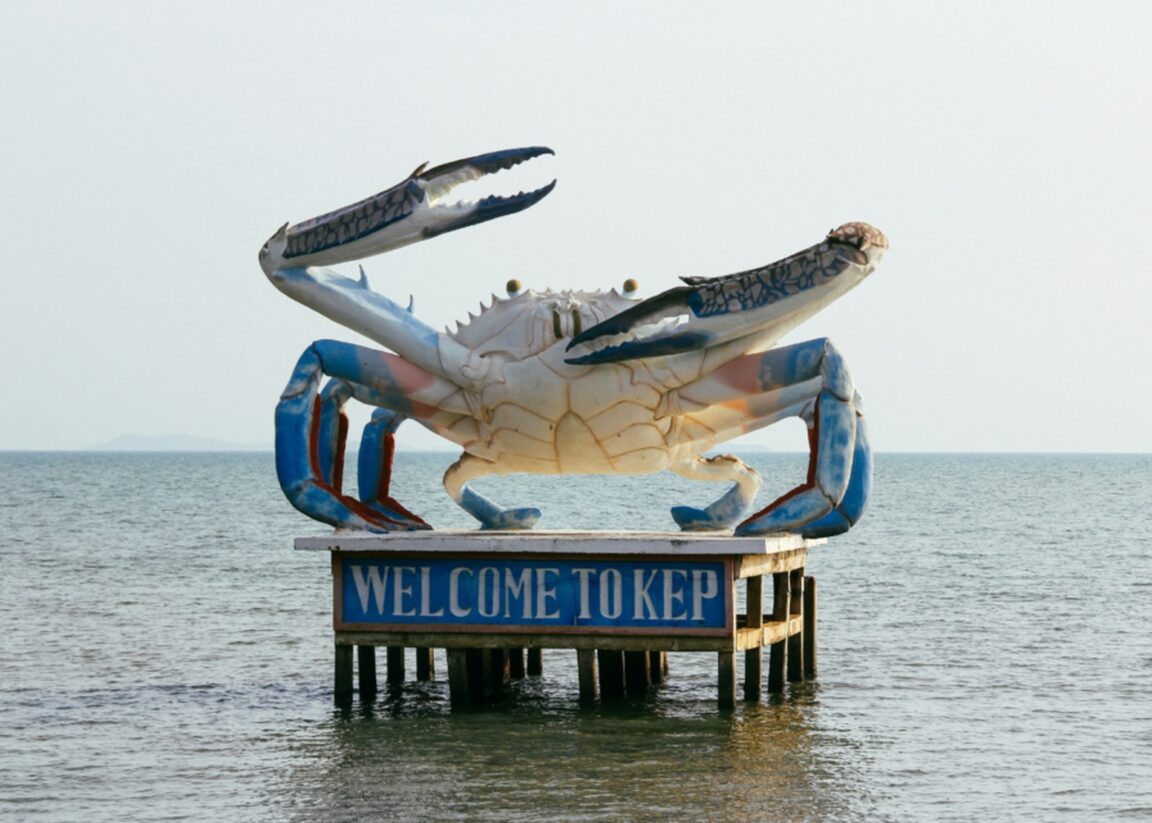
- Photo credit: Photo by Tobias Tullius on Unsplash, Unsplash License. The featured image shows Kep’s blue crab statue standing in the sea off the Kep waterfront.
What does rainy season rain actually look like in Kep and Kampot?
It is not drizzle. The southwest monsoon builds through the day, and the rain tends to arrive as a short, intense downpour that floods a street corner in minutes, rattles the roof of the Kep Crab Market, turns the Kampot riverside grey, and then often clears. TravelFish, using World Meteorological Organization station averages, describes the coast and islands as poor and stormy in the core wet months, with rough seas part of the picture, while the same coast in the dry season, November to April, is calm and sunny. That contrast is the whole packing brief: plan every day as a dry morning plan and a wet afternoon reality.
Two consequences follow. First, waterproofing must be instant, not back at the hotel: the rain layer lives in the daypack every single day, however blue the breakfast sky looks. Second, boats need respect. Crossings from Kep pier to Koh Tonsay are short, about 20 to 30 minutes, but wet season seas can be choppy, departures can shift with the weather, and everything on deck gets sprayed. Pack for the boat as if you will get wet, because on a wet season crossing you often do. Before any Cambodia trip, the arrival formalities matter too; our explainer on how the Cambodia e-Arrival app replaced the paper forms covers the filing to complete before you fly.
What clothing works when nothing fully dries?
Quick dry synthetics and light merino blends, in a small rotation washed often. Choose tops and bottoms that dry overnight on a line or a fan in the room, because in wet season humidity a cotton t shirt can stay damp for two days and start to smell. Three tops, two pairs of quick dry shorts or light trousers, one long sleeved shirt for sun, temples and air conditioned buses, and swimwear that doubles as boat day clothing cover most of the trip. A sarong or light travel towel earns its place three ways: beach, boat seat, and an extra layer in cold bus air conditioning.
- Tops: 3 quick dry t shirts or shirts, 1 long sleeved sun and temple shirt.
- Bottoms: 2 quick dry shorts or trousers, 1 pair of light long trousers for temples, travel days and evenings with mosquitoes.
- Underwear and socks: 4 sets, synthetic, washed in rotation. Socks only for travel days and any Bokor plateau trip, where the hill station is cooler and often in cloud.
- Sleep: 1 light sleep set; rooms are warm and air conditioning, not blankets, sets the temperature.
- Swim: 1 to 2 sets, so one is always dry. Rash vest if you burn easily or for long boat days.
- Evening: The clean long trousers and the least worn shirt. Kep and Kampot evenings are casual; dry beats smart.
What is the rain system, for you and for your gear?
For you, a light waterproof jacket or a quality poncho, chosen honestly. A poncho covers you and a daypack at once and ventilates better in tropical heat, which is why local riders wear them; a jacket looks tidier and works better on a windy boat. Many travellers carry the poncho for town and boat days and skip the jacket entirely. What does not work is a water resistant fashion shell: in a monsoon downpour it wets through in minutes. Umbrellas help in town for short hops between cafes in Kampot’s old town, but they are useless on a boat or a motorbike and awkward in market crowds.
For gear, think in dry bags, not in hopes. Pack clothing inside two large dry sacks or strong zip bags in the main bag, so a soaked bag exterior never reaches clean clothes. Carry a 10 to 20 litre dry bag as the boat and day bag liner: phone, money, passport photos and documents, medication and a dry shirt for the return crossing live in it. Add small zip bags for a phone at the Crab Market and on the pier, a microfibre towel for drying seats and screens, and a spare bag for wet swimwear so it never touches dry clothes. This system is the same discipline used for island stays up this coast, including the private island format covered in our guide to Song Saa Private Island, where boat transfers set the packing rules.
What footwear survives Kep and Kampot in the wet?
Two pairs, both allowed to get wet. The main pair is a sturdy sandal with tread and a heel strap, worn for markets, piers, beaches and flooded streets, that can be rinsed and shaken dry. The second is a light trainer or walking shoe, kept as dry as possible, for travel days, the Kep National Park trails in a dry morning window, and the climb up to Bokor’s hill station ruins from Kampot. Flip flops alone are not enough: wet tiles at the Crab Market, slick wooden piers and muddy pepper farm paths in the Kampot countryside all punish flat, loose footwear. If a shoe gets soaked, stuff it with newspaper or a dry towel overnight and put it by the fan; rotating the two pairs keeps one always usable.
What else earns its space on this coast in rainy season?
- Mosquito protection: Repellent for evenings in Kep and Kampot, and the long trousers above. Standing water in the wet season means mosquitoes are a daily fact, not an edge case.
- Sun protection: Sunscreen, hat and sunglasses. Wet season mornings can be fiercely sunny between systems, and boat glare is strong.
- Health basics: Rehydration sachets, plasters, antiseptic for coral and pier scrapes, and any prescription medication kept in the dry bag, in hand luggage, never in a checked bag on a boat day.
- Money: Small US dollar notes and Cambodian riel for markets, tuk tuks and boat tickets, kept in the dry bag. Cards work in hotels and larger restaurants, not at a crab stall.
- Power: A power bank and a torch or headtorch. Heavy rain can bring short power cuts, and unlit coastal paths after dinner are properly dark.
- Laundry: A small wash kit or money for the cheap, fast laundry services in Kampot, which is how a three top rotation survives a two week trip.
What should you leave out?
Leave jeans, cotton hoodies, leather shoes and bags, a hairdryer dependent hairstyle, and any white clothing you care about: wet season roads and boat spray will mark it. Leave a large hard suitcase if you can; a soft bag that can ride in a tuk tuk, sit on a wet pier for five minutes and be carried over a flooded doorstep beats rigid luggage here. Leave expensive, non waterproof electronics unprotected or at home, and leave a tight schedule: the correct wet season plan in Kep and Kampot has slack in it, so a cancelled afternoon boat becomes a pepper farm lunch or a long Crab Market afternoon instead of a ruined day. If your route continues inland, our sunrise guide to visiting Angkor Wat pairs naturally with this coast in one Cambodia trip.
Frequently Asked Questions
Does it rain all day in Kep and Kampot in the rainy season?
Usually not. The common pattern is a usable, often sunny morning and a heavy shower later in the day, though the core months from August to October can bring longer wet spells and stormy seas on the coast. Plan boat trips and national park walks for the morning and keep afternoons flexible.
Can you still go to Koh Tonsay in the rainy season?
Boats from Kep pier run in the wet season when conditions allow, and the crossing is short, but departures can be delayed or cancelled in rough weather and you should expect spray on deck. Keep a full spare day for the island, carry everything for the crossing in a dry bag, and check at the pier on the morning itself.
Poncho or rain jacket for Cambodia’s coast?
For most travellers, a good poncho wins in town and on boats because it covers a daypack and ventilates in tropical heat. A light waterproof jacket is better if you will ride a motorbike or spend long days outdoors in wind. Either beats a water resistant shell, which wets through in a monsoon downpour.
How many clothes do I need for two weeks?
Fewer than you think: three quick dry tops, two bottoms, four sets of underwear and two swim sets, washed in rotation at Kampot’s fast, inexpensive laundries. The system only works if everything is quick dry; one cotton item in the rotation becomes the permanently damp item.
What about mosquitoes and dengue risk in the wet season?
Wet season standing water raises mosquito numbers on this coast. Use repellent in the evenings, wear the long trousers after dark, sleep under the net or air conditioning provided, and seek medical advice promptly for a fever during or after the trip. Pack repellent from home if you have a preferred type, though it is also sold in Kampot pharmacies.
Last updated: 16 November 2026. Season dates and rain patterns are from World Meteorological Organization based climate summaries checked today; check the local forecast and pier conditions on the day for boats.