 Camille Baptiste
A trip to Travnik costs less than almost any comparable old town day in Europe, and the numbers are refreshingly simple. Budget about 31 to 57 euros per person per day as a backpacker in current 2026 checks, covering a guesthouse bed, three meals and the small entry fees, and you will see the whole vizier’s town: the medieval fortress for 4 KM, the regional museum for 4 KM, cevapi for the price of a coffee in Vienna, and lunch beside the Plava Voda springs for 6 to 12 euros. Travnik is not a town of big ticket sights. It is a town where the entire bill, tickets, beds and food together, stays small enough that the deciding factor is time, not money.
Quick Facts
- Currency: The convertible mark (KM or BAM), pegged to the euro at about 1.96 KM to 1 euro; halve the KM figure to think in euros. Carry cash, because cards are not accepted everywhere
- Total daily budget: About 31 to 57 euros per person per day at backpacker level in a November 2026 cost check, most of it the bed and food
- The fortress: Travnik Fortress (Stari Grad), entry 4 KM; open 8 am to 8 pm from April to September and 8 am to 4:30 pm from October to March
- Museums: Regional museum entry 4 KM; the Ivo Andric birthplace museum and local collections run small fees in a similar range, confirm at the door
- Beds: Budget guesthouses and private rooms about 15 to 25 euros per person; dorm beds are rare in Travnik, so expect to pay for a room
- Food: About 8 to 15 euros a day eating well: a cevapi portion about 4 to 6 euros, bakery burek cheaper still, a Plava Voda trout lunch about 6 to 12 euros
- Parking: The lot beside Plava Voda costs about 2 KM per hour, paid to the attendant; the castle is a 10 minute walk from it
- Getting there: About 90 km west of Sarajevo, roughly 1.5 hours by car and about 2 hours by bus; Jajce is about an hour further on
The ticket line items: fortress, museums and the painted mosque
Start with the hill. Travnik Fortress, the Stari Grad, is a medieval town fortress complex built between the second half of the 14th century and the first half of the 15th, later adapted under the Ottomans, and it is one of the best preserved fortresses in Bosnia and Herzegovina. Entry is 4 KM, payable in cash at the gate, and the hours split by season: 8 am to 8 pm from 1 April to 30 September, and 8 am to 4:30 pm from 1 October to 31 March. Allow 1 to 1.5 hours for the towers, the walls and the wide views over the red roofs and the Lasva valley, and go in the morning in summer, when the climb is cool. A small museum inside covers the fortress history and ethnography.
Down in the town, the ticket spending stays tiny. The regional museum charges 4 KM. The birthplace of Ivo Andric, the Nobel Prize winning author of The Bridge on the Drina, who was born in Travnik in 1892 and set his Bosnian Chronicle in the town’s vizier era, is kept as a small museum in a reconstructed house near the centre; local reporting puts its tickets and the other small collections in the low single KM range, so confirm the current figure on the door rather than trusting any guide, this one included. The Sarena Dzamija, the Colourful or Sulejmanija Mosque of 1815, painted inside and out with floral motifs above its small covered market, is an active mosque: entry is not a ticket product, so dress modestly, visit outside prayer times, and treat it as a place of worship that tolerates respectful visitors, not an attraction with a price.
The bed line item: what a night in Travnik costs
Travnik’s accommodation is guesthouse scale, and that is the budget story. Dorm beds are rare in town, so the honest budget unit is a private room or guesthouse bed at roughly 15 to 25 euros per person, with prices rising on summer weekends when the small places fill. Well rated doubles in the centre and near Plava Voda are listed in the 50 to 90 euro range in current guides for travellers who want more comfort, and the average hotel price trackers put a mid range Travnik room at roughly 97 KM, about 55 US dollars. Where you sleep matters more than what you pay: the old bazaar streets and the lanes around Plava Voda put the fortress, the mosque, the museums and the springs within a ten minute walk, so a slightly pricier central room saves its premium back in taxis you never take.
Staying the night is the Travnik decision that changes the trip. Most visitors day trip from Sarajevo and leave by mid afternoon, which means the town at its best, the fortress in morning light and Plava Voda in the evening, belongs to the people who stayed. At these prices, the night costs less than the day trip’s fuel and parking. Travellers pairing Travnik with the wider central Bosnia circuit should read it alongside Jajce, about an hour away, where the Pliva waterfall drops into the Vrbas in the middle of town; our guide to eating in Trebinje covers the food logic at the other end of the country, where the same grill and bakery economy keeps Herzegovina cheap too.
The food line item: cevapi, burek and Plava Voda trout
Food is where Travnik’s budget becomes a pleasure rather than a discipline. A day of eating well runs about 8 to 15 euros. The town claims a serious cevapi tradition, and its most famous grill rooms sit a few doors apart in the old town; a portion costs about 4 to 6 euros, with five piece servings of cevapi in the 6 to 8 KM range and ten pieces at 10 to 13 KM in current country pricing. Bakeries undercut everything: a slice of burek or spinach zeljanica costs about 3 to 5 KM, and Bosnian coffee is priced as a daily habit, not a treat.
The one deliberate splurge is lunch at Plava Voda. The spring rises under Vlasic mountain just below the castle, in the centre of the old town, and runs about 350 metres through a park lined with riverside restaurants serving trout and grilled meat. A meal there costs around 6 to 12 euros, and the setting, cold clear water, shade and the fortress above, is the town’s living room. Order the trout, try Travnicki sir, the salty white Vlasic cheese, with bread or in a pie, and count the whole lunch as the day’s entertainment budget as well as its food budget. Drivers should add the parking line: the lot beside Plava Voda charges about 2 KM an hour to the attendant.
The vizier’s town line item, and the Lasva valley castles
The slot in the budget that Travnik is famous for costs nothing at all. From the late 17th century to the middle of the 19th, Travnik was the seat of the Ottoman viziers who governed Bosnia, and their town is still legible at street level for free: the viziers’ tombs, the turbe, along the main street, the old residences, the two clock towers that make Travnik the only town in Bosnia and Herzegovina with a pair of them, the bazaar lanes and the fountains. Walking that layer of the town is the core experience, and its price is shoe leather. This is the deciding evidence against the alternatives: Sarajevo does the Ottoman city bigger, Mostar does it more beautifully, but neither lets you read a vizier’s capital in an unhurried hour for the cost of a coffee.
The Lasva valley extends the same logic. The valley castles and fortified towns around Travnik, with Jajce’s royal fortress town at its head about an hour away, make a cheap, dense castle day by car or bus, each site charging the same small KM fees as Travnik itself rather than Western European castle prices. Public transport inside Travnik is about 1.40 KM for a one way local ticket in current price trackers, and taxis start around 2.50 KM, but most visitors will walk everything. For a Balkans budget comparison further south, our guide to getting to Gjirokaster’s bazaar quarter works through the same small fee, cash first arithmetic in Albania’s castle town.
A worked day budget, and what to skip
Put the lines together for a backpacker day in 2026 prices: a guesthouse bed at 15 to 25 euros, food at 8 to 15 euros eaten properly rather than skimped, fortress and museum entries at 3 to 6 euros combined, and a few euros of local transport and coffee, for the 31 to 57 euro total that current cost checks give. A couple in a mid range double should expect the bed line to rise and the per person food line to fall, landing in a similar band per head. What can be skipped without loss: paid parking anywhere but the Plava Voda lot, any organised day tour from Sarajevo, which charges a premium to compress a town that rewards slowness, and the drive up Vlasic in summer unless skiing or hiking is the point of your trip. What cannot be skipped is cash. Travnik runs on convertible marks in hand: gate fees, parking attendants, bakeries and smaller cafes are cash territory, and the card machines, where they exist, are not a plan.
Frequently Asked Questions
How much does a day in Travnik cost in 2026?
About 31 to 57 euros per person at backpacker level in a November 2026 cost check: 15 to 25 euros for the bed, 8 to 15 euros for food, 3 to 6 euros for the fortress and museum entries, and the rest in coffee and local transport. A day trip without the bed costs well under 25 euros if you eat at Plava Voda.
What does Travnik Fortress cost and when is it open?
Entry is 4 KM in cash. The fortress opens 8 am to 8 pm from April to September and 8 am to 4:30 pm from October to March. Allow 1 to 1.5 hours, and climb in the morning in summer.
What currency should you carry in Travnik?
Convertible marks (KM/BAM), in cash. The mark is pegged to the euro at about 1.96 to 1, so halving a KM price gives a close euro figure. Cards are not accepted at gates, smaller cafes and parking lots.
Is Travnik worth an overnight stay or just a day trip?
An overnight stay, on the numbers as much as the experience: a guesthouse bed costs 15 to 25 euros per person, the town empties of day trippers by mid afternoon, and the fortress and Plava Voda are at their best in the morning and evening hours that day trippers miss.
What is Plava Voda and what does lunch there cost?
Plava Voda, Blue Water, is a spring fed stream that rises below the fortress and runs about 350 metres through a park in the old town, lined with restaurants serving trout and grilled meat. A meal costs about 6 to 12 euros, and parking beside it is about 2 KM per hour.
How do you get to Travnik from Sarajevo?
About 90 km west: roughly 1.5 hours by car and about 2 hours by bus, with several buses a day. Jajce, the other great central Bosnia fortress town, is about an hour beyond Travnik, so the two pair naturally into one or two days.
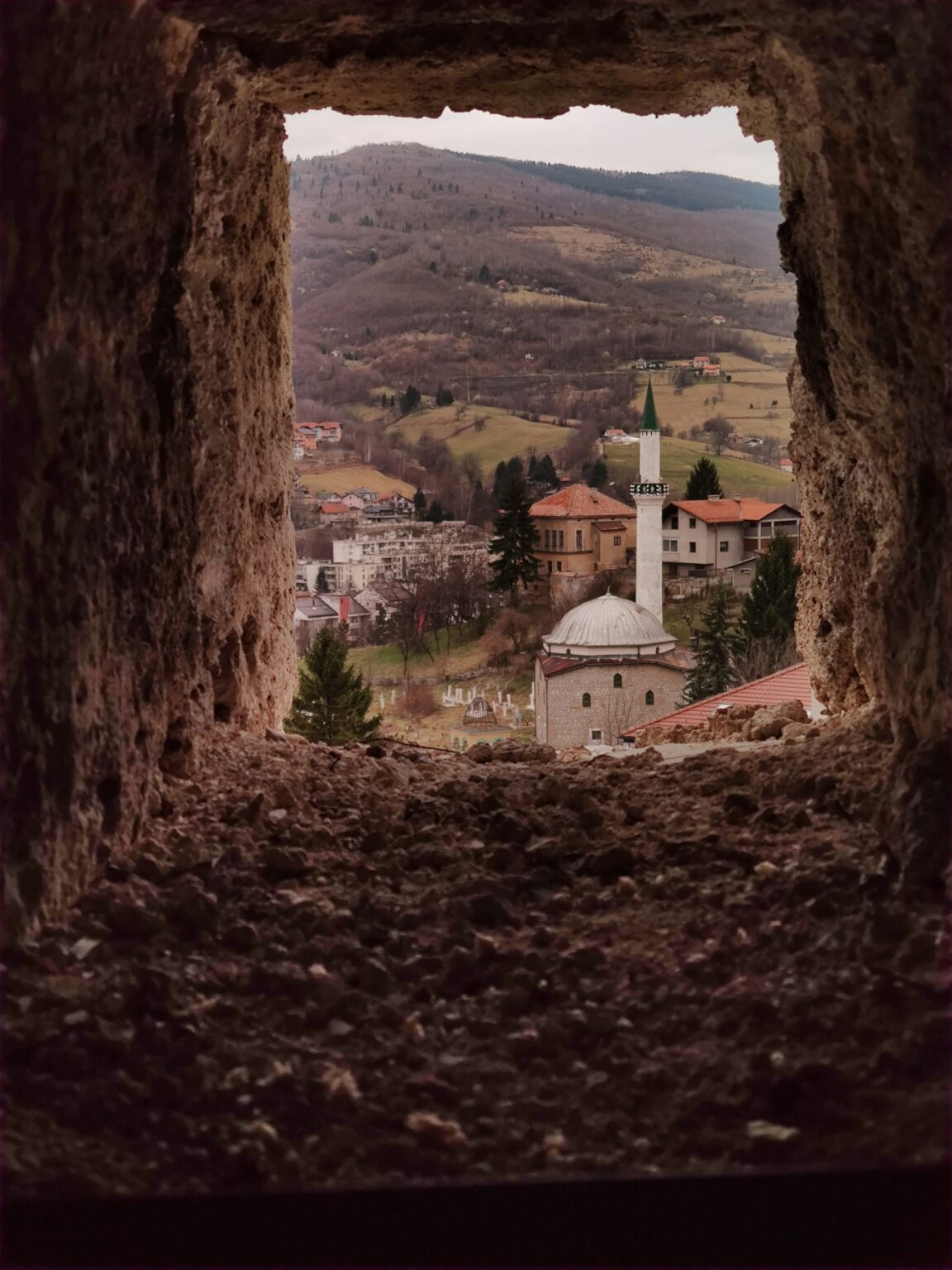
Facts checked 16 November 2026 against TakeYourBackpack’s Travnik city guide (costs as of 6 November 2026), Sandaltanman’s Travnik guide updated June 2026 (fortress entry 4 KM and seasonal hours), HikersBay Travnik prices 2026, Next Stop Anywhere’s Jajce and Travnik guide and MyBosniaStay’s Travnik guide. Where sources differ on small museum fees, the article says so and directs readers to the door price. Featured image: Travnik old town, its mosque and minaret seen through a window of the fortress walls. Photo on Unsplash, Unsplash License, via Next Stop Anywhere; the page credits its Bosnia photography to Damien Dan, Miguel Alcantara, Sara Sedlmajerova, Mujo Hasanovic, Dino Aganovic and Osman Genc on Unsplash without mapping names to individual frames.