 Lucas Meyer
Stay in Chachapoyas town if this is your first trip and your days mix Kuelap, Gocta and the sarcophagi viewpoints, because the town is where every tour leaves from, where the restaurants are, and where a changed plan costs nothing. Stay in Cocachimba if Gocta is the point of the trip, because the lodges there face the waterfall and you can be on the trail before the day groups arrive. Stay near Nuevo Tingo only if Kuelap is your single fixed priority and you want the cable car queue beaten rather than merely joined. Those three bases, town, waterfall village and fortress gateway, are the whole decision. Everything else in this guide is matching the base to the sequence of your days, because in the Chachapoyas region the drives between sights are long, the cable car does not run on Mondays, and the wrong base quietly taxes every single day of the trip.
Quick Facts
- Region: Chachapoyas, capital of the Amazonas region, northern Peru, at about 2,300 metres above sea level
- Base 1, town: Around the Plaza de Armas and Jr. Grau and Jr. Amazonas, restored colonial houses with interior patios, widest choice of hotels, cafes and tour departures
- Base 2, Cocachimba: Village below Gocta Waterfall, about 1 to 1.5 hours by road from town; lodges face the falls, including Gocta Andes Lodge with all rooms oriented to the cascade
- Base 3, Nuevo Tingo: Gateway to the Kuelap cable car; the ride itself takes about 20 minutes over the Utcubamba Valley
- Headline sights: Gocta Waterfall, 771 metres in two drops; Kuelap fortress at about 3,000 metres; Karajia sarcophagi and Revash mausoleums as separate day trips
- Key constraint: The Kuelap cable car does not operate on Mondays, per regional tour operators; sequence Kuelap on any other day
- Checked: Base areas, drive times and sight facts cross-checked against regional guides and operator sources on November 17, 2026; hotel rates change often and are described in bands rather than fixed prices
What does staying in Chachapoyas town actually get you?
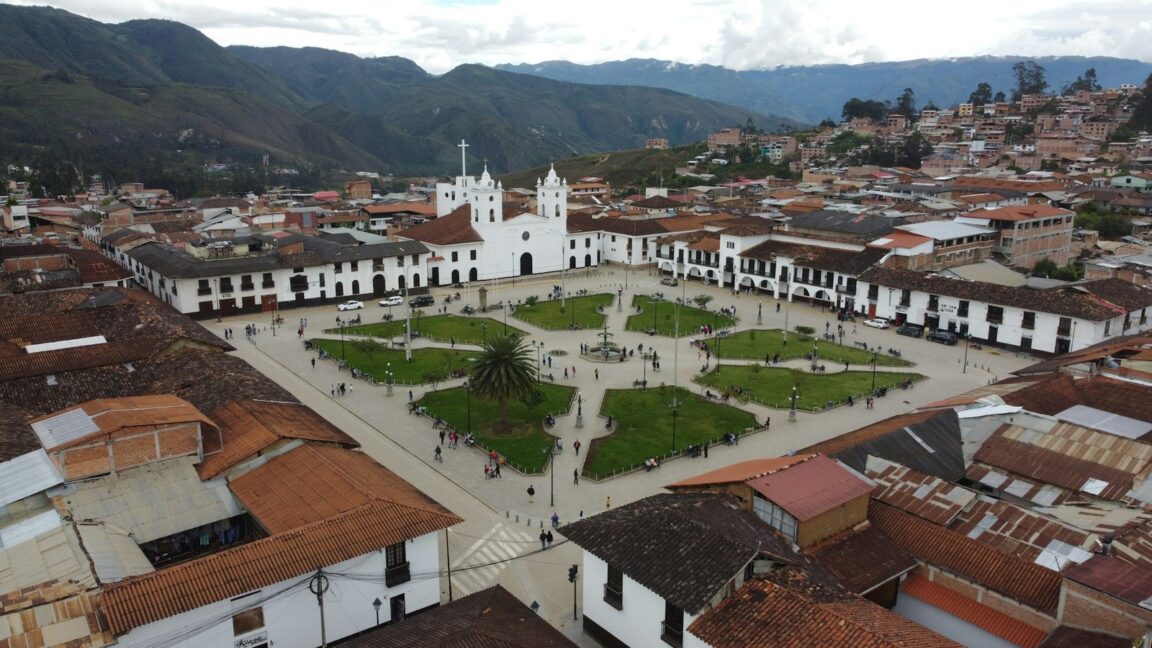
The town base is the flexible base, and flexibility is the scarcest resource in this region. Chachapoyas is a compact, walkable grid around its Plaza de Armas, with whitewashed colonial houses, wooden balconies and interior courtyard hotels concentrated on and around Jr. Grau and Jr. Amazonas. Regional guides name the pattern consistently: traditional casas converted into small hotels, rooms opening onto sheltered patios, breakfast cafes within a few minutes on foot, and tour pickups at the door. Properties cited by northern Peru specialists include La Casona Monsante near Jr. Grau, Hotel Villa de Paris on Jr. Amazonas about ten minutes from the square, and La Xalca, about five minutes from the main square and repeatedly recommended for travellers who want a comfortable town base.
The honest trade is views for options. Town rooms look onto patios and streets, not waterfalls. What they give back is the ability to reorder the trip at no cost: if cloud closes over Gocta, swap in the museum and a town day; if the Kuelap day moves, the restaurants, laundry, pharmacies and bus connections are all still at hand. For a first visit of three to five nights with mixed sights, that resilience beats scenery from the window. It is the same base logic that applies in the Colombian heritage towns covered in our Barichara history and culture guide: sleep in the historic centre, day trip outward, and let the town carry the evenings.
When is Cocachimba the better base?
Cocachimba wins when Gocta is not a day trip but the destination. The village sits below the falls at roughly 1,800 metres, softer and warmer than the town, and its lodges are built around a single fact: the 771 metre cascade is in view from the rooms, the pool and the terraces. Gocta Andes Lodge is the headline address, with its rooms facing the waterfall and the cloud forest, and smaller cabins and posadas in and around the village offer the same orientation at gentler rates. From the village tourist office, the classic trail to the base of the lower falls runs about 5 to 5.5 kilometres each way, five to six hours round trip with time at the bottom, and the entry window matters: PromPeru lists entry from 7 a.m. to 2 p.m., with a modest general admission fee paid locally in soles.
Sleeping in Cocachimba changes the arithmetic of that hike. You start at dawn from your door, walk in the coolest hours, reach the base before the day groups from town, and you are back for lunch rather than still on the road. The cost is the mirror of the town trade: evenings are quiet, dining is whatever your lodge and the village offer, and Kuelap becomes the long day instead, roughly two and a half hours each way by road in operator itineraries. The pattern that suits most travellers with four or more nights is a split stay, two nights in Cocachimba for Gocta and the valley, then two or three in town for Kuelap, Karajia and departure logistics. Split stays feel like friction on paper and like relief on the ground, because each sight gets the base it actually wants.
Who should stay near Nuevo Tingo and the Kuelap cable car?
Kuelap is the region’s great fortress, a walled Chachapoya city on a ridge at about 3,000 metres above the Utcubamba Valley, its perimeter walls rising 10 to 20 metres in places. Since the cable car opened, the standard approach runs from Nuevo Tingo: a short transfer to the station, then a ride of about 20 minutes and roughly 4 kilometres over the valley, followed by the walk to the site entrance. Staying in or near Nuevo Tingo, or in the small lodges along the Utcubamba road, puts you first in that sequence. Regional sources name options such as Ekokuelap Lodge near the access road for exactly this purpose.
This base suits a narrow and genuine use case: a short trip where Kuelap is the one non negotiable sight, travellers who prefer not to repeat the two hour road from town in both directions on the same day, and anyone sequencing Kuelap at dawn before cloud builds over the ridge. It suits almost nobody as a whole trip base, because Gocta, Karajia and the town itself all become long transfers. And one scheduling fact governs every version of this plan, repeated by regional operators: the Kuelap cable car does not operate on Mondays. Build the fortress day on any other day of the week, book Kuelap entry in advance through the official culture ticketing channel where operators direct you, and confirm the cable car operating status the day before, because a fortress day lost to a closed cable car is the single most common sequencing failure in this region.
How should the sights be sequenced across a stay?
Sequence by altitude, distance and the Monday rule, in that order. A workable pattern for a town based trip runs like this. Day one is arrival and the town itself, kept deliberately light while you adjust to 2,300 metres: the plaza, the viewpoints over the Sonche canyon country nearby, and an early night. Day two is Gocta, the long walking day, taken while legs are fresh; if you are split staying, this is the Cocachimba morning described above. Day three is Kuelap, the high day at 3,000 metres, provided it is not a Monday. Day four is the sarcophagi circuit, Karajia’s cliff face figures viewed from below and, for those continuing south, Revash and the Leymebamba museum as a longer arc or an onward overnight. A fifth day is buffer, and in this region buffer is not a luxury: cloud, rain and road conditions regularly move one sight by a day, and the traveller with a spare day absorbs it while the traveller without one loses Kuelap or Gocta outright.
Two smaller sequencing rules save disproportionate pain. First, never put Gocta and Kuelap on the same day; operators and guides are unanimous that each deserves its own day, and the combined road time alone defeats the idea. Second, keep the last night in town or on your departure route rather than in the furthest lodge, because onward connections from this region, whether toward Jaen, Chiclayo or back to Lima, start early and run long. Travellers who like this kind of base matching will find the same thinking applied to a very different Peruvian circuit in our wider South America coverage, and the Andean town pattern is explored further in our Villa de Leyva one sight deep dive.
What should you expect from hotels in this region?
Expect character rather than chains. There are no international resort properties in the Chachapoyas bases; the stock is restored colonial houses in town, family run lodges in the valleys and a small number of polished addresses such as Gocta Andes Lodge that book out early in the dry season, roughly May to September. Hot water, heating on cold nights and reliable wifi vary more than star ratings suggest, so read recent reviews for those three specifics rather than for thread counts. Rates are best treated as bands that move with season and Peruvian holidays, and any property quoting in soles or dollars should be confirmed directly before arrival. Book the Cocachimba nights earliest, because the waterfall facing rooms are few, and tell your hotel your Kuelap day in advance: town hotels routinely arrange the early departure, packed breakfast and return transfer that make the fortress day run on time.
Frequently asked questions
Is Chachapoyas town or Cocachimba the better base?
Town for a first, mixed trip, because every tour, restaurant and connection is there. Cocachimba for a Gocta centred trip, because the lodges face the falls and the trail starts at your door. With four or more nights, split the stay between the two.
How far is Gocta Waterfall from Chachapoyas town?
About 44 kilometres, roughly one to one and a half hours by road to Cocachimba depending on conditions. The hike from Cocachimba to the base of the lower falls is about 10 to 11 kilometres round trip and takes five to six hours. PromPeru lists trail entry from 7 a.m. to 2 p.m.
How do you reach Kuelap, and when does the cable car not run?
By road from Chachapoyas to the Nuevo Tingo area, about two hours, then the cable car, which crosses the Utcubamba Valley in about 20 minutes. Regional operators state the cable car does not operate on Mondays, so schedule Kuelap on another day and confirm status the day before.
How many nights do you need in the Chachapoyas region?
Four nights is the comfortable minimum: one each for Gocta, Kuelap and the Karajia sarcophagi, plus a buffer or town day. Three nights works only with a split base and no delays. Five nights allows the Leymebamba museum and Revash as well.
What altitude are the bases, and does it matter?
Chachapoyas town sits at about 2,300 metres, Cocachimba lower at roughly 1,800 metres, and Kuelap itself at about 3,000 metres. Most travellers feel the town altitude mildly on day one, which is why this guide sequences the lightest day first and the fortress later in the stay.
When is the best season to stay in Chachapoyas?
The dry season, roughly May to September, brings firmer trails and clearer views of both the falls and the fortress. Gocta runs fullest after rain, so late dry season can mean a thinner cascade; April to June is a reasonable compromise between flow and conditions.
Photo: Aerial view of the Plaza de Armas and cathedral of Chachapoyas, Peru. Photo via Unsplash (Unsplash License), hosted copy credited on the source guide page.