 Elena Vasquez
Four Seasons Hotel Istanbul at Sultanahmet is the right Istanbul splurge if being inside the Old Town matters more to you than a resort’s worth of facilities: a century old former prison, converted in 1996 and fully renovated before reopening in 2022, holding just 65 rooms around a garden courtyard a few minutes on foot from Hagia Sophia, the Blue Mosque and Topkapi Palace. The former prison conversion is not a theme. It is the architecture itself, a Turkish neoclassical landmark from 1918 and 1919 whose wings, towers and courtyard now frame one of the quietest luxury stays in the city. Book elsewhere if you need a pool on site, a big spa complex or Bosphorus water at the window. Book here if you want Istanbul’s most historic square kilometre as your neighbourhood.
Quick Facts
- Setting: Sultanahmet, Istanbul’s Old Town, steps from Hagia Sophia and the Blue Mosque
- Address: Tevkifhane Sokak No 1, Sultanahmet Eminonu, 34122 Istanbul, Turkiye
- Building: Constructed 1918 to 1919 as a prison, designed by Mimar Kemaleddin Bey in the Turkish neoclassical style
- Hotel history: Converted to a Four Seasons in 1996, the group’s first hotel in Turkiye, reopened in 2022 after a hotelwide renovation
- Rooms: 65 rooms and suites arranged around a landscaped courtyard garden
- Signature suites: St Sophia Suite with a private terrace facing Hagia Sophia, Marmara Suite, Beyzade Suite, Sehzade Suite
- Dining: Courtyard dining and a rooftop lounge with views of Hagia Sophia and the Blue Mosque
- Spa: Kurna Spa, with original marble from the building’s earlier life preserved
- Pool: No pool on site; guests can use the indoor and outdoor pools at the sister Four Seasons Hotel Bosphorus, with private transfers
- Policies: Check in 3:00 pm, check out 12:00 pm, per the official accommodations page
- Official source: fourseasons.com and Four Seasons press materials, checked 16 November 2026
What was this building before it was a hotel?
The building began in 1918, designed in the French influenced Turkish neoclassical style first as a guesthouse project and then built between 1918 and 1919 beside the courthouse as the first modern prison in the capital of the Ottoman Empire, per Four Seasons press materials. It held detainees awaiting trial and prisoners serving brief sentences, among them some of Turkiye’s most celebrated writers and poets, including Nazim Hikmet Ran, Sabahattin Ali, Orhan Kemal, Kemal Tahir and Can Yucel. Turkish literary classics were written within its walls, and the press materials note it was known in its day as the luxury prison, because some rooms had Bosphorus views.
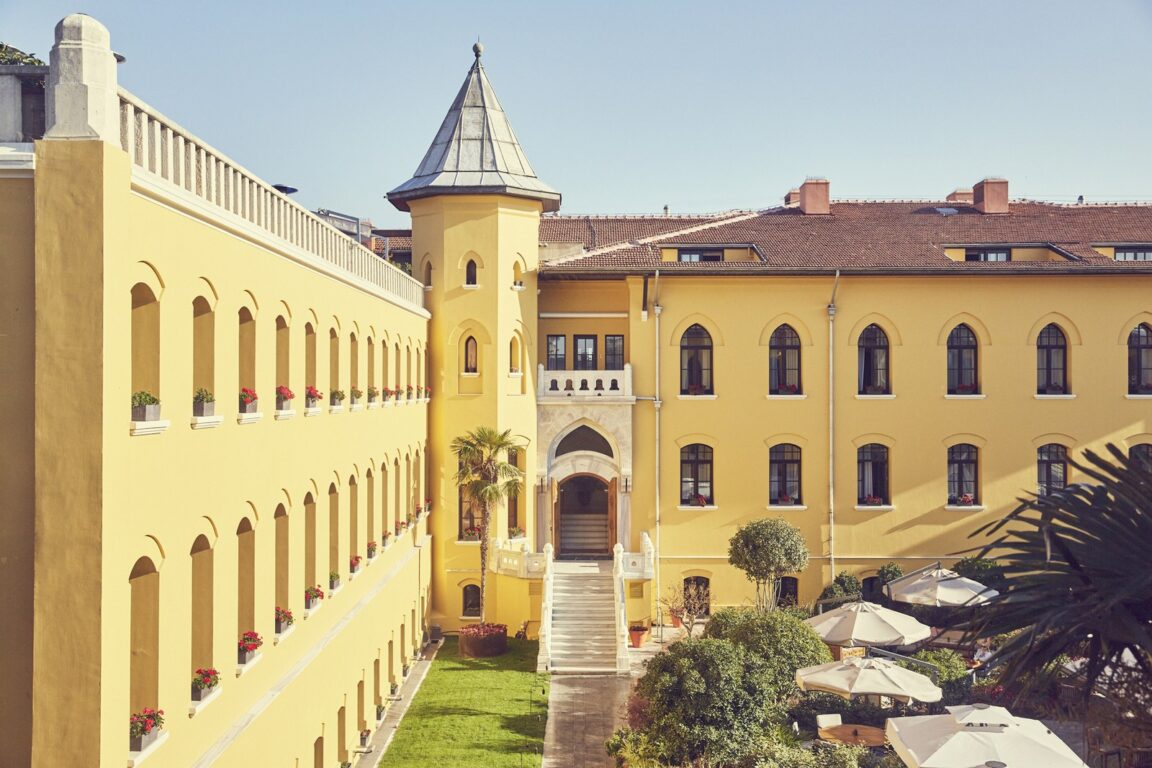
Architecturally it is an enduring example of the First National Architecture movement, where Ottoman influence meets neoclassical style, with pointed arches, ornate tiles, domes and corner towers. During the transformation into a hotel, original marble and stone were meticulously preserved, including at the entrance to the elevators and in the marble wall of Kurna Spa. That preservation is what a guest actually experiences: not prison theming, of which there is essentially none in the rooms, but a low, ochre, courtyard building whose proportions and details belong to another century.
How does the conversion shape the stay today?
The prison’s plan turns out to be a gift to a hotel. Wings arranged around a central yard, built to be enclosed and quiet, now form a landscaped garden courtyard perfumed with herbs, in Four Seasons’ own description, where breakfast and courtyard dining happen away from the Sultanahmet crowds. With only 65 rooms, the scale stays intimate: staff learn names, the courtyard never feels like a lobby scrum, and the building reads as a residence rather than a resort.
The 2022 reopening followed a hotelwide renovation, so the interiors are current rather than faded grande dame. Rooms vary in layout, as converted historic rooms always do, and divide by outlook: courtyard and garden views for quiet, street and city views, and the prized upper floor rooms and suites facing Hagia Sophia, the Blue Mosque or the Sea of Marmara. Travelers pairing the stay with sightseeing should read our guide to visiting Topkapi Palace, with harem tickets, the treasury order and how long you need, since the palace gates are a short walk from the hotel door.
Which rooms and suites are worth choosing?
The official accommodations page groups the hotel into guest rooms, one bedroom suites and specialty suites, each room individual in layout. The names carry the building’s story. The Beyzade Suite, its name meaning son of a bey, is a lofty duplex with warm textiles and generous proportions. The Sehzade Suite, named for an Ottoman crown prince, adds a balcony overlooking the courtyard. The Marmara Suite frames the Sea of Marmara, while the St Sophia Suite is the one to request for the defining view: a private terrace where the domes and minarets of Hagia Sophia fill the frame from sunrise to moonlight, per Four Seasons press materials.
The decision logic is simpler than at a large hotel. If budget allows one upgrade, spend it on outlook rather than square metres, because the Hagia Sophia facing rooms deliver the thing no other Istanbul hotel can copy. If you are traveling as a family or for a longer stay, the one bedroom suites give a separate living room behind doors, useful in a district where evenings are best spent in the courtyard or out at dinner. Ground floor courtyard rooms suit travelers who want the garden at the door and minimal stairs in a historic building.
What are the Hagia Sophia views really like?
Proximity is the hotel’s whole argument, and it is not exaggerated. Four Seasons lists Hagia Sophia, the Blue Mosque, Topkapi Palace and the Basilica Cistern as all within walking distance, and the walk to Hagia Sophia is measured in minutes. From the St Sophia Suite terrace and the rooftop lounge, the domes and minarets stand close enough to dominate the view, changing with the light across the day. At dawn the monument is rose gold and the courtyard is quiet. At dusk the call to prayer drifts across, in the press materials’ phrase, mingling with the scent of jasmine.
There is a sightseeing dividend as well. Staying this close lets you visit Hagia Sophia and the Blue Mosque at opening time, before the day groups arrive, retreat to the courtyard for lunch, and return to the district in the evening when the monuments are lit and the crowds have thinned. Our first timer’s guide to what to eat in Istanbul, from Turkish breakfast to kokorec, will help you eat beyond the tourist menus that surround the hotel.
How does courtyard dining work, and what about the spa and pool?
Dining centres on the courtyard, where the hotel’s restaurant serves breakfast through dinner in a glass pavilion style setting among the gardens, with Turkish and international cooking built on seasonal and local ingredients; Four Seasons press materials name the courtyard restaurant Avlu. Above, a rooftop lounge faces Hagia Sophia and the Blue Mosque and exists for the golden hour. In room dining runs 24 hours, and the multilingual concierge team is the hotel’s real dining asset, able to book the Old Town and Karakoy tables that visitors cannot easily get.
Kurna Spa carries the building’s history in its preserved marble wall and offers the hammam ritual in a subterranean, marble lined setting, the most atmospheric treatment space in the hotel. The honest limitation is leisure scale: there is no pool at Sultanahmet. Four Seasons answers this with extended pool privileges at its sister property, Four Seasons Hotel Bosphorus, where Sultanahmet guests can use the indoor and outdoor pools with private transfers by land or sea, per the official site. That arrangement works well for a half day of swimming in a longer stay. It will not suit travelers who want a daily dawn swim at their own hotel.
Who should book elsewhere?
Book the Bosphorus properties instead if water, a spa complex and resort facilities headline your trip; the Four Seasons’ own sister hotel and The Peninsula Istanbul, covered elsewhere in this block, both sit on the strait with pools and large wellness centres. Book elsewhere in Sultanahmet if you want a rooftop pool or a large modern room count at a lower rate, since 65 room heritage hotels price their scarcity. And book elsewhere if the prison history unsettles rather than fascinates you, though the hotel treats it with restraint: the story is in the architecture, the preserved marble and the street name, Tevkifhane, the detention house, rather than in any novelty decor.
For the right traveler, though, this is the most characterful luxury address in Istanbul: a small, calm, courtyard hotel inside a landmark, from which the greatest hits of three empires are a stroll, not an excursion.
Frequently Asked Questions
Was Four Seasons Sultanahmet really a prison?
Yes. The building was constructed in 1918 and 1919 as the first modern prison in the Ottoman capital, beside the courthouse, and held detainees awaiting trial, including celebrated writers such as Nazim Hikmet and Sabahattin Ali, per Four Seasons press materials. It converted to a Four Seasons hotel in 1996.
How many rooms does Four Seasons Sultanahmet have?
The hotel has 65 rooms and suites arranged around a central courtyard garden, per Four Seasons press materials. That small count is central to its calm, residential feel.
Can you see Hagia Sophia from the hotel?
Yes. Select suites, including the St Sophia Suite with its private terrace, face Hagia Sophia directly, and the rooftop lounge overlooks both Hagia Sophia and the Blue Mosque. Hagia Sophia itself is a few minutes away on foot.
Does Four Seasons Sultanahmet have a pool?
There is no pool on site. Guests can use the indoor and outdoor pools at the sister property, Four Seasons Hotel Istanbul at the Bosphorus, with private transfers by land or sea, per the official site.
When was the hotel last renovated?
The hotel reopened in 2022 after a hotelwide renovation, per Four Seasons press materials, which preserved original marble and stone features including elements now seen in Kurna Spa.
What are the check in and check out times?
Check in is 3:00 pm and check out is 12:00 pm, per the official Four Seasons accommodations page for the property.
Last updated and facts checked: 16 November 2026, against fourseasons.com and Four Seasons press materials.