 River Callahan
Mariposa Grove works best when you treat it as its own half day at Yosemite’s South Entrance, not as a stop squeezed between valley sights. Park once at the Mariposa Grove Welcome Plaza, ride the free shuttle two miles up to the grove, walk the two mile Grizzly Giant Loop past the Bachelor and Three Graces, the Grizzly Giant and the California Tunnel Tree, then pair the visit with Wawona on the way out. In November the shuttle runs on a shorter, weather dependent schedule, so the order matters more than the mileage: grove first, everything else second.
Quick Facts
- Where: Mariposa Grove of Giant Sequoias, at the southern end of Yosemite National Park, California, just inside the South Entrance on Highway 41.
- Access: Park at the Mariposa Grove Welcome Plaza (about 300 spaces) and ride the free shuttle two miles to the grove arrival area. Private cars cannot drive the grove road, except vehicles displaying a disability placard when the road is open.
- Shuttle hours for 2026: May 3 to September 23, 8 am to 7 pm (last bus back at 8 pm). September 24 to October 31, 8 am to 5 pm, weather permitting. November 1 to November 30, 8 am to 3:30 pm, weather permitting, with the last bus leaving the grove at 5 pm. No shuttle from December 1 until at least April 15. Buses arrive about every 15 minutes.
- Cost: The shuttle is free. Yosemite entry is $35 per private vehicle, valid seven days. From 2026, non US residents aged 16 and over pay an additional $100 per person unless entering on an annual or America the Beautiful pass.
- The one walk to do: Grizzly Giant Loop, 2 miles, 1.5 to 2 hours, about 300 feet of elevation gain.
- Short on time: Big Trees Loop, 0.3 mile, flat and wheelchair accessible, 30 to 45 minutes.
- Water and food: Drinking water is available at the welcome plaza year round and at the arrival area in summer only. There is no food service at the plaza or in the grove.
- Pets: Not allowed on the shuttle, the grove road, the Washburn Trail or anywhere in the grove.
- Facts checked: 18 November 2026, against the National Park Service Mariposa Grove page and Yosemite fees listing.
Why does the grove have its own entrance logic?
Mariposa Grove holds more than 500 mature giant sequoias, the largest sequoia grove in Yosemite, and it sits apart from the park’s famous valley, close to the South Entrance rather than to El Capitan or Half Dome. That geography is the whole planning point. A first timer who tries to combine the grove with a full Yosemite Valley day ends up driving the winding Wawona Road twice and rushing the trees. Give the grove its own morning or afternoon instead.
The grove also carries the origin story of the national park idea itself. In 1864, during the Civil War, President Lincoln signed legislation protecting Mariposa Grove and Yosemite Valley for public use, resort and recreation, the first time the federal government set aside scenic land for future generations. The grove was added to Yosemite National Park in 1906. It closed in spring 2015 for a large restoration that removed roads and parking from sequoia root zones and rebuilt the arrival system around the welcome plaza and shuttle, then reopened on 15 June 2018. The shuttle is not an optional extra in that design. It is the design.
How does the shuttle sequence actually work?
Drive in through the South Entrance on Highway 41 and follow signs to the Mariposa Grove Welcome Plaza. The plaza car park holds about 300 vehicles and, the Park Service warns, may fill by late morning in season, so arriving by mid morning is the safe play. There is no separate grove fee and no shuttle ticket. You simply board; buses arrive about every 15 minutes and take roughly ten minutes to cover the two miles to the arrival area.
Two details catch first timers out. First, the last bus time matters more than the first: in November the final shuttle leaves the grove at 5 pm even though boarding at the plaza stops at 3:30 pm, and missing it means a two mile walk back down. Second, when the shuttle is not running, at all, from December into at least mid April, the grove is still reachable on foot via the two mile Washburn Trail or the grove road itself, each with about 500 feet of elevation gain. Winter trails can be snowy or icy, and the Park Service keeps the grove open to skiers and snowshoers in that season.
Drivers with a valid disability placard are the exception to the shuttle rule. When the grove road is open for the season, roughly mid April through November, placard vehicles may drive to the arrival area and the accessible parking near the Grizzly Giant, where a section of trail is wheelchair accessible. Bicycles are also allowed on the grove road between the plaza and the Grizzly Giant in season, but nowhere else in the grove. Commercial carriers with capacity for 16 or more people need an advance reservation; private cars need none.
Before you set off for Yosemite at all, it is worth reading how the wider reservation picture has changed in our guide to US national park reservations in 2026, and checking the current entry rules, because Yosemite’s requirements have shifted several times in recent seasons.
Which loop should a first timer walk?
Start at the arrival area with the short Big Trees Loop if anyone in the group needs to calibrate. It is 0.3 mile, relatively flat, wheelchair accessible, and passes the Fallen Monarch with panels explaining sequoia ecology. Thirty to forty five minutes is plenty, and it settles the scale of the trees before the main walk.
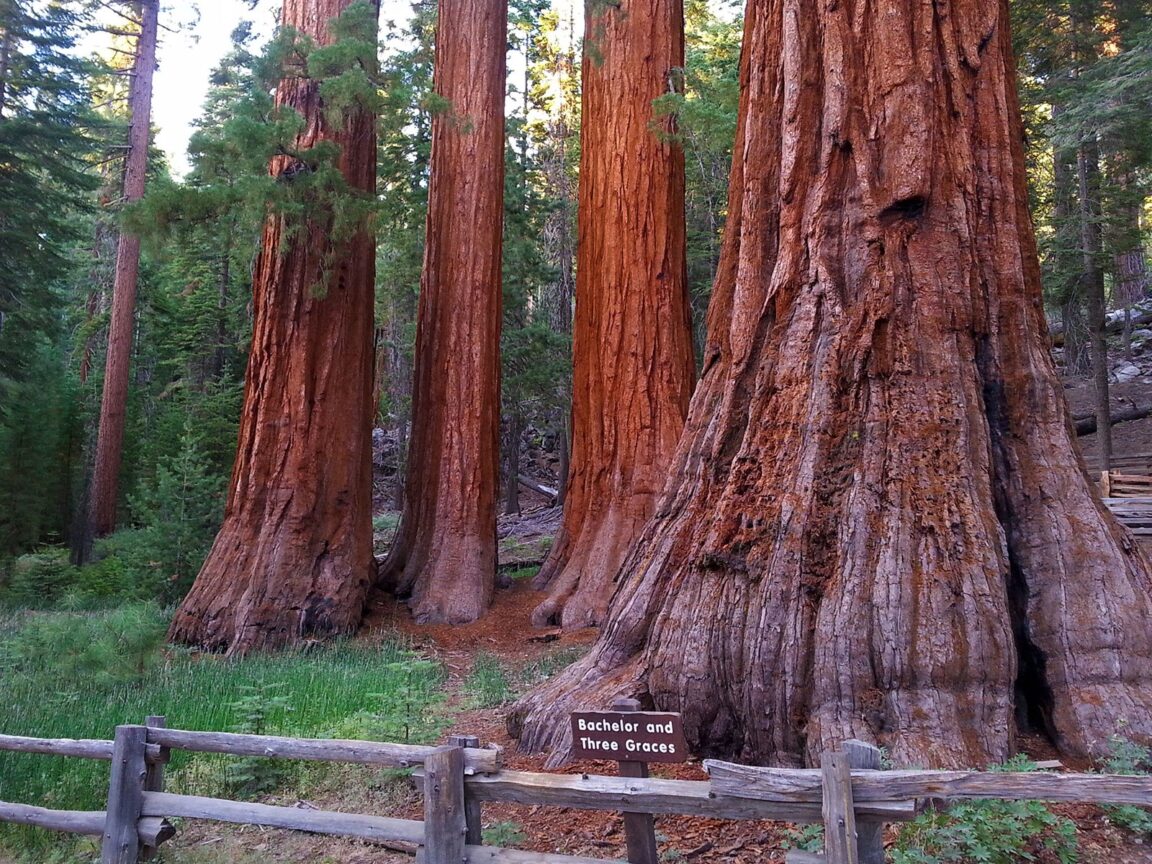
The Grizzly Giant Loop is the visit. Two miles and 300 feet of climbing, starting along the Mariposa Grove Trail, it passes the Bachelor and Three Graces, a lone tree standing beside a trio, then the Grizzly Giant itself, which the Park Service describes as 3,000 years old, and then the California Tunnel Tree, cut in 1895 so that coaches, and now walkers, could pass through its trunk. Allow the full two hours the Park Service suggests. The loop winds along the edge of the grove, so the light and the quiet improve as you get further from the arrival area, which is exactly why arriving on an early shuttle pays off. Late morning groups bunch at the famous trees; an hour earlier the same loop can feel almost private.
Walkers with a full day have two longer options. The Guardians Loop runs 6.5 miles round trip into the upper grove, passing the fallen Wawona Tunnel Tree, the Telescope Tree and the historic Mariposa Grove Cabin, in four to six hours. The Mariposa Grove Trail continues 7 miles round trip to Wawona Point, an overlook with panoramic views, climbing 1,200 feet past the Faithful Couple and the Clothespin Tree. Neither is necessary for a satisfying first visit, and both are poor choices if you are watching a November last bus.
How does Wawona pair with the grove?
Wawona, the small park community just inside the South Entrance, is the natural second half of a grove day because it asks nothing extra of your driving. The Pioneer Yosemite History Center there covers the park’s stagecoach and early tourism era in a cluster of historic buildings, and the Wawona area gives you picnic space, river frontage along the South Fork of the Merced River and a slower register after the grove’s big trees. The pairing order is deliberate: sequoias while you are fresh and the shuttle is running early, Wawona afterwards, when a missed bus no longer matters because you are already back at your car.
If the grove has given you a taste for quieter corners of famous parks, the same approach works elsewhere in Utah’s red rock country, as our Capitol Reef first timer guide shows with its orchard district and scenic drive. And if you are visiting from outside the United States, read the new pricing carefully before you arrive: our explainer on the 2026 nonresident pass changes sets out when the annual pass beats paying per park.
What mistakes do first timers make at Mariposa Grove?
The first is assuming you can drive to the trees. You cannot, placard aside, and sat nav directions that point up Mariposa Grove Road lead to a closed gate and a shuttle queue you could have joined earlier. The second is arriving at midday in season and finding the 300 space plaza car park full. The third is forgetting water: supplies exist at the plaza year round, but in the grove itself drinking water is a summer only service at the arrival area, and there is no food anywhere on this side of the visit. Fill bottles at the plaza. The fourth is bringing a dog. Pets are barred from the shuttle, the road, the trails and the grove entirely, so a grove day needs a pet free plan. The fifth, in November specifically, is building the day around summer shuttle hours. The service shrinks as the month goes on and stops entirely after November 30.
Frequently Asked Questions
Do I need a reservation for the Mariposa Grove shuttle?
No. The shuttle is free, unticketed and first come, first served, running about every 15 minutes in season. Only commercial carriers with capacity for 16 or more people need an advance reservation. Private visitors need only the standard Yosemite entrance pass.
Can I drive my own car into Mariposa Grove?
No, unless your vehicle displays a valid disability placard and the grove road is open for the season, roughly mid April through November. Everyone else parks at the welcome plaza and rides the shuttle, cycles the grove road in season, or walks the two mile Washburn Trail.
How long does a first visit to Mariposa Grove take?
Allow three to four hours in total: shuttle rides both ways, the 0.3 mile Big Trees Loop and the two mile Grizzly Giant Loop at the Park Service pace of 1.5 to 2 hours. Add an hour for Wawona afterwards.
Is Mariposa Grove open in winter?
Yes, but there is no shuttle from December 1 until at least April 15. Access is a two mile walk each way on the Washburn Trail or the grove road, with about 500 feet of elevation gain, and trails may be snowy or icy. The grove stays open to cross country skiing and snowshoeing.
What does it cost to visit Mariposa Grove?
There is no separate grove charge and the shuttle is free. Yosemite entry costs $35 per private vehicle for seven days. From 2026, non US residents aged 16 and over pay an extra $100 per person unless they enter on an annual or America the Beautiful pass.
Which is the best trail for someone who cannot walk far?
The Big Trees Loop: 0.3 mile, relatively flat and wheelchair accessible, with the Fallen Monarch and interpretive panels. Placard holders can also drive to accessible parking near the Grizzly Giant in season and use the accessible trail section there.