 Hana Kim
Eat in Merida in this order and the city makes sense: cochinita pibil first, ideally on a Sunday morning at the Lucas de Galvez market before the best stalls sell out, then sopa de lima as the midday bowl, panuchos and salbutes as the evening antojitos, and the market’s recado stalls as the shopping that lets you take the flavours home. Yucatecan food is not central Mexican food with a regional accent. It is a Maya rooted kitchen built on achiote, sour orange and habanero, on pit cooking and on recados, the ground spice pastes sold by the block in every market. Plan meals around the clock as much as the map: cochinita is a morning food, markets wind down by mid afternoon and the cantina botana tradition belongs to the early afternoon drinking hours.
Quick Facts
- Signature dish: Cochinita pibil, pork marinated in achiote recado and sour orange, wrapped in banana leaf and slow cooked in a pib earth oven
- Sunday ritual: Cochinita tortas and tacos at Mercado Lucas de Galvez from early morning, with the best vendors selling out by late morning
- The soup: Sopa de lima, chicken and turkey broth sharpened with lima, a fragrant local citrus, finished with fried tortilla strips
- Market: Mercado Lucas de Galvez, the main central market, for recado rojo, recado negro, achiote, sour oranges and habaneros
- Evening order: Panuchos (tortillas stuffed with black bean puree) and salbutes (puffed tortillas) topped with turkey, pickled onion and avocado
- Cantina tradition: Free botanas, small plates that arrive with drinks, in Merida’s traditional cantinas during the afternoon
- Heat rule: Habanero salsa is served on the side, always. Add it by the fork tip first
- Book ahead: The best known Yucatecan restaurants at weekends; market eating needs no booking, only an early start
Why does Sunday belong to cochinita pibil?
Cochinita pibil is the dish Merida plans its weekend around. Pork is marinated in recado rojo, the brick red achiote paste ground with sour orange juice, garlic and spices, wrapped in banana leaves and cooked low and slow in a pib, the earth oven that gives the dish its name. The meat comes out soft enough to shred by hand, stained orange red and perfumed with citrus and annatto rather than chilli heat. It is eaten in tacos on small corn tortillas or in a torta, a crusty roll, with pickled red onion over the top and habanero salsa offered separately.
Sunday is the traditional cochinita morning, and Mercado Lucas de Galvez is where the ritual concentrates. Dedicated stalls serve from early in the morning and the pattern reported by every local guide is the same: arrive early, because the best pork is the first out of the pit and popular vendors sell out by late morning, long before the market itself closes. Treat a Sunday lie in as a food decision, not a neutral one. If your trip has no Sunday, weekday mornings at the market and at neighbourhood taquerias still serve cochinita, but the Sunday scene, families buying by the kilo and eating tortas at the counters, is the fullest version of the dish.
For the city around the food, our guide to Merida’s haciendas, cenotes and slow evenings covers where to base yourself and how the days pace out between meals.
What should you order at Lucas de Galvez besides cochinita?
Lucas de Galvez is Merida’s main market, a covered sprawl a few blocks from the Plaza Grande, and it works as both a meal and an education. The food stalls in the interior serve from early morning: tacos and tortas de cochinita, lechon al horno (roast suckling pig with crackling skin) as the closest rival to cochinita, salbutes and panuchos, and juices and aguas frescas including chaya and lime. A market breakfast here costs a small fraction of a restaurant meal and puts you at a counter next to the people who shop in the market every day.
The second job at Lucas de Galvez is the recado stalls. Recados are the ground seasoning pastes that structure Yucatecan cooking, sold as dense blocks and balls: recado rojo (also called achiote) for cochinita, recado negro, made from charred chillies, for relleno negro, the black turkey stew, and recado blanco for escabeche and white stews. Stallholders also sell the sour oranges, habaneros, banana leaves and achiote seed that the pastes are built from. A block of recado rojo is the single best food souvenir from Merida: it keeps well, weighs almost nothing and turns a plain pork shoulder at home into something recognisably Yucatecan. Buy from a stall that sells to local cooks in quantity, and ask which recado is for which dish before you buy, because the colours are the labelling.
What makes sopa de lima different from a chicken soup?
Sopa de lima looks simple and is not. It is a clear chicken and often turkey broth flavoured with lima, a local citrus that is fragrant rather than sharply sour, with shredded poultry, tomato, pepper and onion, finished at the table with crisp fried tortilla strips and a squeeze more lima. The lima is the whole point: ordinary lime juice makes a sharper, thinner soup, and kitchens outside Yucatan substituting it produce an approximation. In Merida the soup is the standard midday restorative, served in fondas and traditional restaurants across the centro, and it pairs naturally with a cochinita morning because it resets the palate after the rich pork.
Order it where the full Yucatecan canon is cooked rather than where menus chase international dishes. Traditional restaurants around Santa Lucia and the centro, and the market area fondas at lunch, are the reliable hunting ground. A good sopa de lima arrives fragrant before it arrives hot: the citrus and broth aroma should reach you first, the tortilla strips should still crackle and the broth should taste of poultry and lima, not of stock cube and lime.
How does the cantina botana tradition work?
Merida’s traditional cantinas run on a generous old rule: order a drink and food appears. Botanas, small plates of snacks, arrive with each round during the afternoon hours, and in the classic cantinas the sequence escalates from simple pickles and peanuts toward cooked dishes as the rounds continue. It is a midday and early afternoon institution rather than a late night one, and it doubles as one of the cheapest lunches in the city for travellers who drink slowly and eat everything that lands.
The etiquette is easy. Sit, order, eat what arrives, tip on the full value of what you consumed and do not treat the botanas as a buffet to be mined without ordering. Cantina food also gives you a low risk tour of flavours that are harder to commit a whole meal to: sikil pak, the pumpkin seed and tomato dip served with tostadas, is the classic botana plate and one of the oldest recipes in the Yucatecan repertoire. Pair a cantina afternoon with a slow walk on the Paseo de Montejo or a siesta, because Merida’s midday heat makes ambitious sightseeing between one and four o’clock a poor trade.
What else belongs on a first timer’s order?
Four dishes complete the core list. Papadzules are corn tortillas dipped in a pumpkin seed sauce, filled with chopped hard boiled egg and finished with a tomato sauce: eggless looking, entirely egg centred and one of the oldest documented Maya dishes. Queso relleno is a whole Edam style cheese, a legacy of Yucatan’s trading history, hollowed, filled with seasoned ground meat and baked in a white sauce with a tomato sauce over it, and it divides opinion happily at any table. Poc chuc is pork marinated in sour orange and grilled, served with pickled onion, beans and tortillas, and it is the dish to order when pit cooked pork has sold out. Huevos motulenos, from the nearby town of Motul, stack eggs on a tostada with beans, ham, peas, cheese and a tomato sauce, and they own the second breakfast slot.
Dessert has its own street ritual: the marquesita, a crisp rolled wafer cooked on a cart iron and filled most classically with shredded Edam cheese, with chocolate and cajeta as the modern alternatives. Marquesita carts gather in the plazas in the evening, and the cheese version, sweet, salty and shattering, is the one to try first. For a wider Mexico food comparison, Puebla’s mole and talavera city makes the natural second stop: two regional kitchens, both built on ground pastes and long histories, tasting nothing alike.
What should you book, and what should you just arrive early for?
Book the famous tables. Merida’s best known Yucatecan restaurants fill at weekends and on holidays, and a reservation protects a Saturday night dinner. Book nothing else. The market, the taquerias, the cantinas and the marquesita carts all run on arrival, and the skill they reward is timing rather than planning: early for cochinita and the market, midday for sopa de lima and cantina botanas, evening for panuchos, salbutes and marquesitas in the plazas. Carry small peso notes for market stalls, expect counters rather than tables at the best market positions and learn the two words that run the whole system: con todo, with everything, which in Merida means the pickled onion goes on and the habanero stays, wisely, on the side.
One arrival formality is worth settling before the food planning: Mexico’s tourist permit for air arrivals is now digital, and our explainer on the digital FMM and the QR code that replaced the paper slip covers what to save on your phone before you fly.
Frequently asked questions
What is the one dish to eat in Merida if you only eat one?
Cochinita pibil, eaten in the morning, in a taco or a torta with pickled red onion. It is the dish the city is known for, the dish with the deepest roots and the dish whose quality varies most between an early market stall and a late restaurant portion.
Why is cochinita a Sunday food?
The pit cooking cycle and family tradition made cochinita the weekend breakfast dish, bought from specialists on Sunday mornings and eaten at market counters or taken home by the kilo. Stalls serve it on other days, but Sunday at Lucas de Galvez is the fullest scene and the earliest sell out.
Is Yucatecan food very spicy?
The dishes themselves are seasoned, not hot. Habanero, one of the hottest chillies in Mexico, is served as a salsa or pickled on the side so each eater sets the heat. Test any habanero salsa on a fork tip before spooning it on.
What food souvenir should you buy at the market?
A block of recado rojo (achiote paste) from the recado stalls at Lucas de Galvez. It keeps without refrigeration, packs flat and is the base of cochinita pibil. Recado negro is the second block to add if you want to cook relleno negro at home.
Do you need to book restaurants in Merida?
Only the best known traditional restaurants, and mainly for weekend evenings. Market stalls, taquerias, cantinas and street carts take no bookings. For those, arriving early is the reservation.
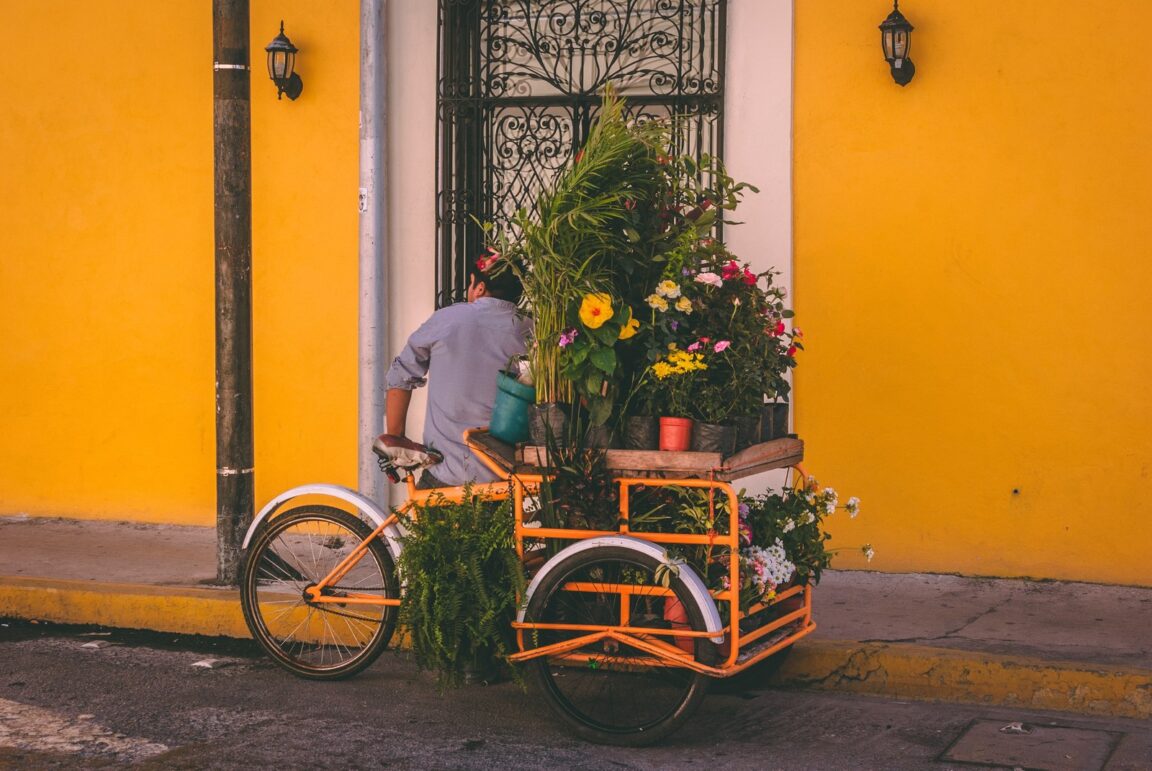
Photo credit: A flower vendor with his tricycle cart in the Barrio de Santiago, Merida, Mexico. Photo by Jorge Zapata on Unsplash, Unsplash License, used with credit.