 Hana Kim
Nha Trang eats by the clock, and the order matters more than the address list: jellyfish noodle soup for breakfast while the market morning is still cool, nem nuong grilled pork rolls as the hands on lunch or early dinner you assemble yourself, and banh can mini pancakes only after the clay mould stalls light their coals in the afternoon. Get the order wrong and you will find shutters down at the banh can stall at noon and the best noodle bowls gone by mid morning. Get it right and three dishes that were genuinely created in this province, bun sua, nem nuong Ninh Hoa and banh can, carry a whole day of eating for a few dollars, with Dam Market as the morning anchor and the seafood strip as the evening release.
Quick Facts
- Breakfast bowl: Bun sua, rice noodles in a clear fish broth with crunchy jellyfish and fish cake, from about 35,000 to 45,000 dong at local shops
- The roll it yourself dish: Nem nuong Ninh Hoa, charcoal grilled pork served with rice paper, crispy fried rice paper shards, herbs, green mango and a warm orange dipping sauce, about 50,000 dong a portion
- Afternoon only: Banh can, small rice pancakes baked in clay moulds over coals with quail egg, prawn or squid, sold by the piece or the plate from mid afternoon
- Market anchor: Dam Market (Cho Dam), the city’s main market on Phan Boi Chau Street, trading from early morning, roughly 5 am to 6.30 pm
- Close cousin bowl: Bun cha ca, the same broth and noodles with steamed and fried fish cake and no jellyfish
- Evening: Oc (sea snails and shellfish) stalls and the Bo Ke seafood strip, priced by the plate and by weight
- Book ahead: Almost nothing. Nha Trang street food runs on arrival and timing, not reservations
- Season note: Jellyfish is firmest in late spring and early summer; shops serve it year round from stored catch
Why is bun sua the breakfast to start with?
Bun sua is the bowl Nha Trang invented for itself. A clear, pale broth is simmered from fish, fine rice noodles go in, and over the top come two textures that define the city’s cooking: slices of house made fish cake, springy and lightly seasoned, and pieces of jellyfish that eat like a cool, crunchy jelly rather than anything fishy. Tomato, herbs and a wedge of lime finish it, with chilli on the side. The jellyfish is the point of the dish and the reason to eat it here rather than anywhere else in Vietnam: outside Khanh Hoa province the bowl is a rarity, and inside it, it is an ordinary working breakfast.
Eat it in the morning. The noodle shops around Dam Market and on streets such as Ngo Gia Tu open from about 6 am, and the market morning, roughly 6 to 10 am, is when the broth is freshest and the shops are full of local customers rather than beach traffic. Local listings put a bowl at about 35,000 to 45,000 dong, firmly in the one to two dollar range. If jellyfish sounds like a step too far at 7 am, order bun cha ca instead: the same broth, noodles and fish cake without the jellyfish, and the bowl most Nha Trang children grow up on. Either way, breakfast here is a soup, eaten at a low table with chopsticks and a spoon, and it sets up the day better than any hotel buffet on the Tran Phu strip.
Nha Trang is one stop on a coast that eats brilliantly at every latitude. Further north, Hue eats like a former capital, with bun bo Hue and imperial cakes, and the contrast between the two cities’ broths is a short lesson in how regional Vietnamese cooking really is.
What is nem nuong, and how do you eat it properly?
Nem nuong is the dish you build. It comes from Ninh Hoa, the town north of Nha Trang that gives the full name, nem nuong Ninh Hoa, and it arrives not as a finished plate but as a construction kit: skewers of minced pork, seasoned, moulded and grilled over charcoal until the edges char, a stack of soft rice papers, shards of rice paper fried crisp, a heap of herbs, lettuce, cucumber, star fruit and green mango, and a bowl of warm, thick orange dipping sauce built on ground pork, peanuts and fermented notes. Nothing on the tray is decoration. Everything goes in the roll.
The method matters. Lay a soft rice paper flat, add a crisp shard first so the roll has a spine, then herbs and cucumber, then the pork pulled off its skewer, then a strip of sour green mango. Roll it tight, dip it deep in the warm sauce and eat it in two or three bites before the paper softens. A portion costs about 50,000 dong at the long running specialists near Dam Market, on streets such as Lan Ong, and one portion per person with a drink is a full meal. The famous names have queues at peak hours, but the dish is standardised enough across the city’s nem nuong shops that a busy local room anywhere near the market will serve you well. Lunch and dinner are both correct; it is the most flexible meal of the Nha Trang day.
Why can you only get banh can in the afternoon?
Banh can catches out more visitors than any other dish in the city, because it runs on an afternoon clock. These are small, round rice flour pancakes baked, not fried, in individual clay moulds set over charcoal, each one topped as it cooks with a quail egg, a small prawn, squid or minced pork. They are served in pairs as they come off the moulds, with a warm fish sauce based dip, shredded green mango and herbs, and they are eaten the moment they land, crisp at the rim and soft in the middle.
Most stalls light the coals at about 3 to 4 pm and serve into the evening, so a lunchtime visit finds the griddle cold and the stools stacked. Plan banh can as the late afternoon snack that bridges the beach and dinner, in the Thap Ba area north of the centre, where the densest cluster of stalls operates, or at evening stalls around the market. They are sold by the piece, at a few thousand dong each, or by the plate, so the correct order is more than you first think: a plate disappears quickly between two people. Do not confuse banh can with banh canh, the thick noodle soup with fish cake that shares every letter but one: one is a pancake counted in pieces, the other is a bowl counted in broth.
For the pancake comparison up the coast, Quy Nhon’s banh xeo shrimp pancakes are the crackling, turmeric tinted cousins: same coastal logic, completely different batter and build.
How should you use Dam Market?
Dam Market, Cho Dam, is Nha Trang’s main market, housed in and around its distinctive round building on Phan Boi Chau Street, a short walk inland from the beach strip. It trades from early morning, roughly 5 am to 6.30 pm, and it does three jobs for a food traveller. In the morning it is a breakfast district, with bun sua, bun ca and banh canh stalls serving the market crowd. Through the day it is the place to buy the city’s edible souvenirs: dried seafood, fish sauce, mango rice paper and the bird’s nest products, yen sao, that Khanh Hoa province is famous for. And it is the price benchmark: anything sold to tourists on the beachfront can be checked against what the same thing costs in the market.
Use it early and use it comparatively. Go for breakfast, walk the dried goods aisles while the day is cool, note prices, then buy on a second pass rather than the first. Haggling is expected on dry goods and souvenirs, politely and in small increments, and is not part of the food stalls, where prices are low, fast and effectively fixed. The streets immediately around the market hold many of the city’s best noodle and nem nuong addresses, so the market works as a compass point even when you eat outside it.
What happens in the evening: snails, seafood and the Bo Ke strip?
Evening belongs to oc, the catch all word for sea snails, clams and shellfish cooked to order with lemongrass, chilli, tamarind or garlic butter, served at pavement stalls where you pick by pointing and pay by the plate. Plates at local stalls run in the range of a few tens of thousands of dong, and the ritual, small stools, cold beer, a bowl of salt, pepper and lime for dipping, is as much the product as the shellfish. The Bo Ke strip, the line of seafood restaurants along the northern waterfront, is the bigger commitment version: tanks and trays of live seafood priced by weight, grilled, steamed or hotpotted, at prices that reward agreeing the weight and the per kilo price before anything is cooked.
That one rule, confirm the price per kilo and the total weight in front of you, is the difference between a fair seafood dinner and the only common Nha Trang food complaint. At the pavement oc stalls the risk barely exists; at by weight restaurants it is entirely manageable with thirty seconds of clarity before the grill. Finish the night as the city does, with something sweet and cold from a dessert or che stall near the market, and save the beachfront bars for after.
Frequently asked questions
What are the three dishes Nha Trang is actually known for?
Bun sua (jellyfish noodle soup), nem nuong Ninh Hoa (grilled pork rolls you wrap yourself) and banh can (clay mould mini pancakes). All three come from this province, and all three are hard to find in proper form elsewhere in Vietnam.
When should you eat each dish?
Bun sua for breakfast, from about 6 am while the market morning lasts. Nem nuong at lunch or dinner, when the specialist shops are grilling. Banh can from mid afternoon into the evening, because most stalls only light their clay moulds at about 3 to 4 pm.
Does jellyfish taste of anything?
Very little, and that is normal. Jellyfish brings texture, a cool crunch, rather than flavour, and takes on the broth, lime and chilli around it. If the texture worries you, bun cha ca gives you the same bowl without it.
How much does a day of eating cost in Nha Trang?
At local shops, a noodle bowl runs about 35,000 to 45,000 dong, a nem nuong portion about 50,000 dong and banh can a few thousand dong a piece, so the three signature dishes together cost well under 200,000 dong before drinks and any evening seafood.
Do you need to book any restaurants in Nha Trang?
No. Street stalls, noodle shops and nem nuong specialists all run on arrival. Timing is the skill: early for noodles, afternoon for banh can, and a price check before by weight seafood is cooked.
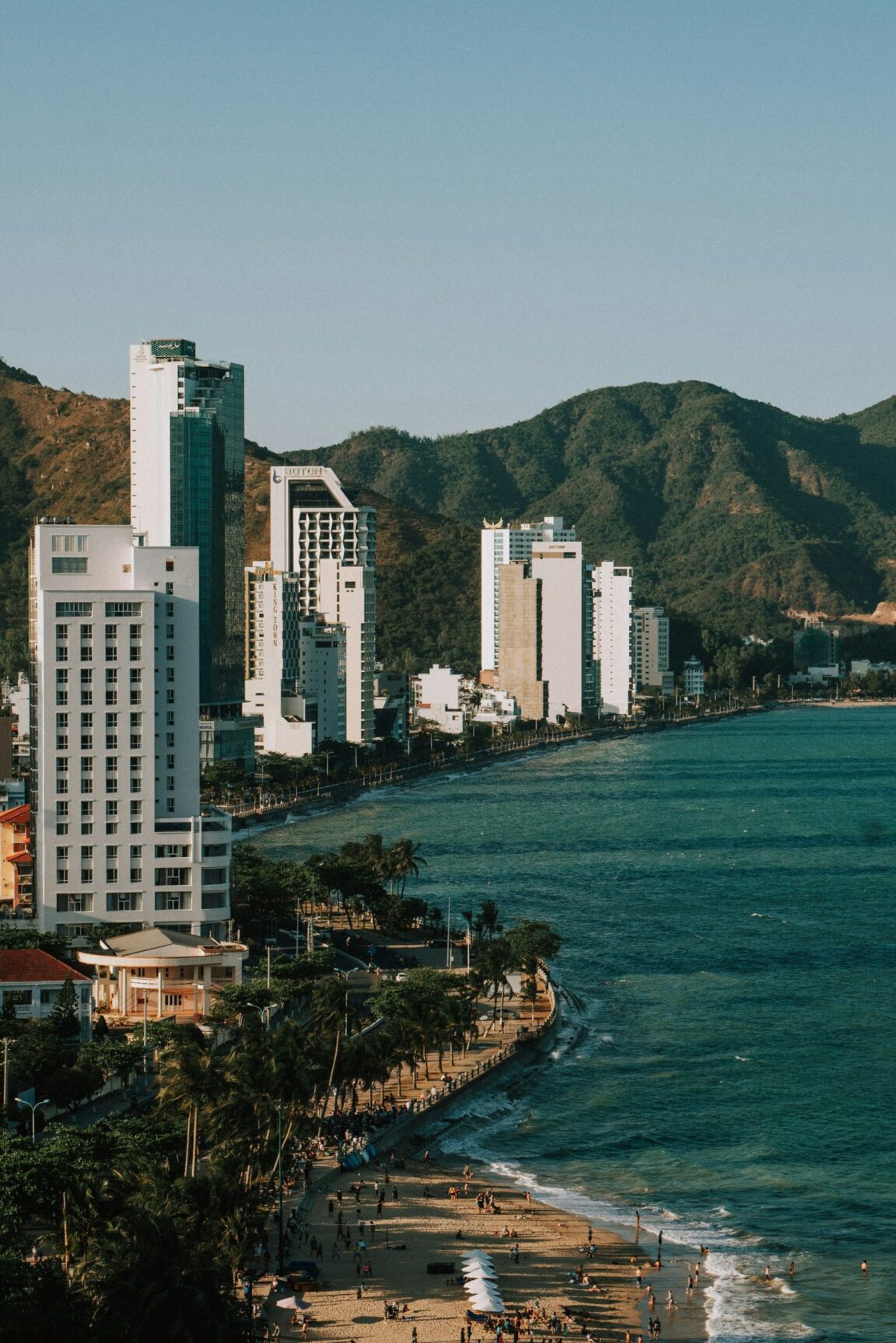
Photo credit: The Tran Phu beachfront and hotel strip in Nha Trang, Vietnam, in late afternoon light. Photo by Hai Son Dam on Unsplash, Unsplash License, used with credit.