 Camille Baptiste
Mount Fuji’s climbing rules changed from advice into a gate, a fee and a clock, and the order you do things in now decides whether you climb at all. Start with the honest position today: the 2026 season has ended, the official climbing site states that Mt. Fuji is currently closed, and the trails from the 5th stations to the summit are shut for winter. The rules below are the 2026 rules as published by the official website for Mt. Fuji climbing, fujisan-climb.jp, and they are the system to plan a 2027 climb around until the prefectures publish next season’s dates. In short: every climber pays a 4,000 yen hiking fee, the Yoshida Trail caps entry at 4,000 climbers a day, and its 5th station gate closes from 2 p.m. to 3 a.m. to everyone except mountain hut guests, which is what finally ended bullet climbing in practice.
Quick Facts
- Current status (checked 19 November 2026): Closed. The 2026 season ended on 10 September 2026 and the official site lists all four trails, 5th station to summit, as closed for winter. Do not plan a summit climb now
- 2026 season dates: Yoshida and Subashiri trails 1 July to 10 September 2026; Fujinomiya and Gotemba trails and the summit crater rim 10 July to 10 September 2026
- The fee: 4,000 yen per person per climb, mandatory on all four trails in 2026, paid in advance through the reservation systems
- The Yoshida cap: 4,000 climbers per day on the Yoshida Trail; when the cap is reached, the gate closes to climbers without a hut reservation
- The gate hours: The Yoshida 5th station gate is closed from 2 p.m. to 3 a.m. to climbers without a mountain hut reservation. Descent is possible at any time
- Huts are separate: Paying the fee does not book a hut. Hut reservations are made directly with each hut, and a hut booking is also your pass through the gate after 2 p.m.
- Bullet climbing: Climbing through the night without a hut stay, the old bullet climbing pattern, is blocked by the gate hours and is treated as prohibited in practice on the official guidance
- Summit height: 3,776 metres. Fuji is a UNESCO World Heritage cultural site, listed in 2013
What is the correct booking order for a Fuji climb?
Work in this sequence, because each step unlocks the next. First, choose your trail and date inside the official season, accepting that the season is roughly ten weeks and that no date outside it is negotiable. Second, book a mountain hut for the night of your climb if you intend the classic pattern of an afternoon ascent, a few hours of rest and a summit push before dawn; huts are reserved directly with the hut operators, the popular Yoshida huts between the 7th and 8th stations fill earliest, and reservations for a season typically open in spring. Third, complete the entry side: on the Yoshida Trail, reserve your passage and pay the 4,000 yen fee in advance through the Yamanashi reservation system, which issues the proof you show at the gate; on the Shizuoka side trails, register and pay through that prefecture’s system, including its pre climb learning requirements. Fourth, plan your transport to the 5th station so that you pass the gate before 2 p.m. unless your hut booking covers a later entry. Reverse the order and the failure modes are predictable: a fee paid with no hut leaves you locked out of an afternoon start, and a hut booked on a date when the day cap or gate has already closed your entry window is money spent on a climb you cannot begin.
How do the fee and the daily cap actually work on the Yoshida Trail?
The Yoshida Trail, starting at the Fuji Subaru Line 5th station at about 2,300 metres, is the route most international visitors climb, and it carries the full weight of the new system. The hiking fee is 4,000 yen per person per climb, paid in advance when you reserve passage, and the trail is capped at 4,000 climbers per day. Two details catch people out. The first is that hut guests sit outside the ordinary day entry logic: a confirmed hut reservation lets you pass the gate even when the day cap has closed entry to others, and lets you start after 2 p.m. The second is that a reservation is not a flexible ticket. The official notice is explicit that even advance reservation holders who have not passed the 5th station gate by 2 p.m. are subject to the closure, hut guests excepted. The fee also reaches people who did not start on the Yoshida: climbers who ascend another trail and descend the Yoshida owe the fee on the descending trail, collected under the official rules. Treat the fee, the cap and the gate as one machine rather than three separate hurdles, because that is how the trailhead staff operate them.
What do the gate hours do to bullet climbing?
Bullet climbing meant arriving at the 5th station in the evening, climbing all night without sleeping, reaching the summit for sunrise and descending immediately, a pattern the authorities linked to exhaustion, altitude sickness and accidents. The gate hours dismantle it without needing a policeman on the trail. The Yoshida gate closes at 2 p.m. and does not reopen to non hut climbers until 3 a.m., so the evening start the bullet pattern depends on no longer exists: arrive at 6 p.m. without a hut booking and you are not starting, whatever your fitness or intentions. The same 2 p.m. to 3 a.m. restriction applies on the Shizuoka side for climbers without a hut stay. What remains legal and sensible is the pattern the system is designed around: start late morning or early afternoon, sleep at a hut partway up, and climb the final section in the dark hours before dawn with rested legs. A single day ascent inside gate hours is possible for the very fit who start early, but it is a long day at altitude, and the official safety guidance is built around hut based climbs for good reason. Travellers combining a climb with time in the capital can plan the city days with our Tokyo first timer itinerary, and our Japan spring packing guide covers the layering approach that Fuji’s summit temperatures demand in any season.
How do the four trails differ under the rules?
All four trails charged the same 4,000 yen fee in 2026 and all four close outside the season, but they are not interchangeable. Yoshida, on the Yamanashi side, opens first, has the most huts, the easiest bus access from Tokyo via Kawaguchiko and Shinjuku, and the strictest crowd machinery: advance reservation, the 4,000 a day cap and the staffed gate. Subashiri, also opening 1 July on the Shizuoka side, starts in forest, merges with the Yoshida route high on the mountain, and is far quieter, with entry handled through the Shizuoka registration and learning system rather than the Yoshida cap. Fujinomiya is the shortest route to the summit and the closest to the shinkansen corridor, opening 10 July. Gotemba is the longest and quietest, with the biggest elevation gain and the fewest huts, suited to experienced climbers rather than first timers. The practical consequence: a first international climb usually belongs on the Yoshida, booked earliest and planned most carefully, while repeat climbers trade its convenience for the space of Subashiri or Gotemba and accept thinner hut and transport options.
What should you do now, while the mountain is closed?
Use the closed season for the parts of the plan that do not need the mountain to be open. Decide your trail and your target week inside the expected early July to 10 September window, understanding that the prefectures confirm exact dates in spring and that the 2026 pattern is a guide, not a promise, for 2027. Watch the official site for the reservation opening announcements, which in 2026 came in spring, and be ready to book huts the moment your chosen hut opens its list, because the fee reservation is worthless without the bed that unlocks the gate after 2 p.m. Build the fitness and the kit list in parallel: broken in boots, headlamp, waterproof shell, warm layers for a summit that can sit near freezing before dawn even in August, and cash and cards for hut meals and supplies. Finally, hold refundable transport and hotel bookings until your hut and entry are confirmed. The mountain will reopen on schedule; the climbers who struggle are the ones who treated the new rules as paperwork to sort out at the trailhead.
Frequently asked questions
Can you climb Mount Fuji now?
No. Checked on 19 November 2026, the official climbing site states that Mt. Fuji is currently closed, the 2026 season ended on 10 September, and all four trails are closed from the 5th stations to the summit for winter, with huts and first aid stations not operating. Climbing outside the season is prohibited and dangerous.
How much is the Mount Fuji climbing fee?
4,000 yen per person per climb in 2026, mandatory on all four trails and paid in advance through the reservation systems. It is separate from hut charges, and it can also be owed by climbers descending the Yoshida Trail after ascending another route.
What are the Yoshida Trail gate hours?
The 5th station gate closes from 2 p.m. to 3 a.m. to climbers without a mountain hut reservation, and it also closes when the daily cap of 4,000 climbers is reached. Hut guests are exempt from both closures. Descending climbers may pass at any time.
Does paying the fee reserve a mountain hut?
No. The fee and the hut are two separate bookings. Huts are reserved directly with each hut operator, typically from spring for the summer season, and the hut booking is what allows entry after 2 p.m. and outside the day cap.
Is bullet climbing banned?
In practice, yes. The gate closure from 2 p.m. to 3 a.m. for anyone without a hut reservation removes the evening start that bullet climbing requires, on both the Yamanashi and Shizuoka sides. The system is designed to force a hut rest into every overnight climb.
When will the 2027 season dates and reservations open?
The prefectures confirm dates in spring; in 2026 the Yoshida season ran 1 July to 10 September and reservations opened in spring 2026. Expect a similar pattern for 2027, and confirm on fujisan-climb.jp before booking anything non refundable.
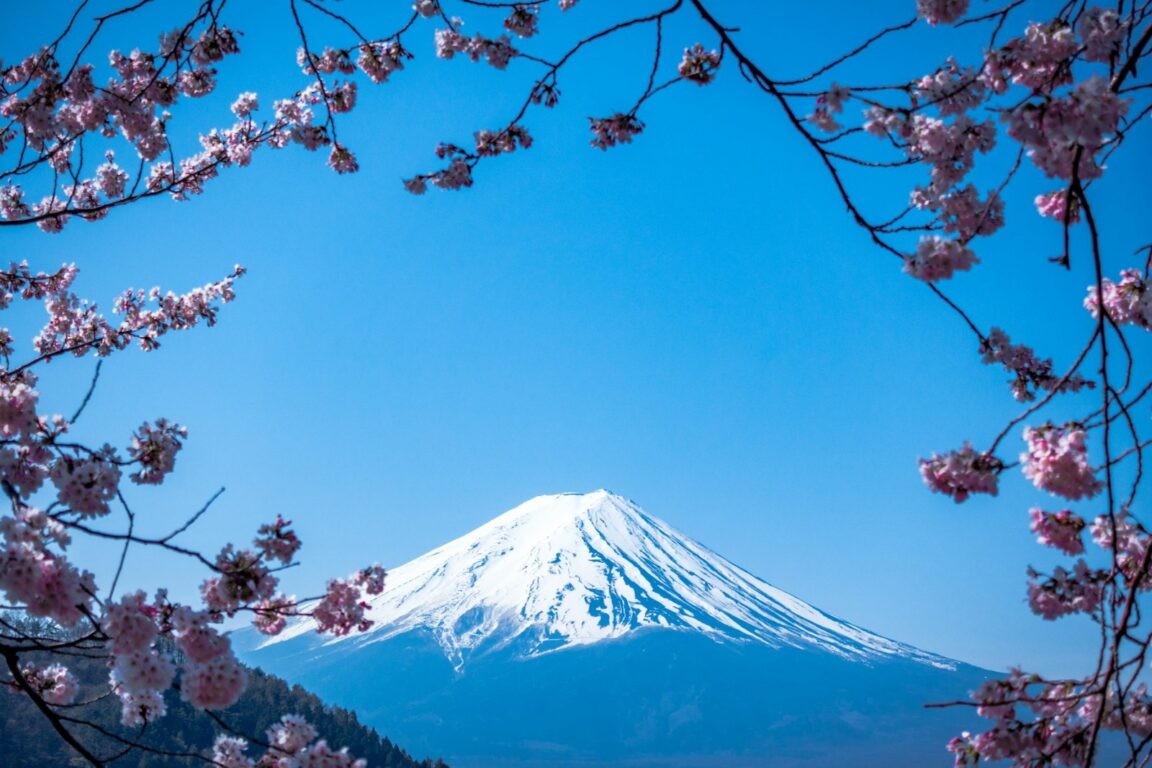
Featured image: Mount Fuji framed by cherry blossom. Photo via Unsplash, Unsplash License (images.unsplash.com/photo-1490806843957-31f4c9a91c65).