 Thandiwe Nkosi
Thessaloniki eats in a fixed daily order, and the traveller who follows it eats best: bougatsa for breakfast, still warm, with the custard version dusted in icing sugar and cinnamon; a slow run through the Kapani and Modiano markets late in the morning, tasting as you go; meze with tsipouro in the Ladadika quarter or around the markets at lunch; and the city’s two famous sweets, trigona and tsoureki, held back for the afternoon, when they were designed to be eaten. Book a table for dinner in Ladadika on a Friday or Saturday, book nothing else, and let the markets set the pace of the day. This is Greece’s second city and, since 2021, its first UNESCO Creative City of Gastronomy, and the title is not marketing: it describes how the city actually organises its mornings.
Quick Facts: Thessaloniki’s Table at a Glance
- The order: Bougatsa breakfast, Kapani and Modiano market run, meze lunch, trigona and tsoureki in the afternoon, Ladadika tavernas at night
- The credential: UNESCO named Thessaloniki a Creative City of Gastronomy in 2021, the first Greek city to receive the title
- Bougatsa: Hand stretched filo around semolina custard, cheese or minced meat, cut in squares at the counter; the custard version is served with icing sugar and cinnamon, always ask for both
- Breakfast names: Bougatsa Bantis, making filo by hand since 1969, and Bougatsa Giannis on Mitropoleos Street, known for its long hours through the night
- The markets: Kapani, also called Vlali, the city’s oldest market, and Agora Modiano, the covered hall built in the 1920s by architect Eli Modiano, restored and reopened on December 5, 2022, and refreshed again in 2026 as a food hall of individual shops and counters
- Trigona Panoramatos: Crisp filo cones soaked in syrup and filled with cream at the moment of ordering, from the Panorama suburb; Elenidis has made them since 1960
- Tsoureki: The braided, mahlepi scented sweet bread sold all year in Thessaloniki; Terkenlis, founded in 1948, is the best known name, famous for chocolate filled and coated versions
- What to book ahead: A Ladadika dinner table on weekend nights; markets, bakeries and bougatsa shops are walk in only
- Checked: November 19, 2026, against the Municipality of Thessaloniki market pages, the Agora Modiano official site and UNESCO Creative Cities material
Why Does the Day Start With Bougatsa, and What Is the Cinnamon Rule?
Bougatsa is a tray of thin, buttery filo layered around a filling and baked until it shatters, and in Thessaloniki it is breakfast, not dessert. The classic filling is semolina custard, and the rule the title of every local order turns on is the finish: the square is cut with a wide blade at the counter and dusted with icing sugar and cinnamon before it reaches you. Order it exactly that way, with cinnamon, because the spice against the warm custard is the city’s signature in a single bite. Cheese and minced meat versions are the savoury branch of the same tray, and a sesame koulouri ring from a street cart is the other half of the traditional morning, eaten on the walk between stops.
Two names anchor the breakfast map. Bougatsa Bantis, on Panagias Faneromenis Street, has made its filo by hand since 1969, working from family recipes that came with the city’s refugee pastry tradition. Bougatsa Giannis, on Mitropoleos Street in the centre, is the famous long hours shop, opening in the evening and serving through the night into the following afternoon, which is why a warm bougatsa at an unlikely hour is a normal Thessaloniki experience rather than a novelty. Go to Bantis for the craft version in the morning; know Giannis exists for every other hour of the day.
Eat bougatsa where you buy it, standing or at a small table, with a coffee, and do not carry it around the markets first. It is a food with a ten minute prime, while the filo is still crisp and the custard still warm, and the whole market order in this guide is built around protecting that first half hour of the day.
How Should You Work the Kapani and Modiano Market Run?
The old commercial heart of Thessaloniki sits between Aristotelous Square and Venizelou Street, and its two markets are a study in contrasts that works best back to back. Start with Kapani, also signed as the Vlali market, the oldest market in the city: a warren of narrow lanes under awnings where fishmongers, butchers, olive and spice sellers, cheese shops and small eateries trade at full volume. Kapani is where the city shops, not where it performs shopping, and the correct method is to walk it slowly, taste what is offered, and buy small: a handful of olives, a piece of cheese, spices and dried goods that travel well.
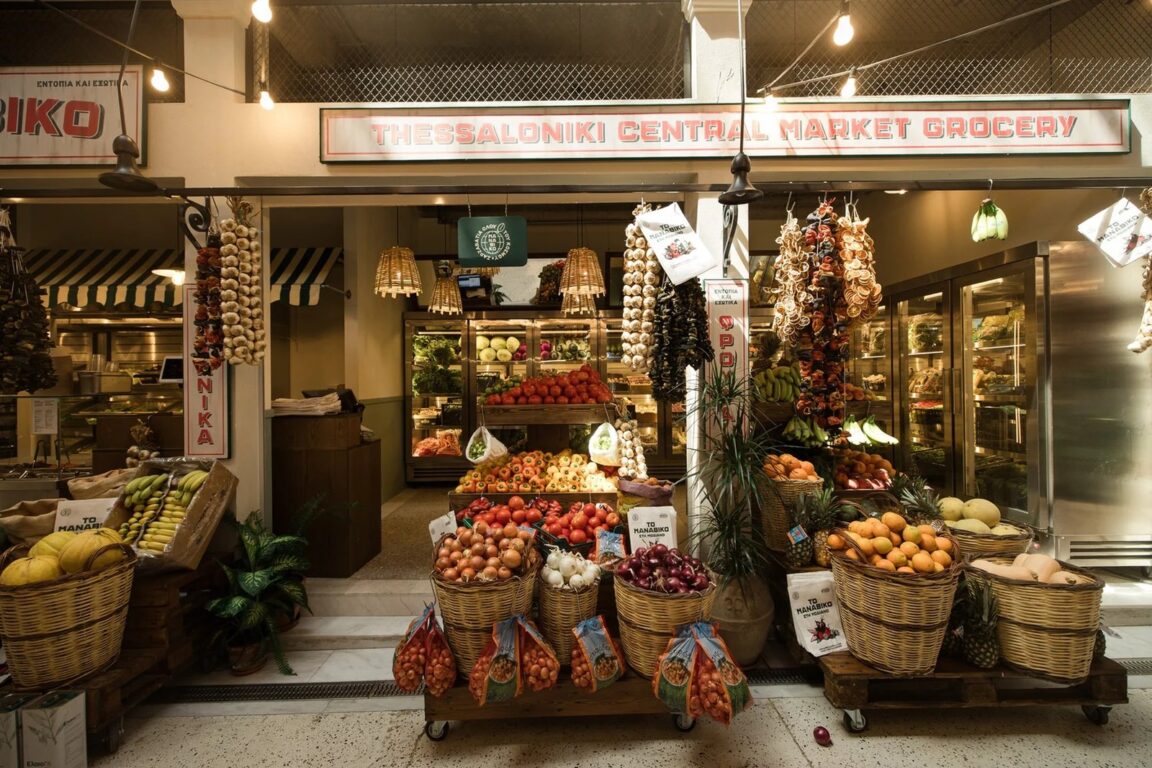
Then cross to Agora Modiano, a block away between Ermou and Vasileos Irakliou streets, for the polished half of the run. The covered hall was built in the 1920s to designs by Eli Modiano, of the city’s Sephardic Jewish Modiano family, on the site of the old Talmud Torah synagogue, and it was restored and reopened on December 5, 2022. After a further refresh, it reopened in 2026 with a food hall lineup of individual businesses under the historic roof: a central grocery, butcher, fishmonger, bakery and dairy alongside counters serving cooked food, coffee, wine and sweets, with the market’s own listing giving long daily hours from 8:00 in the morning, though individual shops set their own times inside that frame.
The Modiano order is different from the Kapani order. In Kapani you buy ingredients; in Modiano you can also sit down and eat them, fish chosen at the counter and cooked beside it, soutzoukakia and grilled meats from the butcher taverna tradition, a bougatsa from the market bakery if breakfast was missed. Do the full circuit of the hall before ordering anything, because the hall is small enough to survey in five minutes and the best seat is rarely at the first counter you pass. Entry to both markets is free; you pay only for what you eat and carry away.
Travellers continuing south can pair this city with the capital using our 3 days in Athens itinerary, which applies the same eat by neighbourhood logic to the Acropolis slopes and Plaka.
Where Do the Ladadika Tavernas Fit, and What Should You Order There?
Ladadika, the old warehouse and oil merchants’ quarter down by the port, a short walk west of the markets, is where the market run turns into a meal. Its cobbled lanes of restored 19th century warehouses now hold tavernas and ouzeris that fill from lunchtime onward, and this is the place for the city’s meze culture: a table of small plates and a small bottle of tsipouro or ouzo, ordered in rounds rather than all at once.
Order with the city’s history in mind. Thessaloniki’s cooking was reshaped by the Greek refugees who arrived from Asia Minor in 1922, and their spiced, cumin scented dishes are the quarter’s backbone: soutzoukakia, the oblong meatballs in tomato sauce, are the dish to start with. Add mussels from the Thermaic Gulf, served as a pilaf or saganaki, whatever small fish the house is frying that day, and grilled peppers and cheeses as they come. The tsipouro ritual does the pacing for you: each round of spirit traditionally arrives with its own small plate, so a Ladadika lunch assembles itself over an hour or more, and forcing it faster misses the point.
Ladadika is the one part of the day worth a reservation. On Friday and Saturday nights the best known tavernas fill with local groups, and a booked table at 9:00 in the evening, which is an early dinner by Thessaloniki standards, saves the wait. At lunch and on weeknights, walk in and take what is free.
Why Are Trigona and Tsoureki an Afternoon Order, Not a Morning One?
Because Thessaloniki separates its sweets from its breakfast by design, and the afternoon belongs to two pastries with addresses. Trigona Panoramatos are cones of buttered filo baked crisp, soaked in syrup, and filled with pastry cream only when you order them, so the shell stays crunchy against the cool cream. They come from Panorama, the suburb in the hills above the city, where the Elenidis family began making them in 1960; the firm’s central shop on Dimitriou Gounari Street, between the Rotunda and the waterfront, is the practical place to eat them. Order one, eat it immediately, and understand that a trigona carried around for an hour is a different and lesser pastry, because the cream softens the cone from the inside.
Tsoureki is the take home sweet. The braided bread, scented with mahlepi and mastic and tied to Greek Easter, is baked all year in Thessaloniki, and Terkenlis, founded in 1948 with its best known shop on Tsimiski Street, built its name on it, including the chocolate filled and chocolate coated versions that travel as gifts across Greece. Buy tsoureki last, on the way back to the hotel or the station, in the afternoon or evening; it keeps, it packs flat in a suitcase better than any bottle, and it is the correct answer to the question of what to bring home from this city.
Between the two, leave room for a coffee. The frappe, the iced instant coffee now drunk across Greece, was invented at the Thessaloniki International Fair in 1957, and an afternoon frappe at a waterfront cafe between Elenidis and Terkenlis is the city’s own pause built into the order.
How Does a Second Day of Eating Work?
Repeat the order with different names. Breakfast at the other bougatsa shop from day one; the markets again, this time buying rather than surveying, because Kapani rewards a second visit with a shopping list; lunch in the market quarter rather than Ladadika, at the small eateries around Athonos Square and the Kapani lanes; and the evening up in Ano Poli, the old upper town, where small tavernas serve the same meze culture with a view down over the rooftops to the Thermaic Gulf. The structure never changes, bougatsa, markets, meze, sweets, because the structure is the city’s, not this guide’s invention.
If the trip continues to the islands, our guide to packing for a Greek island ferry trip covers the one bag system for the ferry legs, and our explainer of Greece’s cruise passenger fee covers the Santorini and Mykonos levy for anyone routing that way.
Frequently Asked Questions
What food is Thessaloniki most famous for?
Bougatsa first of all, then the sesame koulouri, trigona Panoramatos, tsoureki, soutzoukakia and Thermaic Gulf mussels, all eaten in the daily order this guide sets out. UNESCO recognised the whole culture in 2021 by naming Thessaloniki its first Greek Creative City of Gastronomy.
What is the difference between Kapani and Modiano markets?
Kapani is the older, rawer working market of lanes and stalls where the city buys ingredients. Modiano is the restored 1920s covered hall nearby, reopened in December 2022 and refreshed in 2026, where individual shops and food counters let you eat as well as shop under one roof. Visit both, Kapani first.
How do you order bougatsa correctly?
Ask for the custard version, called krema, and accept the standard finish of icing sugar and cinnamon dusted over the cut square. Eat it within minutes, while the hand stretched filo is still crisp. Cheese and minced meat versions are ordered the same way, without the sweet dusting.
Do you need to book restaurants in Thessaloniki?
Only Ladadika’s popular tavernas on Friday and Saturday nights are worth booking. Bougatsa shops, bakeries, both markets and the sweet shops are walk in, and market eating is counter and stool based, first come first served.
What should you bring home from Thessaloniki?
A Terkenlis tsoureki, plain or chocolate coated, is the classic edible souvenir and travels well. From Kapani, spices, dried goods, olives and spoon sweets pack safely. Trigona do not travel; eat those in the city, filled to order at Elenidis.
When is the best time of day for the markets?
Late morning, after bougatsa and before lunch, when both Kapani and Modiano are fully open and trading at their busiest. Kapani winds down earlier in the afternoon than the Modiano food hall, which runs into the evening, so do Kapani first in the run.
Featured image: The Thessaloniki Central Market grocery inside Agora Modiano. Photo from Agora Modiano, the market’s own official website (agoramodiano.com), used with credit.