 LeVar Thomas
Yes, you can sleep in the rooms where modernism came to dinner. The Mabel Dodge Luhan House at 240 Morada Lane in Taos, New Mexico, is a working historic inn and conference centre on 12 acres bordering Taos Pueblo land, and it remains what its creator made it between 1918 and 1925: a 17 room adobe Big House built under Tony Luhan’s direction, where Mabel Dodge Luhan hosted Georgia O’Keeffe, D.H. Lawrence, Ansel Adams, Willa Cather, Martha Graham and Aldous Huxley. Guests today take breakfast in the house, walk ten minutes into Taos, and sleep in rooms named for the people who made the place famous. This is not a museum with ropes. It is a salon that never quite stopped.
Quick Facts
- Address: 240 Morada Lane, Taos, NM 87571, at the end of a quiet road bordering Taos Pueblo land
- Contact: (800) 846-2235 or (575) 751-9686, via the house’s own website, mabeldodgeluhan.com
- The house: A four room adobe bought in 1918 for $1,500, expanded to roughly 17 rooms by 1925 and known as Los Gallos
- Status: Historic inn and conference centre owned and operated by the Attiyeh Foundation, a 501(c)(3) non-profit, since 1996
- Staying: Guest rooms named for famous guests, full breakfast included in the house’s description of a stay, workshops and retreats year round
- Visiting without staying: Visitors are welcome but the house asks you to call ahead for visiting hours, and the house and grounds close to visitors during certain retreats and workshops
- Facts checked: 21 November 2026, against the house’s own website and its published history
Who was Mabel, and why did everyone come to Taos?
Mabel Ganson was born into Buffalo banking wealth in 1879 and reinvented herself four times, through four surnames: Evans, Dodge, Sterne and finally Luhan. In Florence she hosted a salon at the Villa Curonia. In New York, at 23 Fifth Avenue, her Wednesday evenings became one of the most famous salons in American history, drawing Emma Goldman, Margaret Sanger, John Reed and Alfred Stieglitz to argue about art, politics and the new century over dinner. She was, as the house’s own biography puts it, a salon hostess, art patroness, writer and self-appointed saviour of humanity, generous and domineering in equal measure.
In December 1917 she followed her third husband, the painter Maurice Sterne, to New Mexico. Santa Fe felt confining; Taos did not. There she met Antonio Luhan, known as Tony, a Taos Pueblo man, and the marriage that followed in 1923 scandalised and fascinated America in roughly equal parts. On 22 June 1918, at Tony’s urging, she bought 12 acres of meadow bordering Pueblo land. The four room adobe on it cost $1,500. Tony supervised a crew from Taos Pueblo who rebuilt and expanded it with traditional materials and methods, thick adobe walls, vigas and latillas, into the house that stands today.
How was the Big House built, room by room?
The house’s own construction timeline reads like a diary. The Big House, called Los Gallos, the Roosters, after the weathervanes Tony made, was under construction from 1918 to 1922 and had six rooms and a balcony by December 1920. A third storey sun porch followed in 1921, now the solarium, from which Mabel admired her view of Taos Mountain. The Pink House was finished in 1924, and in 1925 the Rainbow Room was added, named for its ceiling of multicoloured latillas painted by the Russian emigre artist Leon Gaspard. The dining room carries its own art: latillas painted in a chevron pattern echoing Navajo weaving, and a Saltillo tile floor painted in a red and black checkerboard by William Penhallow Henderson.
The most retold detail is the bathroom Tony built for D.H. Lawrence, whose windows were painted, in the story the house has told for a century, so that the writer could bathe in privacy without losing the light and the view of the cottonwoods. Painted glass, adobe, vigas and kiva fireplaces are the house’s vocabulary throughout, and the SAH Archipedia entry on the property notes how the Big Room is divided by twisting Solomonic columns into two spaces, each with its own fireplace. Nothing here was built to impress a hotel inspector. It was built to hold conversation.
Who actually came to dinner?
The guest list is the reason you have heard of this house. Mary Austin, the writer and activist, was among the first, in March 1919. Then came the painters, sculptors and photographers John Marin, Georgia O’Keeffe, Ansel Adams and Laura Gilpin; the choreographer Martha Graham; the anthropologists John Collier and Elsie Clews Parsons; and the writers Willa Cather, Aldous Huxley and, above all, D.H. Lawrence. Carl Jung visited Taos Pueblo from this orbit. Mabel had, in her own telling, willed Lawrence to New Mexico before she formally invited him in 1921, and Lawrence and his wife Frieda arrived in 1922. He wrote under a famous pine at the ranch Mabel later gave the Lawrences, the property now known as the D.H. Lawrence Ranch, and his ashes rest there.
Historian Lois Rudnick, quoted on the house’s own history page from her book Utopian Vistas, described the house as a kind of life crisis centre where guests at turning points in their lives broke down, healed, fell in and out of love, mentored each other and feuded, often all in the same week. That is the honest version of the salon myth: the dinners mattered because the people at the table were mid-transformation, and Taos, its light, its Pueblo neighbours and its distance from New York did the rest of the work. O’Keeffe’s New Mexico paintings, Adams’s photographs and Lawrence’s New Mexico writings all carry this house in their background.
What happened to the house after Mabel?
Mabel died in 1962. In 1970 Dennis Hopper bought the house, having first seen it while filming Easy Rider, renamed it the Mud Palace and ran a 1970s version of the salon with his own circle. He sold in 1977 to George Otero, who took on years of rehabilitation after the Hopper era’s hard use. The Oteros founded the non-profit Las Palomas de Taos and began holding workshops. In 1996 the Attiyeh Foundation bought the house and has run it since as a historic inn and conference centre, which is the operation you book today.
What is it like to stay there now?
The house sells atmosphere, not thread counts. Its own description promises warm adobe charm, early century elegance, vigas, arched doorways, kiva fireplaces and carved pillars, a welcoming hearth, quiet patios and a tree lined acequia, with a full breakfast to start the day. Rooms carry the names and associations of the famous guests, so the literary game of the stay is choosing whose room to sleep in. The third storey solarium still frames the mountain view Mabel wrote about. The location does quiet work too: the end of Morada Lane, against Pueblo land, yet an easy ten minute walk to the centre of Taos for galleries, the plaza and dinner.
Two practical cautions. First, this is a retreat house as much as an inn: workshops in the arts, humanities and personal growth fill much of the calendar, and during certain retreats the house and grounds close to outside visitors entirely. Second, day visitors are welcome but must call ahead for visiting hours. Book rooms and check workshop dates on the house’s own site, and treat rates as live pricing to confirm at booking rather than numbers to plan a budget around months ahead.
Taos pairs naturally with the other great New Mexico house stay in this programme’s coverage, the lavender farm inn in Albuquerque we profile in our guide to Los Poblanos. For more American houses with outsized stories, see also our profile of the Inn at Little Washington and our story of Beaver Island and its Mormon king.
Frequently Asked Questions
Can you actually stay overnight at the Mabel Dodge Luhan House?
Yes. It operates as a historic inn and conference centre, with guest rooms named for its famous guests and a full breakfast included. Book through the house’s own website or by phone on (800) 846-2235.
Did Georgia O’Keeffe and D.H. Lawrence really stay there?
Yes. The house’s own history lists O’Keeffe, Lawrence, Ansel Adams, Willa Cather, Martha Graham, Aldous Huxley and many others among Mabel and Tony’s guests, and their stays are documented in their own writings and work.
Can I visit without staying overnight?
Visitors are welcome, but you should call ahead for visiting hours, and the house and grounds are closed to visitors during certain retreats and workshops.
Where is the house, exactly?
At 240 Morada Lane, Taos, NM 87571, at the end of a quiet road bordering Taos Pueblo land, about a ten minute walk from the centre of Taos.
Who owns and runs the house today?
The Attiyeh Foundation, a 501(c)(3) non-profit, which bought the house in 1996 and operates it as a historic inn and conference centre with workshops in the arts and humanities.
What is the painted window story?
The house is famous for the bathroom built for D.H. Lawrence’s stay, whose windows were painted so the writer could bathe privately without losing light, a detail that has become the emblem of how the house bent itself around its guests.
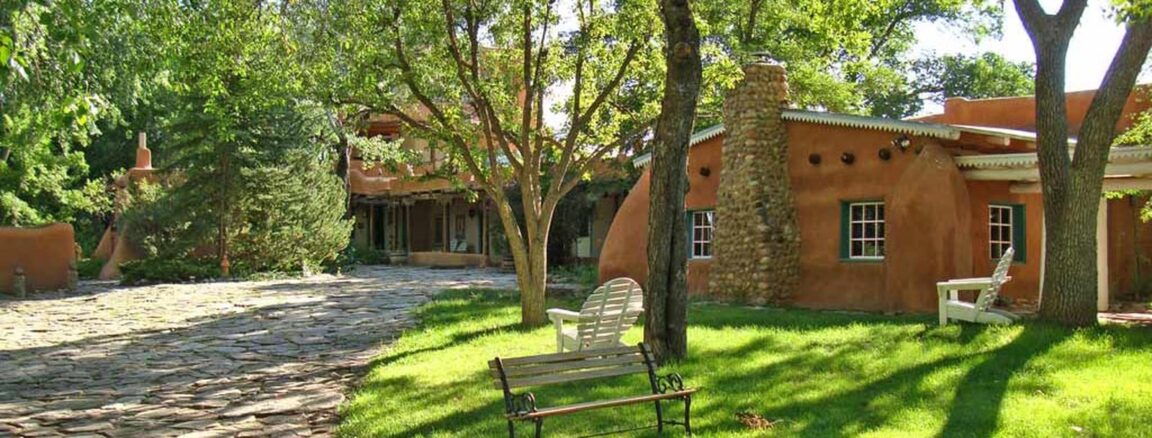
Featured image: The adobe courtyard of the Mabel Dodge Luhan House, Taos. Photo: Mabel Dodge Luhan House (mabeldodgeluhan.com), the property’s own official website, used with credit.