 Kwame Mensah
The Bernina Express is not a single ticket. It is two purchases that must both be right: an ordinary Rhaetian Railway fare for the route, plus a compulsory seat reservation supplement for the panoramic cars, and the supplement is the part that sells out. For the full Chur to Tirano run in second class, the fare is CHF 66 one way, and the reservation adds CHF 40 in low season or CHF 44 in high season, so the real price is CHF 106 to CHF 110 before any pass discount. Pass holders, including Swiss Travel Pass, GA, Eurail and Interrail, pay the supplement in full. Book the reservation first, choose your side for the Landwasser Viaduct with the direction logic below, and keep the regional trains in mind: they run the same line with opening windows and no compulsory supplement at all.
Quick Facts
- Route: Chur to Tirano, about four hours, 144 kilometres, 55 tunnels and 196 bridges, highest point Ospizio Bernina at 2,253 metres
- Fares, one way: Chur to Tirano CHF 66 second class, CHF 113 first class; St. Moritz to Tirano CHF 33 second class, CHF 57 first class
- Reservation supplement, per person each way: CHF 32 on St. Moritz to Tirano trains; CHF 40 low season and CHF 44 high season on Chur to Tirano trains; Bernina Express Bus Tirano to Lugano CHF 16 to CHF 18
- Children: Under 6 travel free and ages 6 to 16 pay half the fare, but the reservation supplement is paid in full for everyone
- Passes: Swiss Travel Pass, GA, Half Fare, Eurail and Interrail cover the fare where valid; none of them cover the supplement
- Regional alternative: Ordinary trains on the same line need no reservation; an optional seat reservation between St. Moritz and Tirano costs CHF 5, and their windows open
- Prices checked: 21 November 2026, against Rhaetian Railway (rhb.ch) published fares
Why does the reservation exist at all?
The Bernina Express runs in panoramic cars with tall, curved windows and an assigned seat for every passenger. Rhaetian Railway, RhB, controls that inventory through the supplement, which is priced by train rather than by distance. That last point catches people out: ride a long route Chur to Tirano train only between two nearby stations and you still pay the long route supplement for that train. The short route trains between St. Moritz and Tirano carry the CHF 32 supplement all year. The long route trains carry CHF 40 in the low season periods and CHF 44 in the high season period, which for the 2026 timetable ran from early May to late October. First and second class pay exactly the same supplement; what changes with class is the fare and the seat, not the reservation.
There is no walk-up fallback on a sold out departure. If the panoramic cars are full, your options are a different departure, the bus connection on another day, or the regional trains. In high summer the popular morning departures from Chur can fill weeks ahead, so treat the reservation as the first booking of the whole Swiss itinerary, made before hotels that depend on which day you cross the Alps.
Which side faces the Landwasser Viaduct?
The Landwasser Viaduct is the line’s signature structure: a curved limestone viaduct, 142 metres long and 65 metres high, that carries the Albula line straight into a tunnel in a vertical rock face near Filisur. Travelling south from Chur to Tirano, the viaduct view opens on the right hand side of the train as the line curves across the gorge; travelling north from Tirano to Chur, it opens on the left. Book a window seat on that side if the viaduct photograph matters to you, and be ready early, because the crossing itself takes seconds.
Two honest caveats. First, seat maps and the direction a given set of cars faces can vary, so no side advice is a guarantee; the panoramic windows wrap high enough that the gorge is visible from both sides in part. Second, the Bernina section south of St. Moritz arguably outdoes the viaduct anyway: the climb to Ospizio Bernina beside Lago Bianco, the descent past the Palu Glacier at Alp Grum, and the Brusio spiral viaduct, where the line loops over itself in the open air, all reward whichever window you get. Southbound, the right side also takes the best of the Brusio loop. If you can only optimise for one thing, optimise southbound and right.
Why do photographers prefer the regional trains?
Because glass is the enemy. The panoramic cars are comfortable, quiet and superb for watching, but their sealed, curved windows reflect cabins, screens and jackets straight back into photographs, and they do not open. The ordinary regional trains on the Bernina line run the identical route, stop at more stations, run more often, and have windows that open, which is why so many of the classic line side photographs are taken from them. In summer RhB also attaches open scenic carriages on parts of the route, the closest thing on rails to a convertible.
The trade is real, so weigh it honestly. Regional trains need no supplement and only an optional CHF 5 reservation on the St. Moritz to Tirano section, they let you break the journey at Alp Grum or Morteratsch without reservation anxiety, and a Swiss Travel Pass covers them completely. What you give up is the guaranteed reserved seat, the panoramic glazing, the onboard commentary and minibar service, and the through train: some regional combinations require a change, usually at Pontresina or St. Moritz. A hybrid plan suits many travellers: Bernina Express one way for the occasion, regional train back for the photographs and the stops.
How do passes and child fares really stack up?
Work an example. Two adults, no pass, Chur to Tirano in high season second class: two fares at CHF 66 plus two supplements at CHF 44 equals CHF 220 one way. The same two adults with valid Swiss Travel Passes pay only the supplements: CHF 88. A family should note the asymmetry in the rules: children aged 6 to 16 pay half fare and under 6s are free, yet every child who needs a seat in the panoramic car pays the full supplement, so a family of four on passes still pays four supplements. The Half Fare Card halves the fare portion only. None of this is hidden, but it is split across two lines of the booking flow, which is why the headline price so often surprises people at checkout.
The Bernina Express Bus between Tirano and Lugano follows the same logic with its own mandatory reservation, CHF 16 in low season and CHF 18 in high season, on top of the bus fare or pass coverage. If your plan is the full glacier to palm trees to Lugano arc in one day, reserve both legs in the same sitting.
When should you book, and what can go wrong?
Book as early as the reservation system allows for travel between May and October, on weekends, and on the first southbound departure of the day, which photographers favour for the light. Shoulder season weekdays are far more forgiving. Keep three failure modes in mind. Engineering work can reroute or bustitute sections of the Albula line in the quieter months, and RhB publishes these changes on the Bernina Express page, so recheck your departure the week before. A missed connection into Chur does not move your reservation to the next train; the supplement is tied to the train you booked. And in winter, the journey is at its most dramatic but daylight is short, so the Tirano end of a late departure runs in the dark.
For more rail booking reality checks, read our guide to the Nightjet network in 2026 and our explainer on train luggage rules in Spain.
Frequently Asked Questions
Do I need both a ticket and a reservation for the Bernina Express?
Yes. You need a valid fare for the route plus the compulsory seat reservation supplement for the panoramic cars. A pass can cover the fare, but the supplement, CHF 32 to CHF 44 per person each way, is always paid in full.
Which side of the train is best for the Landwasser Viaduct?
Southbound from Chur to Tirano, sit on the right for the viaduct view; northbound from Tirano, sit on the left. Seat orientation can vary by set, so treat this as a strong probability, not a promise.
Are regional trains on the Bernina line worse?
No. They run the same route with more departures and more stops, need no compulsory reservation, and their windows open, which photographers prefer. You give up the panoramic glazing, reserved seat and onboard services of the Bernina Express cars.
How much is the full Chur to Tirano trip without a pass?
In second class, CHF 66 fare plus CHF 40 low season or CHF 44 high season reservation, so CHF 106 to CHF 110 one way. First class is CHF 113 plus the same supplement.
Do children pay the reservation supplement?
Yes, in full. Children under 6 travel free on the fare and ages 6 to 16 pay half fare, but RhB states the seat reservation supplement must be paid in full for everyone.
Can I break the journey at Alp Grum or St. Moritz?
On regional trains, easily. On the Bernina Express, your reservation is for a specific train and seat, so hopping off means a new reservation for the next panoramic departure; plan stops into the regional legs instead.
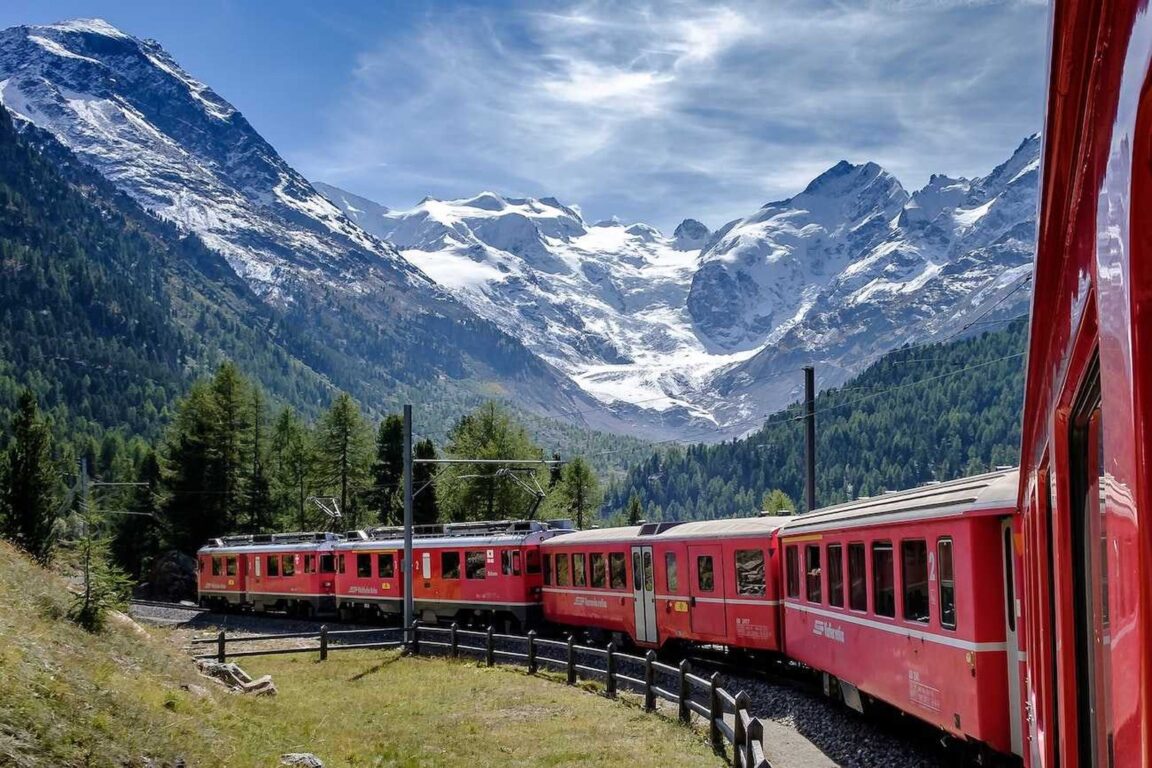
Featured image: A red Rhaetian Railway train on the Bernina line below the Morteratsch Glacier. Photo: Andreas Stutz, via Unsplash, Unsplash License, used with credit.