 Maya Chen
Order a Penang hawker day by the clock, not by appetite: roti canai at a George Town kopitiam for breakfast, the bus ride out to Air Itam for assam laksa below Kek Lok Si late in the morning, a rest through the afternoon heat, then New Lane, called Lorong Baru, as the stalls set up from late afternoon for char kway teow eaten standing in the evening crowd. That order matters because each dish belongs to a different hour and a different part of town. The laksa stall country is a morning market suburb, New Lane only exists as a hawker street after about 4 p.m., and a charcoal wok needs a queue of hungry people before it reaches full heat. Eat in that sequence and one day covers the canon; eat at random and the best stalls are either closed, sold out or not yet open.
Quick Facts
- Base: George Town, Penang, Malaysia, the UNESCO listed heritage core on the northeast of Penang Island
- The canon: Char koay teow, assam laksa, Hokkien mee, curry mee, pasembor, char koay kak, oh chien and cendol, the signature list named by Penang Global Tourism on its official food pages
- Hawker districts: Gurney Drive, New Lane, Chulia Street, Air Itam and Pulau Tikus, per Penang Global Tourism (mypenang.gov.my), checked November 21, 2026
- Breakfast: Roti canai and teh tarik at a mamak stall or kopitiam in the heritage core
- The bus ride dish: Assam laksa at Air Itam, below Kek Lok Si Temple, a morning and lunch dish
- Evening anchor: New Lane (Lorong Baru), off Macalister Road, where hawker stalls open from late afternoon into the evening
- Money rule: Carry small ringgit notes; many hawker stalls remain cash based and small change speeds every order
- Sources checked: November 21, 2026, against Penang Global Tourism official pages
Why does breakfast belong to roti canai?
Because Penang wakes up in kopitiams, and roti canai is the breakfast the day is built around. The flatbread is stretched, folded and griddled to order at Indian Muslim mamak stalls across George Town, served with dhal or curry for tearing and dipping, usually beside a glass of teh tarik, pulled tea. It is light enough to leave room for everything that follows, fast enough to eat before the morning gets hot, and social in the right Penang way: marble topped tables, shared space, orders shouted across the room. Penang Global Tourism, the state tourism authority, describes the pattern on its official Penang food pages: early morning coffee shops serving freshly made noodles and traditional breakfasts, hawker centres busy well into the night, and generations of hawkers preparing time honoured dishes with recipes passed down through families. Start inside that rhythm rather than at a hotel buffet and the whole day reads correctly.
Keep breakfast deliberately small. The temptation in George Town is to order three dishes at the first kopitiam, because the neighbouring tables will be doing exactly that, but the day ahead holds a laksa, a cendol and a wok fried dinner. One roti, one tea, and a short walk through the heritage streets while the shophouses are still cool is the disciplined opening. Travellers who have already worked through the Nyonya side of the city can compare notes with our George Town Nyonya food guide, which covers the kuih and clan jetty snacks that sit beside the hawker canon rather than inside it.
Which laksa is worth the bus ride to Air Itam?
The assam laksa at Air Itam, and it is not close. Penang assam laksa is a sour, spicy noodle soup built on a tamarind sharp fish broth, typically mackerel, poured over thick rice noodles and finished with pineapple, mint, cucumber, onion and torch ginger, with a spoon of prawn paste for those who want the fuller flavour. Penang Global Tourism’s own street food material calls it world famous and records that CNN Travel ranked Penang assam laksa number 7 in its World’s 50 Best Foods list. The Air Itam version, sold around the market at the foot of the Kek Lok Si Temple hill, is the bowl Penang argues about most and agrees on most: sharper, fishier and less forgiving than the George Town versions, eaten in a neighbourhood that is cooking for itself first and visitors second.
The logistics reward a late morning departure. Ride out from George Town after breakfast, allowing roughly half an hour for the trip across town to Air Itam, eat the laksa as a late morning or early lunch bowl, and pair it with the temple above: Kek Lok Si, the vast Buddhist temple complex on the hillside, is the natural second half of the excursion, and the market streets below it hold curry mee and other morning dishes for anyone travelling with a laksa sceptic. The official Penang street food trail published by Penang Global Tourism builds its first day the same way, starting with curry mee at Air Itam in the morning, which underlines the point: Air Itam is a morning suburb, not an evening destination. Go early, eat first, climb second, and be back in George Town before the afternoon rain hour.
What should fill the middle of the day?
Very little, on purpose. The hours between lunch and the New Lane set up are Penang’s hottest and its hawker scene’s quietest, because many specialist stalls rest, prep or simply close between services. Use the gap the way locals use it: cendol from a famous Penang Road stall as a cold, sweet pause, shaved ice, green rice flour jellies, red beans, coconut milk and palm sugar, then retreat to shade, a museum, a clan house or a nap. George Town’s heritage core, inscribed with Melaka on the UNESCO World Heritage List in 2008, rewards slow afternoon walking once the sun drops, and the street art lanes around Armenian Street are at their most pleasant in the last hour before the food streets reopen.
One midday exception is worth knowing. Nasi kandar, the Indian Muslim rice and curry institution born in Penang, runs on its own clock and serves through the day at long established restaurants such as Hameediyah on Lebuh Campbell, which the official street food trail lists at 10 a.m. to 10 p.m. A traveller who wants one substantial sit down meal in the middle of the day should make it nasi kandar, ordered banjir style with the curries flooded over the rice, and then treat the evening as a grazing exercise rather than a second dinner.
Why is New Lane the right place for char kway teow?
Because New Lane at night is Penang hawker eating in its purest street form, and char kway teow is its headline act. Lorong Baru, a small road just off Macalister Road a short distance from Penang Road, fills from late afternoon with stalls along both sides, tables inside the coffee shops and along the roadside, and a crowd that mixes neighbourhood regulars with visitors who have done their homework. The Penang Global Tourism listing for the New Lane Food Corner notes that stalls here generally open only from late afternoon or in the evenings, and that the lane covers many of Penang’s authentic hawker dishes in one short street: Hokkien mee, char kway teow, laksa, porridge, kway teow soup, fried oysters and tong sui desserts. That density is the argument. At New Lane the char kway teow is not a pilgrimage to one famous wok; it is one plate inside a full evening market, which is how the dish is actually eaten in Penang.
The dish itself deserves a plain description. Flat rice noodles are stir fried over very high heat with chilli, soy, prawns, cockles, bean sprouts, Chinese chives and egg, and the best versions carry wok hei, the smoky breath of a properly hot wok, with edges of noodle just charred. Order it once at New Lane, then use the lane’s depth properly: a bowl of Hokkien mee, Penang’s prawn noodle soup, an oh chien oyster omelette to share, and a tong sui to finish. Travellers continuing south can set this night against the hawker mornings in our 2 days in Singapore itinerary, where the hawker centre, rather than the street lane, is the organising form, or against the capital run in our 3 days in Kuala Lumpur itinerary.
How should a second day be ordered?
By district rather than by dish. Give the second morning to Pulau Tikus, the neighbourhood market district Penang Global Tourism names among the island’s food spots, for a market breakfast of curry mee or kway teow soup, then cross back to the heritage core for the Peranakan table at lunch: Nyonya dishes, assam prawns, curry kapitan and kuih from a canteen such as Moh Teng Pheow, which the official trail lists at 10 a.m. to 5 p.m. daily off Lebuh Chulia. Finish at Gurney Drive in the evening, the famous seafront hawker strip, for pasembor, rojak and a second, different char kway teow eaten facing the water. The principle across both days is the one Penang Global Tourism states outright: many hawkers specialise in a single dish perfected over generations, so the traveller’s job is sequencing, not searching. The dishes are already perfected; only the order is yours to get wrong.
Frequently Asked Questions
What is the difference between char kway teow and char koay teow?
Nothing but spelling. Koay teow and kway teow are two romanisations of the same flat rice noodle, and char means fried. Penang Global Tourism uses char koay teow on its official pages; menus in George Town use both. The dish is flat rice noodles wok fried with prawns, cockles, bean sprouts, chives, egg, chilli and soy.
Is Penang assam laksa the same as curry laksa?
No. Penang assam laksa has no coconut milk. It is a sour, tamarind based fish broth with thick rice noodles, pineapple, mint and herbs, sharp and refreshing rather than rich. Curry laksa and Sarawak laksa are different dishes from different places, and ordering assam laksa expecting coconut curry is the classic first timer surprise.
When does New Lane open?
The stalls along New Lane, Lorong Baru, generally open from late afternoon into the evening, per the Penang Global Tourism listing for the New Lane Food Corner. Arrive from about 5 p.m. for the full lane in operation, eat char kway teow and Hokkien mee there, and expect the street to be busiest in the first half of the evening.
How do I get to Air Itam from George Town?
By city bus or ride hailing car across town, allowing roughly half an hour depending on traffic. Air Itam is the suburb below Kek Lok Si Temple and Penang Hill. Go in the morning, when the market and the laksa stalls are in full service, and combine the laksa with the temple visit above the market.
Do Penang hawker stalls take cards?
Many still work in cash, especially older single dish stalls, so carry small ringgit notes and coins. Kopitiam drink orders are usually paid separately from food stall orders, and it is normal to order a drink from the house when you sit at its tables to eat a stall’s food.
What should a vegetarian eat on this route?
More than in most hawker cities. Penang Global Tourism notes vegetarian versions of char koay teow and assam laksa, meatless nasi lemak and Indian vegetarian thali sets across the island, and the scene grows further during the Nine Emperor Gods Festival, when yellow flagged vegan stalls appear across Penang. Roti canai with dhal is the easy breakfast answer on this exact route.
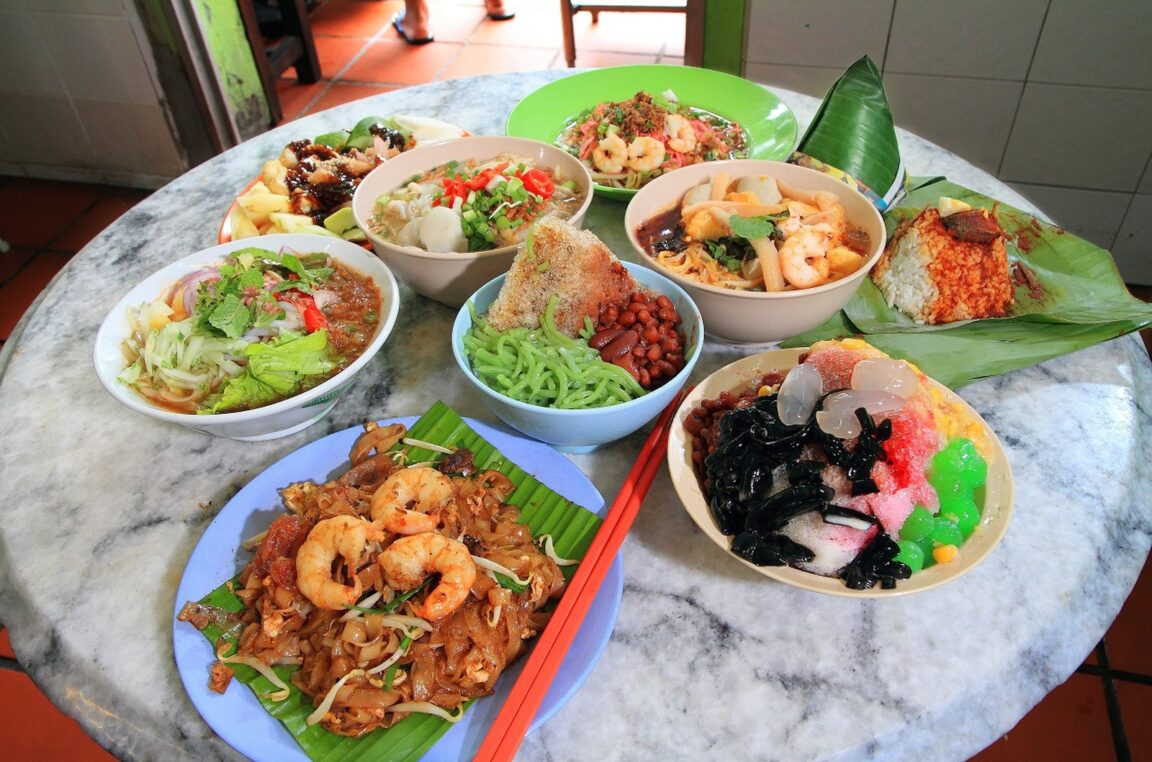
Featured image: A Penang hawker spread on a marble kopitiam table: char kway teow with prawns on a banana leaf in the foreground, assam laksa, cendol, ais kacang and nasi lemak around it. Photo from Penang Global Tourism, the official Penang tourism authority (mypenang.gov.my), used with credit.