 LeVar Thomas
Tombstone is worth far more than its thirty famous seconds: the gunfight near the O.K. Corral on October 26, 1881 lasted about half a minute, but the silver town around it left a Bird Cage Theatre that was never remodelled, a courthouse that now explains the mining law behind the violence, and a rose tree planted in 1885 that still covers a museum patio each spring. Planned in that order, Tombstone stops being a photo stop on Allen Street and becomes what it actually is, the best preserved argument in Arizona for how a boomtown worked. The town sits in Cochise County, roughly 70 miles southeast of Tucson, and most of its sights stand within a few walkable blocks.
Quick Facts
- Founded: 1879, after prospector Ed Schieffelin’s silver claims in the Tombstone hills
- The gunfight: October 26, 1881, in a lot on Fremont Street near the O.K. Corral, lasting about 30 seconds
- Bird Cage Theatre: Opened December 1881 at 517 East Allen Street; theatre, saloon, gambling hall and brothel in one building
- Courthouse: The 1882 Cochise County Courthouse, now Tombstone Courthouse State Historic Park and museum
- Rose Tree: A Lady Banksia rose planted in 1885, recognised as the world’s largest rose tree, at the Rose Tree Museum on South 4th Street
- Boothill: The town’s first cemetery, in use from 1878 to 1884, on the northwest edge of town
- Facts checked: November 23, 2026, against azstateparks.com, tombstonebirdcage.com and tombstonerosetree.com
Why does the Bird Cage Theatre matter more than the gunfight?
Because the gunfight site is an empty lot with a story, while the Bird Cage is the story’s surviving room. Opened in December 1881, the Bird Cage combined a theatre, saloon, gambling hall and brothel under one roof at the east end of Allen Street, taking its name from the curtained balcony boxes, the bird cages, that overlook the stage. Its own history counts more than 140 bullet holes in the building and a poker game in the basement that local tradition describes as running continuously for years. The decisive fact for a visitor is what did not happen afterwards: when Tombstone’s silver economy collapsed, nobody had the money to modernise the Bird Cage, so its stage, boxes, fixtures and gambling artefacts survived in place rather than being stripped or rebuilt. It operates today as a museum with self guided daytime visits and separate evening ghost tours. Go in the morning, before Allen Street fills, and give it the unhurried half hour its density of detail rewards.
What does the courthouse museum explain that Allen Street does not?
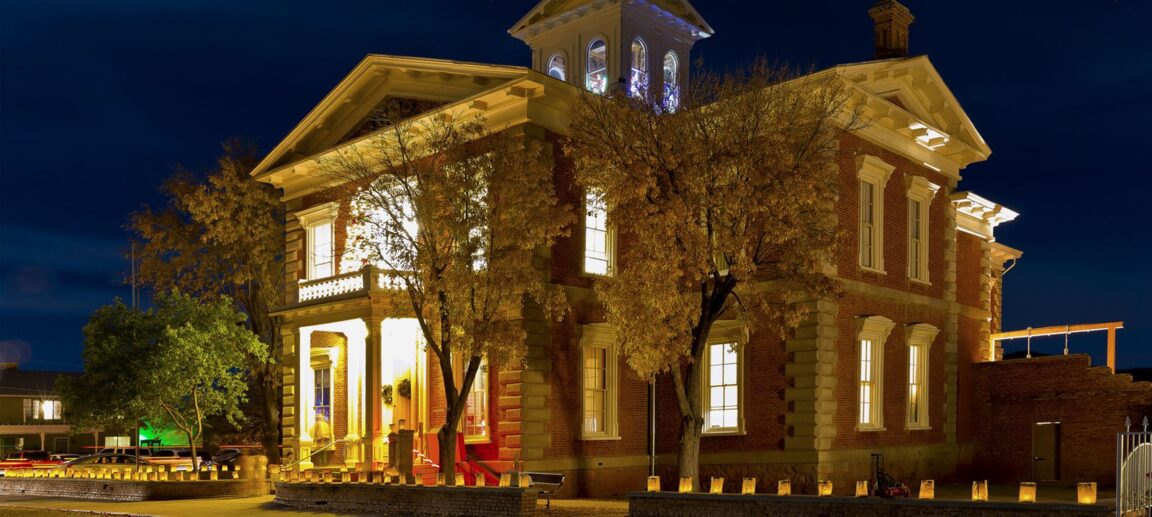
Tombstone Courthouse State Historic Park, in the red brick 1882 county courthouse on Toughnut Street, is where the town’s violence gets its paperwork. The museum’s exhibits cover the mining claims, claim disputes and county law enforcement that made confrontations like the Earp and Clanton fight likely rather than accidental, along with the everyday machinery of a county seat: courtrooms, a sheriff’s office, a jail and a reproduction gallows in the courtyard. Arizona State Parks runs the site, and it is the one stop in town that treats Tombstone as a functioning legal and mining community instead of a film set. Travellers who visit the courthouse first will find the rest of the town reads differently afterwards; the saloons and theatres become businesses operating inside a contested legal order, which is precisely what they were. Allow an hour, and note the building itself, a handsome Victorian courthouse that would be the landmark of most towns its size. Travellers continuing into southern Arizona desert country can pair the trip with our guide to Saguaro National Park’s two districts outside Tucson.
How does a rose tree become a headline sight?
One block south of Allen Street, the Rose Tree Museum at 118 South 4th Street is built around a single plant: a Lady Banksia rose sent from Scotland and planted in 1885 beside a boarding house, now grown over a purpose built trellis across the museum’s patio. The tree is recognised in the Guinness records tradition as the world’s largest rose tree, covering several thousand square feet, and Robert Ripley featured it in his Believe It or Not column in 1937 when it was a fraction of its present size. The Macia family, who bought the property in the 1920s, built the trellis system that lets one trunk carry a patio wide canopy. Timing decides the experience: the tree blooms in spring, usually around April, when the town holds its Rose Tree Festival and the patio sits under white blossom. Outside bloom season the museum’s family history exhibits carry the visit, and the tree reads as green architecture rather than spectacle, still remarkable for its trunk and span.
What else fills a full day in Tombstone?
Start at Boothill Graveyard, the town cemetery from 1878 to 1884, where the graves of the gunfight’s dead, Billy Clanton and the McLaury brothers among them, sit alongside miners, homicide victims and the plain unlucky, many under markers whose wording is part of the town’s folklore. Walk Allen Street’s boardwalks in the middle of the day, taking in the Crystal Palace Saloon, rebuilt after the 1882 fire, and the Tombstone Epitaph office, the newspaper founded in 1880 that reported the gunfight and still publishes. Schieffelin Hall, the 1881 adobe theatre and meeting hall at Fremont and 4th, and St Paul’s Episcopal Church, built in 1882, round out the civic town behind the saloon strip. The O.K. Corral site itself, with its historic exhibits and reenactments, is best visited last, once the courthouse and Bird Cage have given its thirty seconds their context. Stagecoach rides along Allen Street run through the day for travellers who want the town at horse pace.
How should a traveller sequence Tombstone?
Arrive early enough to do the Bird Cage and the courthouse before the day tour crowds, eat on Allen Street, and keep Boothill for the late light, when the desert hills behind the graves take colour. Tombstone works as a long day trip from Tucson, but an overnight changes it: the town empties in the evening, Allen Street’s lamps come on, and the ghost tours at the Bird Cage and elsewhere run a second, quieter Tombstone that day visitors never see. Spring is the strategic season, combining mild desert weather with the rose tree in bloom. Summer visitors should plan indoor sights for the afternoon heat, even at Tombstone’s elevation of about 4,500 feet. For a second desert base on the same Arizona and West Texas arc, see our guide to Terlingua, the Big Bend gateway town.
Frequently Asked Questions
Where did the Gunfight at the O.K. Corral actually happen?
In a vacant lot on Fremont Street, a short distance from the O.K. Corral’s rear entrance, on October 26, 1881. The fight lasted about 30 seconds and left Billy Clanton and Tom and Frank McLaury dead.
Why is the Bird Cage Theatre so well preserved?
When Tombstone’s silver boom collapsed in the late 1880s, the building closed and was never remodelled, so its stage, curtained balcony boxes, fixtures and more than 140 bullet holes survived in place. It is now a museum.
When does the Tombstone rose tree bloom?
In spring, usually around April, when the Rose Tree Festival is held. The Lady Banksia rose was planted in 1885 from a Scottish cutting and is recognised as the world’s largest rose tree.
How long do you need in Tombstone?
A full day covers the Bird Cage, the courthouse museum, the Rose Tree Museum, Boothill and Allen Street without rushing. An overnight adds the evening ghost tours and a quieter town.
What is Tombstone Courthouse State Historic Park?
The 1882 Cochise County Courthouse, operated by Arizona State Parks as a museum of Tombstone’s mining, legal and everyday history, with courtrooms, a jail and a reproduction gallows.
Image: Tombstone Courthouse, the 1882 red brick Cochise County Courthouse, lit at night with luminarias along its walls and the courtyard gallows frame at right. Photo: Arizona State Parks, via azstateparks.com, the park’s official website, used with credit.