 River Callahan
Everyone who hikes past Scout Lookout to the summit of Angels Landing in Zion National Park needs a permit, and every permit comes from one of two lotteries on Recreation.gov: a seasonal lottery that runs a season ahead, and a day-before lottery that opens at 12:01 a.m. and closes at 3 p.m. Mountain Time on the day before you want to hike. There is no walk-up permit, no same-day permit and no permit sold anywhere in the park. The permit covers only the chained half mile from Scout Lookout to the summit. The climb to Scout Lookout itself, 2.25 miles from the Grotto trailhead, needs no permit at all, which means a lost lottery does not have to mean a lost day.
Quick Facts
- Who needs one: every hiker continuing past Scout Lookout onto the chains section to Angels Landing, every day of the year, at any hour.
- Where permits come from: Recreation.gov only, through the seasonal lottery or the day-before lottery. Nothing is issued in the park.
- Cost: a non-refundable $6 application fee covers up to six people including the applicant. If your application is drawn, a $3 per person permit fee is charged. Park entry is separate.
- Seasonal lottery rhythm: applications run from the 1st to the 20th of January, April, July and October, with permits issued on the 25th of the application month.
- Day-before lottery rhythm: apply between 12:01 a.m. and 3 p.m. Mountain Time the day before your hike. Results are emailed after 4 p.m. that day.
- The hike: 5.4 miles round trip with 1,488 feet of elevation gain. Most hikers take about four hours. Your permit start time is measured at the Grotto, shuttle stop 6.
- Checks: rangers may ask to see your permit and identification at any point on the trail, at any time of day or night.
What exactly does the permit allow?
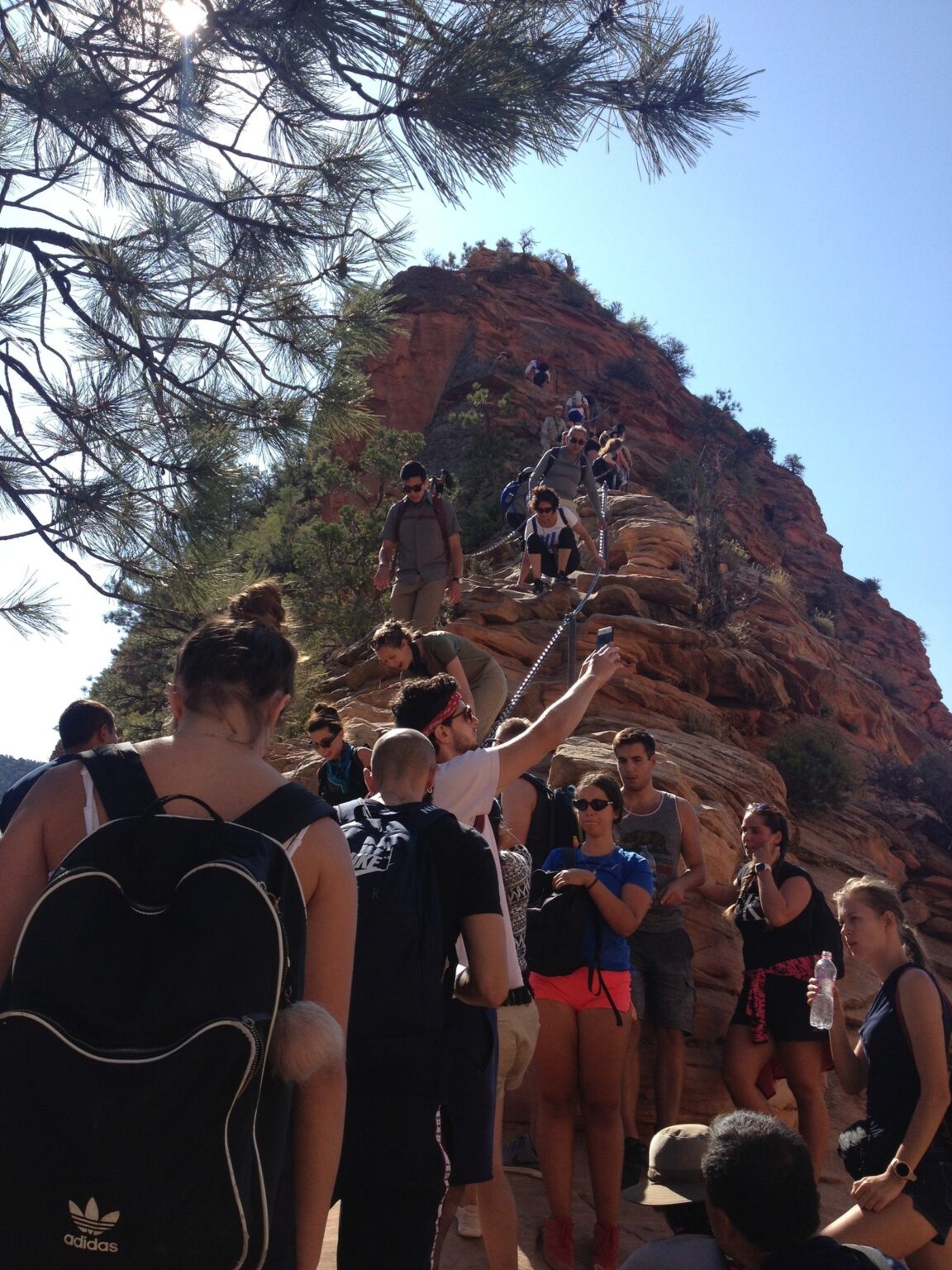
The permit allows one thing: passage along the chained section of the West Rim Trail from Scout Lookout to the Angels Landing summit, on the date and in the start window named on the permit. That section is roughly half a mile of narrow sandstone fin with chains bolted into the rock for handholds and drops on both sides. Everything before it is open to anyone. From the Grotto, the West Rim Trail climbs through Refrigerator Canyon and up Walter’s Wiggles, a tight stack of 21 switchbacks, to Scout Lookout at about 2.25 miles. Scout Lookout has the canyon views, a restroom and a decision point. Without a permit, it is also your turnaround.
The permit does not reserve anything else. It does not include park entry, it does not guarantee a shuttle seat at a particular time, and it does not give priority on the chains themselves, where hikers moving up and down share the same line and take turns at the narrowest points. The start time printed on the permit is the time you should be at the Grotto, not at Scout Lookout, so build the shuttle ride and the climb into your morning accordingly. Print the permit confirmation or download it before you start, because most of Zion Canyon has no mobile signal and a ranger can ask for it anywhere on the route.
How does the seasonal lottery work?
The seasonal lottery is the plan-ahead route, run four times a year, once for each hiking season. Applications open on the 1st and close on the 20th of January for spring hikes from March 1 to May 31, of April for summer hikes from June 1 to August 31, of July for fall hikes from September 1 to November 30, and of October for winter hikes from December 1 to the end of February. Permits are issued on the 25th of the application month, which leaves weeks or months to arrange lodging, shuttles and the rest of a Zion trip around a confirmed date.
On the application you rank up to seven preferred dates and start times. Ranking more choices, and including weekday dates, materially improves your chances, because demand concentrates on weekends and on the shoulder season months of spring and fall. Each application costs $6, is not refundable, and covers up to six people including the person applying. If your application is drawn, the $3 per person permit fee is charged and the permit arrives by email. The permit is tied to the applicant, so the applicant must be on the hike.
How does the day-before lottery work?
The day-before lottery is the second chance, and it is a substantial one: the Park Service holds back a large share of permits for it rather than releasing everything in the seasonal draw. It opens every day at 12:01 a.m. Mountain Time and closes at 3 p.m. the same day, for hikes the following day. Results are emailed after 4 p.m., so by late afternoon you know whether tomorrow is a summit day or a Scout Lookout day. Applying at 12:01 a.m. gives no advantage over applying at noon; every application inside the window has the same odds.
The same pricing applies: $6 per application for up to six people, plus $3 per person if drawn. Each day is a separate application, so a three-day trip gives you three independent attempts, at $6 each. The practical routine for a Springdale base is simple: apply in the morning for the next day, plan a flexible afternoon, and let the 4 p.m. email decide tomorrow’s start time. If you are building a wider Utah itinerary, our guide to where to stay for Joshua Tree’s two entrances shows the same gateway-town logic applied to another desert park, and our Las Vegas day trips guide covers the desert parks most often paired with a Zion run.
What are your real chances in each lottery?
The Park Service published a two-year review of the program, and its central finding is that odds swing enormously with the calendar. Across both lotteries, roughly half of applications succeeded on average, but the range ran from under 10 percent on the busiest holiday weekends to near certainty on quiet midweek days in winter. In other words, the lottery is less a wall than a filter on timing. A Tuesday in February is a fundamentally different draw from the Sunday of Memorial Day weekend. If your dates are flexible, flexibility is the single strongest strategy you have. If they are not, enter the seasonal lottery for every ranked choice you would genuinely use, then work the day-before lottery on each day of the trip.
What should you do if you do not get a permit?
First, hike to Scout Lookout anyway. The West Rim Trail climb is strenuous, scenic and permit-free, and the lookout delivers the full Zion Canyon panorama with the fin of Angels Landing in front of you. Many hikers rate it among the best viewpoints in the park. Second, keep applying: a permit for a later day of the trip may still come through, and plans change as weather and energy levels do. Third, fill the day from Zion’s deep bench of non-permit hikes, including the Narrows bottom-up route from the Temple of Sinawava (subject to flow conditions), the Canyon Overlook Trail near the tunnel, and the Watchman Trail from the visitor center. A lost lottery costs you half a mile of trail, not the park.
Frequently Asked Questions
Do I need a permit to hike to Scout Lookout?
No. The permit requirement starts at Scout Lookout. Anyone may hike the West Rim Trail from the Grotto to Scout Lookout, 2.25 miles each way with about 1,000 feet of climbing, without any permit.
Can I get an Angels Landing permit on the day of my hike?
No. There are no same-day or walk-up permits. The last chance for a given day is the day-before lottery, which closes at 3 p.m. Mountain Time the previous day.
How much does it cost to enter the lottery?
Each application costs a non-refundable $6 and covers up to six people including the applicant. If drawn, you pay an additional $3 per person for the permit itself. Park entrance fees are separate.
How many dates can I rank in the seasonal lottery?
Up to seven dates and start times, ranked in order of preference. Adding more genuine choices, especially weekdays, improves your chances.
What happens if a ranger asks for my permit?
Show the printed or downloaded permit confirmation together with identification. Rangers may check at the Grotto, at Scout Lookout or anywhere along the trail, at any hour, so carry it for the whole hike rather than leaving it in the car.
Can I transfer my permit to someone else?
No. The permit is issued to the applicant named on it, and that person must be present on the hike. Apply under the name of someone who will definitely be in the group.