 Aiko Tanaka
Banska Stiavnica is a silver and gold mining town folded into the caldera of an old volcano in central Slovakia, and it sequences best around its mining bones. Day one belongs to the town itself: Holy Trinity Square and its plague column, the Old Castle and the white New Castle facing each other across the rooftops, and the Kammerhof mining museum. Day two goes underground at the Open Air Mining Museum, climbs the Baroque Calvary chapel by chapel, and finishes at a tajch, one of the reservoir lakes the miners built to power their machines, where the swimming now happens. Two days is the working minimum; three lets the lakes breathe.
Quick Facts
- Where: Banska Stiavnica, central Slovakia, about two hours by road from Bratislava, set in the Stiavnica Mountains inside an ancient volcanic caldera.
- Status: the historic town and the technical monuments around it have been a UNESCO World Heritage Site since 1993.
- The castles: current listings price the Old Castle at 8 euros for adults and the New Castle at 5 euros; both are run by the Slovak Mining Museum. Confirm live prices at muzeumbs.sk.
- Underground: the Open Air Mining Museum runs guided mine tours with helmet, cape and lamp; current listings price adult entry at 14 euros, with tours at set times, typically 9:00, 12:00 and 15:00 in season.
- The Calvary: a Baroque complex of chapels and churches climbing Scharffenberg hill, free to walk, with the best view over the town from the upper church.
- The tajchy: around sixty artificial mining reservoirs were built in the hills; about two dozen survive, and lakes such as Pocuvadlo and Richnava are the summer swimming spots.
- First of its kind: the town’s Mining Academy, founded in 1762, was the world’s first mining academy, a measure of how technically serious this small town was.
How do the two castles divide the town’s story?
The Old Castle began as the parish church: a Romanesque basilica that the town walled and fortified in the sixteenth century as Ottoman forces pressed into Hungary, turning a church into a fortress with the town’s archive and treasury inside. The New Castle, built in the same defensive century on the hill opposite, is a different instrument: a stark white Renaissance watchtower and signal post, now a museum of the long defence against the Ottomans. Standing in either courtyard, you can see the other, and between them the whole grammar of the town, mines below, wealth in the middle, watchfulness on both rims.
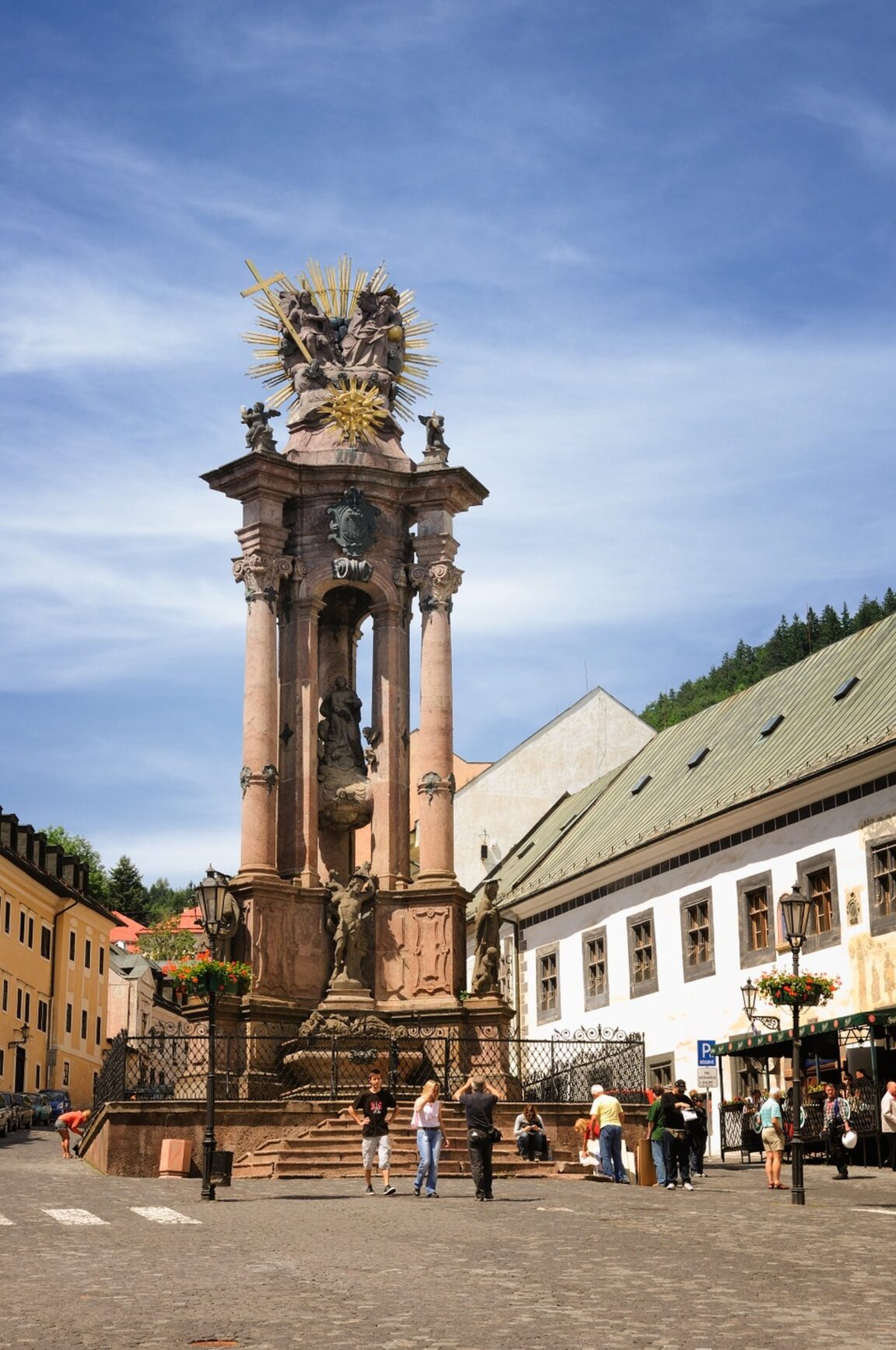
Between the castles, Holy Trinity Square slopes through the centre, lined with the burgher houses of mining families and officials, the town hall with its clock tower, and the Baroque Holy Trinity plague column, raised in thanks after the plague years of 1710 and 1711 and described by the regional tourist board as the tallest plague column in Slovakia. This is the town’s living room: the information centre sits on the square at Namestie sv. Trojice 1, and most walking routes, including the one in this guide, start from it.
What does the mining museum actually show you?
Two institutions carry the underground story. In town, the Kammerhof, the former seat of the mining chamber that administered the royal mines, holds the Slovak Mining Museum’s main exhibition: the geology, the technology and the administration of an industry that made this one of the richest towns in the Kingdom of Hungary. A short walk away, the Glanzenberg adit offers a shorter underground taste right in the centre on its scheduled days.
The full experience is the Open Air Mining Museum, about a kilometre from the centre in the valley below the Klinger tajch. After the surface exhibition of machinery and the geological park, the guided tour issues a helmet, cape and lamp and takes you down into the Bartolomej mine’s galleries, where the passages were worked from the Middle Ages into the twentieth century. It is cold underground all year, so the jacket advice applies in August too. Towns that turn an extractive past into their present tense are a recurring pattern in our coverage, from the sake and merchant streets of Takayama in the Japanese Alps to the silver streets of Tombstone, Arizona, but few let you walk the actual workings as directly as this one.
Why climb the Calvary?
Because it is the town’s second skyline and its best viewpoint. The Calvary, built in the mid eighteenth century on Scharffenberg hill east of the centre, strings a series of Baroque chapels and two churches up a volcanic slope, a pilgrimage route in miniature. The climb is steady rather than hard, the chapels pace it, and the upper church repays the effort with the complete diagram of the town below: both castles, the square, the church towers and the wooded caldera rim holding it all. The complex fell into long decay in the twentieth century and has been under careful restoration since; it is free to enter and walk, and late afternoon is its best light.
What were the tajchy, and which ones do you swim in?
The tajchy are the engineering that made deep mining possible here. With no large river in the caldera, eighteenth century engineers, Samuel Mikoviny prominent among them, built a system of reservoirs, channels and ditches in the hills to catch rain and snowmelt and deliver water power to the pumps and stamping mills of the mines. Around sixty reservoirs were built and roughly two dozen survive, now ringed by forest and used for exactly what reservoirs invite in summer: swimming, fishing and walking.
Pocuvadlo, the largest, south of the town, is the classic first tajch, with beaches, boats and guesthouses. Richnava and the smaller lakes toward Stiavnicke Bane suit a quieter half day. Treat them as what they are, deep, cold mountain reservoirs with steep banks in places: swim at the recognised spots, respect the water temperature even in July, and let the tajch afternoon follow the underground morning, which is the rhythm the town itself suggests.
How should two or three days be ordered?
Day one: Trinity Square, the town hall and Kammerhof in the morning, the Old Castle after lunch, and the New Castle toward evening for the view back. Day two: the Open Air Mining Museum on its first tour of the day, the Calvary climb in the afternoon, and dinner back on the square. Day three, if you have it: a tajch morning at Pocuvadlo, the botanical garden’s old mining academy grounds, and the lanes you skipped. Note the weekly rhythm before you fix dates: most of the town’s museums close on Mondays and reduce days in winter, so a Tuesday to Thursday or weekend visit keeps every door open. The Salamander Days festival in early September, with its torchlit miners’ parade, is the town’s great annual exception to its usual quiet.
Frequently Asked Questions
How do I get to Banska Stiavnica?
The town is about two hours by road from Bratislava, and most visitors drive or take a bus or train and bus combination via Zvolen. Having a car also unlocks the tajchy, which are spread through the hills beyond walking range of the centre.
How much do the main sights cost?
Current listings price the Old Castle at 8 euros and the New Castle at 5 euros for adults, and the Open Air Mining Museum at 14 euros, while the Calvary and the tajchy are free to walk and swim. Prices and opening days change by season, so verify them with the Slovak Mining Museum and the regional tourist board before you go.
Is the mine tour suitable for children?
The Open Air Mining Museum’s underground tour is a family staple and is generally offered to children from about four years old, with helmets and lamps provided. The passages involve steps and low sections, and it is cold underground, so bring a warm layer for everyone.
When is the best time to visit?
Late spring to early autumn, when the museums run full schedules and the tajchy are swimmable. September adds the Salamander Days festival. Winter is atmospheric and quiet, but museum days shrink and the lakes turn to ice.
How many tajchy are there?
Around sixty reservoirs were built in the eighteenth century water system and about two dozen survive today. Pocuvadlo is the largest and the usual first swim; Richnava and the Stiavnicke Bane lakes are quieter alternatives.
Image: The Baroque Holy Trinity plague column on Holy Trinity Square in Banska Stiavnica, the tallest plague column in Slovakia. Photo via Region Banska Stiavnica, the regional tourist board’s official website (banskastiavnica.travel), used with credit.