 Elena Vasquez
Basler Fasnacht is not a carnival that visitors watch in the usual way, and it does not run on carnival time. While the rest of Europe finishes before Lent, Basel waits, then starts its Fasnacht on the Monday after Ash Wednesday at 4am, in total darkness, when the old town’s lights are switched off and thousands of masked pipers and drummers step out behind painted, glowing lanterns at the command “Morgestraich, vorwärts, marsch”. From that moment the festival runs for exactly 72 hours, through two great afternoon parades, a children’s afternoon, a night of brass bands and evenings of satirical song, until the final march at 4am on Thursday. The next edition opens on Monday 15 February 2027. It is Switzerland’s largest carnival, inscribed by UNESCO on the Representative List of the Intangible Cultural Heritage of Humanity, and it rewards visitors who learn its rules: buy the badge, keep the flash off, wear no costume of your own, and be standing in the dark before four.
Quick Facts
- When: From 4am on the Monday after Ash Wednesday for exactly 72 hours; the next Morgestraich is Monday 15 February 2027, ending at 4am on Thursday 18 February 2027.
- Where: Basel’s old town on both banks of the Rhine, with the busiest Morgestraich streets around Barfüsserplatz, Marktplatz and Freie Strasse.
- The start: Morgestraich. At the fourth chime of St Martin’s church the inner city lights go out and the cliques march by lantern light, every group opening with the same ancient march.
- The parades: The Cortège, on Monday and Wednesday afternoons from 1.30pm to about 6pm, with around 10,000 costumed participants presenting the year’s satirical themes.
- The badge: The Blaggedde, the official carnival pin sold from mid-January, funds the cliques; recent editions run from CHF 10 for copper to CHF 100 for the bijou version.
- Cost to watch: The street programme is free. Spectators pay for the badge, food, drink and a hotel bed they will barely use.
- Status: Inscribed on UNESCO’s Representative List of the Intangible Cultural Heritage of Humanity on 7 December 2017.
Morgestraich: the 4am start in total darkness
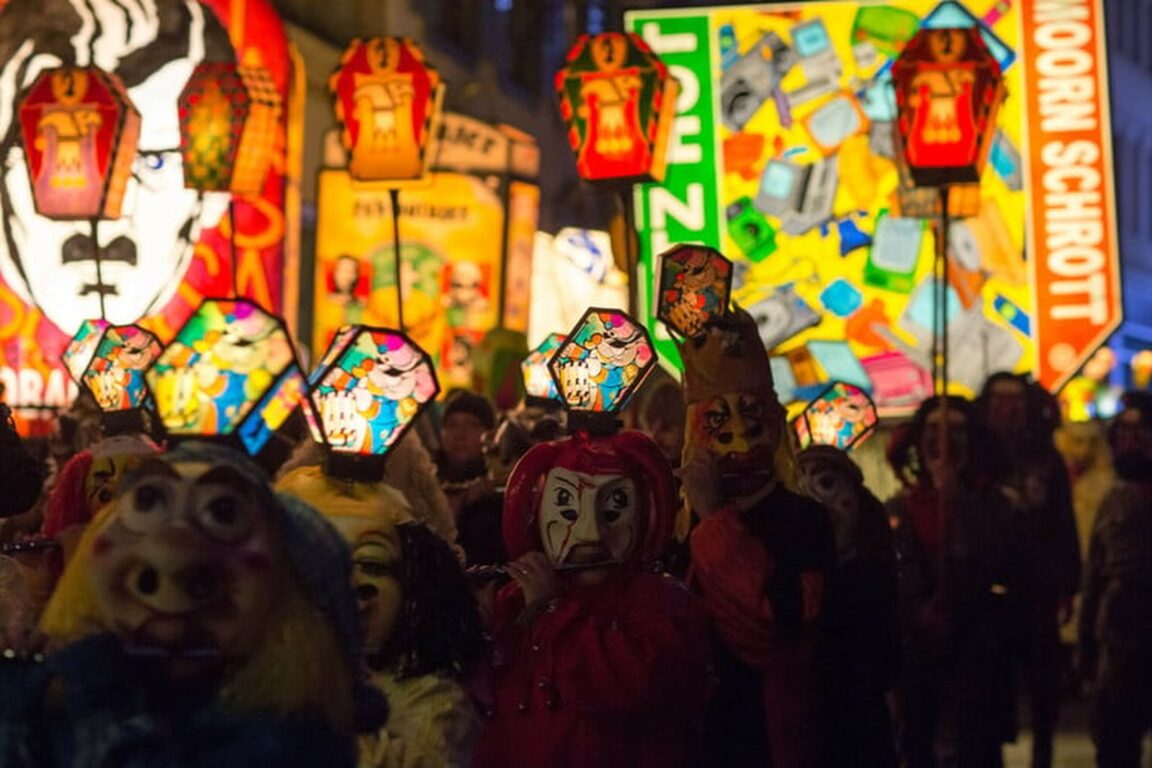
Everything Basel is famous for is compressed into the first hour. Switzerland Tourism’s Morgestraich page describes the mechanics: at 4am the lights go out across downtown Basel, in both Grossbasel and Kleinbasel, and the cliques strike up the same march simultaneously, their headlamps and roughly 200 large painted parade lanterns shining in the darkness. There is no fixed route and no single procession. Each clique, a group of pipers and drummers formed months or decades ago, follows its own path through the lanes behind its lantern, which carries the group’s theme, its sujet, painted by hand over the winter. Spectators stand in near darkness as column after column passes at a measured military pace, a rhythm that descends from the guild musters of the sixteenth century. The busiest ground is around Barfüsserplatz, Marktplatz and Freie Strasse; Basel Tourism points quieter watchers to Leonhardskirchplatz, Martinskirchplatz, Nadelberg and Münsterplatz. Afterwards, the town eats: the classic Morgestraich breakfast is flour soup, onion tart and cheese tart, served in restaurants that open for the frozen crowds. The practical plan is unglamorous and non-negotiable: sleep early on Sunday, set the alarm for 3am, dress for a February night, and be in position well before the fourth chime, because the moment the lights die is the whole point and it does not repeat.
The Cortège and the shape of the three days
Daylight Fasnacht belongs to the Cortège, the set-route parade on Monday and Wednesday afternoons, when the cliques present their sujets in full: floats, painted lanterns, hand-carved wooden masks called Larven, and handbills of satirical verse, called Zeedel, distributed to the crowd. The themes are the year’s politics and scandals, local first and global second, rendered with a wit that assumes the audience knows the story, so visitors should read the sujet as visual satire even when the dialect verses stay mysterious. Monday evening and Wednesday evening belong indoors to the Schnitzelbänke, satirical singers performing rhymed commentary in restaurants and theatres, each verse revealed with a painted placard. Tuesday afternoon is Kinderfasnacht, when children parade in costume with their own small drums and carts, and Tuesday night belongs to the Gugge brass bands, whose deliberately thunderous concerts take over the main squares from about 7.30pm to 11pm. Between the set pieces comes the Gässle, the unstructured wandering of masked groups through the alleys that many Baselers call the best of Fasnacht, and the lantern exhibition on Münsterplatz, where the great lanterns stand lit together on Monday night. The festival ends as it began, at 4am on Thursday, with the Ändstraich, the final march to the cliques’ home locals. Festival veterans of other cities will find the rhythm familiar in outline only; our Edinburgh festivals guide covers a city that also surrenders itself to a season, but no other festival starts by turning its own lights off.
The rules visitors break, and how not to
Fasnacht has few rules and enforces them socially, which makes breaking one feel worse than it sounds. The Fasnacht Committee’s official visitor guidance leads with the Morgestraich rules: darkness is the top priority, so do not open curtains onto the street, do not set off fireworks, and photograph and film without flash, because flash destroys the darkness the masks are moving through and dazzles the costumed marchers behind their narrow eye slits. The same logic bans phone torches and bright screens held high. Second, spectators do not dress up. Costumes and masks belong to the active participants, who spend months building them around their sujet; a visitor in a bought clown wig or novelty mask is not joining in, they are confusing the cast with the audience, and fancy dress marks a tourist faster than any accent. Third, buy and wear the Blaggedde. The badge is the festival’s funding model, sold by the committee and street sellers, worn visibly on the coat, and it is both a ticket and a courtesy. Fourth, mind the confetti etiquette: do not pick Räppli up off the ground and throw it back, and never throw it at active participants. Finally, protect your hearing near the Gugge bands, and keep children and dogs clear of the densest Cortège crush. None of this is forbidding. It is the operating system of a festival run by its participants, and visitors who follow it are treated as guests rather than an audience.
Planning the trip: sleep, base and budget
Stay in or beside the old town if the budget allows, because the festival’s defining moments happen at 4am and the walk home matters more than the walk in. Basel SBB station is a short tram ride or a manageable walk from the old town, and the city’s hotels fill for Fasnacht week, so book early. Build the days around sleep rather than pretending it is optional: nap after the Morgestraich breakfast before the Monday Cortège, and treat Tuesday’s looser programme as recovery before Wednesday’s parade and the final night. February in Basel is cold, and the Morgestraich means standing still in the dark for an hour or more, so thermal layers, a real winter coat, gloves and waterproof shoes are festival equipment, not caution. The street programme costs nothing; the spending goes on the badge, flour soup and onion tart at dawn, restaurant meals between parades, and the Schnitzelbank evenings. Basel also pairs naturally with a wider Swiss or Rhine trip once the 72 hours end, and the rail logic resembles a Vienna base in our 3 days in Vienna itinerary: one historic centre, everything walkable, trains for the rest.
Frequently Asked Questions
When is Basler Fasnacht in 2027?
It begins with the Morgestraich at 4am on Monday 15 February 2027, the Monday after Ash Wednesday, and runs for exactly 72 hours to the Ändstraich at 4am on Thursday 18 February 2027.
Why does Basel start carnival after Ash Wednesday, when others stop?
Basel’s Fasnacht sits a week later than the pre-Lent carnivals, a separation often linked to the city’s Protestant Reformation in 1529 and to older farmers’ carnival customs. Whatever the origin, the offset is deliberate and defines the festival’s separate character.
Can visitors wear costumes or masks?
No. Costumes and masks are for the active participants, the cliques and groups who create them around their annual themes. Spectators watch in ordinary winter clothes, with the official Blaggedde badge pinned visibly to the coat.
Why is flash photography banned at the Morgestraich?
Because the darkness is the event. The old town’s lights are switched off so the cliques can march by lantern light, and flash dazzles masked marchers and destroys the atmosphere for everyone standing in it. The Fasnacht Committee asks visitors to photograph without flash and to keep curtains closed.
Is Basler Fasnacht free to attend?
Yes, the entire street programme is free. The expected contribution is the Blaggedde badge, which funds the cliques, plus the ordinary costs of food, drink and accommodation.
What should I eat during Fasnacht?
Start with the Morgestraich breakfast of flour soup, onion tart and cheese tart, served across the old town from 4am. Käsewähe, the cheese tart, and Basler Läckerli biscuits carry the rest of the three days.
Image: Masked clique members with painted head lanterns and a great procession lantern in the darkness of the Morgestraich, Basler Fasnacht, Basel. Photograph via Basel Tourismus, the official Basel tourism authority (basel.com).