 Priya Nair
Chefchaouen is built for slowing down, and its most restorative ritual is also its oldest everyday one: the hammam. In this blue washed Rif Mountains town, the public bath is not a spa treatment bolted onto a hotel stay. It is a weekly social institution, gender separated, deliberately unhurried, and run on an order that has barely changed in generations: change, warm through, steam, scrub with black soap and a rough glove, rinse, wash, rest. Go in the afternoon, follow the etiquette in this guide, and pair the bath with an evening in the medina and a mountain walk the next morning, and Chefchaouen becomes a genuine recovery stop rather than a photo stop.
Quick Facts
What a hammam is: A traditional steam bathhouse, found in every Moroccan neighbourhood, used for deep cleansing, warmth and social time.
The order: Changing room, warm room, hot steam room, black soap, kessa glove scrub, rinse, ghassoul clay wash where offered, cool down and tea.
Separation: Public hammams are strictly gender separated, either in separate sections or at separate hours for men and women.
What to bring: Your own towel, a change of underwear, flip flops, toiletries, and a plastic bag for wet things. Public baths expect guests to arrive equipped.
What to wear inside: Underwear or swim bottoms throughout. Full nudity is not the norm in Moroccan public hammams.
The scrub: An attendant, called a kessala for women and a tayeb for men, can be tipped to do the exfoliating scrub properly.
Best pairing: A late afternoon hammam, a slow medina evening, and a Rif foothill walk the following morning.
What actually happens inside a Chefchaouen hammam?
The sequence matters more than any single step, because the heat is progressive. You begin in a changing area, where you undress down to underwear or swim bottoms, wrap yourself in your towel, and leave clothes and valuables stored as the attendant directs. Take only what the bath needs: buckets are usually provided or stationed at the water points, along with your black soap, your kessa glove and your toiletries. Phones stay outside the wet rooms. Photography inside a hammam is not acceptable, full stop.
From there you move through rooms of rising heat. The warm room is where you acclimatise and let your skin soften, sitting on the tiled floor or benches and pouring warm water over yourself from the buckets. The hot room is the steam heart of the building, heated traditionally by a wood fired system beneath the floors, and it is where you sweat properly. First timers should treat the hot room in short visits, returning to the warm room whenever the heat stops feeling pleasant. There is no prize for endurance, and attendants watch for guests who overdo it.
The scrub is the centre of the ritual. Black soap, savon beldi, a dark olive based paste, is spread over the skin and left to work in the steam for several minutes. Then comes the kessa, a rough exfoliating glove, used with firm strokes that roll away an astonishing quantity of dead skin. You can scrub yourself, but a first visit is better in the hands of the attendant, who knows the pressure, the order of limbs and the moments to rinse. After the scrub comes washing, often including a ghassoul clay treatment for skin or hair where it is offered, then a final rinse in progressively cooler water, and the slow return to the changing room to rest, dress and rehydrate. Our guide to hammam culture in Morocco explains the history and social role of the bathhouse in more depth for travellers who want the background before the steam.
What is the etiquette a respectful visitor follows?
Modesty and quiet are the two currencies of the public hammam. Keep your underwear or swim bottoms on at all times. Keep conversation low in the hot room, where locals treat the heat as a place of rest rather than entertainment. Greet people simply, accept guidance from the attendant and from regulars with good grace, and do not stare. The bath is a working social space for the neighbourhood, including mothers with children and older residents on their weekly round, and a visitor is a guest in that space, not its audience.
Practical etiquette is just as specific. Wear flip flops on the wet floors, both for hygiene and because the hottest room floors can be genuinely hot underfoot. Bring everything you need, because a public hammam is not stocked like a hotel spa: towel, spare underwear for afterwards, soap and glove if you have your own, shampoo, and a bag for wet kit. Tip the attendant who scrubs you, and tip the person who minds the changing room, in small dirham notes, handed over simply and without ceremony. Arrive with time in hand rather than in the last hour before closing, and eat lightly beforehand, because deep heat on a full stomach is a reliable way to feel unwell. Travellers building a wider slow Morocco stay will find the same unhurried logic in our Chefchaouen guide to the Rif trails and Akchour waterfalls, which covers the mountain half of this recovery pairing.
Should you choose a public hammam or a riad hammam?
Both are real, and they are different products. The public hammam, the beldi bath, is the authentic neighbourhood institution: inexpensive, functional, communal and conducted in Arabic and French more than English, with instructions often delivered by gesture and demonstration. It is the right choice if you want the ritual as Moroccans live it and you are comfortable following along by watching and copying. Go with a same gender friend or a local guide’s introduction the first time if you can, choose a bath near the medina, and treat any confusion as part of the experience rather than a failure of it.
A riad or hotel hammam is a private version of the same sequence: your own small steam room, products provided, an attendant booked for you, English or French spoken, and a massage often added at the end. It costs considerably more and removes the social dimension entirely, which for some travellers, including many women travelling solo who prefer privacy for a first experience, is exactly the point. There is no wrong answer, only an honest one about what you want from the hour. Many visitors do both across a stay: the riad version first to learn the steps, the public bath second to feel the institution.
How do you build the recovery day around the bath?
Sequence the day so the hammam is the hinge. Spend the morning gently: the medina lanes before the day trip crowds, coffee in Plaza Uta el Hammam, the kasbah gardens if you want one cultural anchor, and no serious climbing. Take the bath in the mid to late afternoon, when your muscles are warm from walking and the evening is still ahead of you. Afterwards, your skin will be sensitive and your energy low in the best way, so plan nothing more demanding than a slow dinner, mint tea on a terrace and an early night. Keep sun off freshly scrubbed skin for the rest of the day, moisturise if you have brought oils or cream, and drink water steadily, because the steam takes more out of you than it feels like at the time.
The following morning is for the mountains, taken gently. Chefchaouen sits in the Rif foothills, and the walks out of town, up toward the Spanish Mosque viewpoint above the medina or out on the lower trails toward Ras el Maa and beyond, give you cool air, big views back over the blue town and the pleasant tiredness that completes a recovery stop. Start early, carry water, and keep the ambition modest: this is a restoration pairing, not a summit attempt. Travellers continuing through the north will find our Morocco winter packing guide useful for layering for mountain mornings like these, when Chefchaouen’s altitude makes itself felt before the sun reaches the lanes.
Frequently Asked Questions
Are hammams in Chefchaouen mixed gender?
No. Public hammams are strictly separated, either by section or by scheduled hours for men and women. Private riad hammams are booked for your own party only.
What should I wear inside a public hammam?
Underwear or swim bottoms, kept on throughout, plus flip flops on the wet floors. Bring a towel and a dry change of underwear for afterwards.
Do I have to be scrubbed by an attendant?
No, you can scrub yourself with your own kessa glove and black soap. For a first visit, paying and tipping the attendant for the scrub is strongly recommended, because technique is most of the benefit.
How long does a hammam visit take?
Allow ninety minutes to two hours for the full order without rushing: changing, warming, steam, scrub, washing, rinsing and resting. A hurried hammam misses the point of the ritual.
Is a hammam suitable after hiking or on a rest day?
It is ideal for it. The heat and scrub are a genuine recovery treatment for walked out legs. Eat lightly beforehand, hydrate well afterwards and avoid strong sun on freshly exfoliated skin.
Can I take photos inside a hammam?
No. Phones and photography do not belong in the wet rooms at all. Take your pictures of Chefchaouen’s blue lanes before and after instead.
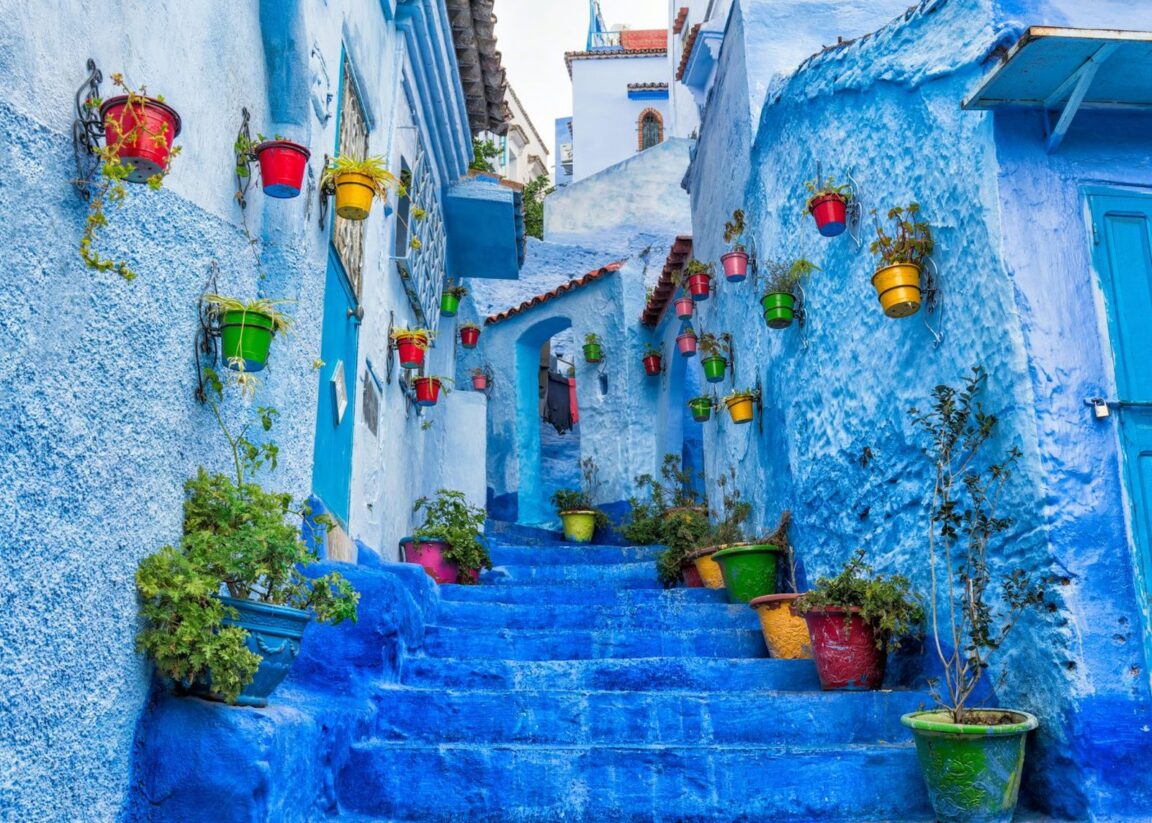
Photo: A blue washed staircase in Chefchaouen’s medina, lined with colourful flower pots. Credit: Milad Alizadeh, via Unsplash (Unsplash License).