 Priya Nair
Diwali in Jaipur is not a single fireworks night tacked onto a normal sightseeing trip. For five days the walled city becomes the festival itself: the bazaars of Johari, Bapu, Tripolia and Kishanpole are lit end to end and formally judged against each other, the Hawa Mahal and Albert Hall glow after dark, and families move between temple visits, sweet shops and home Lakshmi Puja while visitors walk the same streets as respectful guests. Time a trip for it and the planning inverts. Sightsee the forts and palaces in the quieter mornings, rest in the afternoon, and give the evenings, when the city is at its most beautiful and most crowded, entirely to the lit old city.
Quick Facts
- The festival: Diwali, the Hindu festival of lights, runs over five days from Dhanteras to Bhai Dooj, with the main Lakshmi Puja evening at its centre. Dates shift each year with the lunar calendar, falling in October or November.
- The Jaipur difference: Jaipur stages a municipal illumination competition between its walled city bazaars, judged on their lighting displays, so whole market streets, not just individual shops, are decorated end to end.
- The core circuit: Johari Bazaar, Bapu Bazaar, Tripolia Bazaar and Kishanpole Bazaar inside the walled city, with the Hawa Mahal standing over the junction at Badi Chaupar.
- The setting: The walled city of Jaipur is a UNESCO World Heritage Site, inscribed in 2019, as UNESCO records.
- Best hours: The illuminations come into their own from dusk. Walk the bazaars between about 6.30pm and 10pm, and expect the main evening itself to be the busiest.
- Days needed: Three days minimum over the festival, so one crowded main evening never carries the whole trip.
- Official information: Festival programming and city information are published by Rajasthan Tourism and the Jaipur municipal authorities each season.
Why Jaipur Does Diwali Differently
Many Indian cities celebrate Diwali beautifully, but Jaipur organises its celebration at city scale. The municipal authorities run a formal competition in which the market associations of the walled city bazaars compete for prizes for the best illumination, and that single fact changes everything a visitor sees. A shopkeeper anywhere might string lights for the festival. A whole bazaar association, competing against the bazaar two streets away, builds themed lighting across hundreds of metres of shopfronts, gateways and intersections, and maintains it for the full festival period.
The result is a continuous corridor of light through the old city rather than a scattering of decorated pockets. Johari Bazaar, the jewellers quarter, traditionally mounts some of the most elaborate displays, which suits a street whose windows already glitter. Bapu Bazaar answers with its textile and handicraft frontage lit above the crowds. Tripolia and Kishanpole complete the judged circuit, and the great pink gateways of the walled city, the chaupars where the main streets cross, become natural gathering points beneath the lights.
Layered over the municipal display is the domestic festival. Homes are cleaned and decorated in the run up, thresholds are patterned with rangoli in coloured powder and petals, and rows of small earthen oil lamps, diyas, appear on windowsills and parapets. On the main evening, families perform Lakshmi Puja at home, worshipping the goddess of wealth and prosperity, before the city lets off its fireworks. A visitor sees both festivals at once: the public, competitive, civic one in the streets, and the private, devotional one glowing behind every doorway.
The Five Days, in the Order a Visitor Meets Them
Dhanteras: the shopping day
The festival opens with Dhanteras, the day traditionally considered auspicious for buying gold, silver and new household goods. In a city of jewellers this is not a footnote. Johari Bazaar fills from morning with families making significant purchases, and the bazaars take on a purposeful energy quite different from ordinary tourist browsing. For a visitor it is the best day to watch the commercial heart of the festival, and a poor day to expect leisurely shopping of your own.
Choti Diwali: the illumination peak for photographers
The day before the main festival, sometimes called Choti Diwali or Naraka Chaturdashi, is when the bazaar lighting is complete, tested and fully switched on, but the crowds have not yet reached their maximum. Seasoned Jaipur photographers tend to favour this evening for the bazaar circuit: the same displays as the main night, a fractionally calmer street, and room to stop without being carried along by the flow.
The main evening: Lakshmi Puja and fireworks
On Diwali itself the rhythm changes. The bazaars are at their brightest and busiest early in the evening, then the streets briefly take on a more devotional air as families withdraw for Lakshmi Puja at the astrologically set hour. Fireworks follow, from rooftops and open ground across the city, and they can continue late. Plan to be in the old city for the early evening, somewhere with a view for the fireworks, and in no hurry to get anywhere afterwards, because traffic across Jaipur slows to a crawl.
Govardhan Puja and Bhai Dooj: the quiet tail
The two days after the main evening belong to Govardhan Puja, with its temple observances, and Bhai Dooj, which honours the bond between brothers and sisters and is largely a family occasion. The bazaar illuminations usually remain up, the crowds fall away sharply, and these evenings suit visitors who want the lit city at a gentler pace. They are also the sensible buffer days for sightseeing that the festival evenings displaced.
Walking the Lit Bazaars: a Workable Evening Route
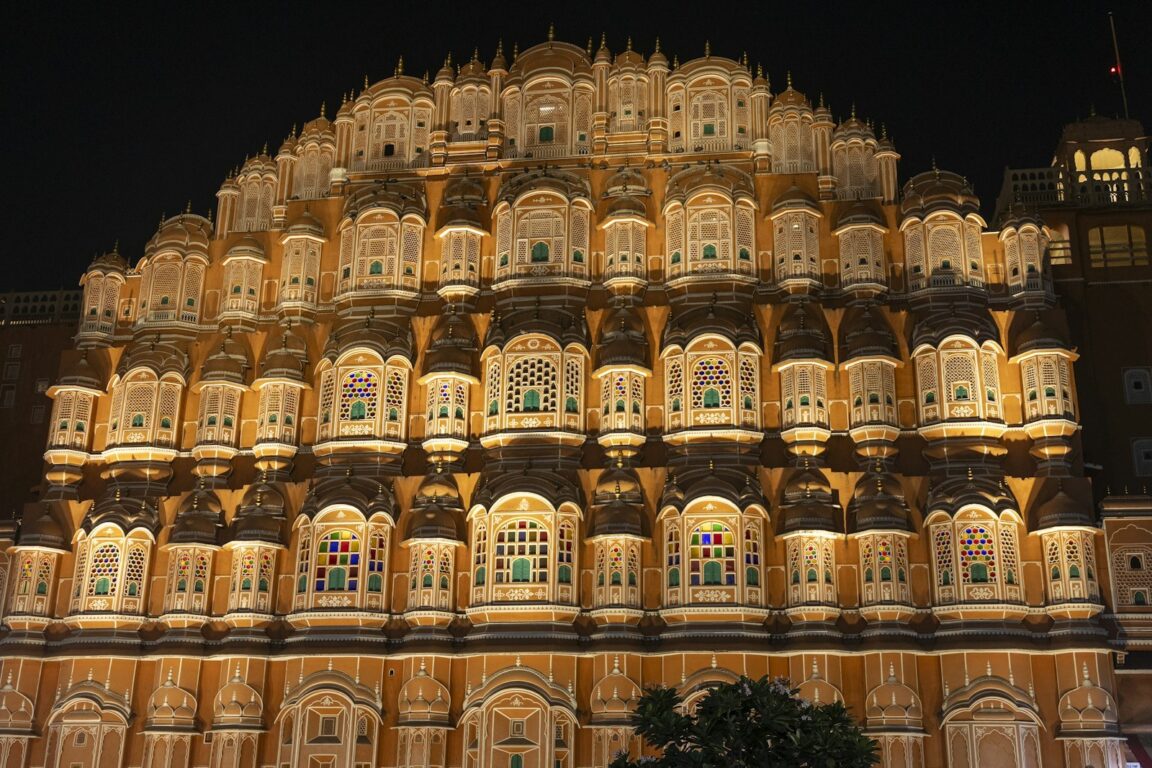
Start at Badi Chaupar, the great crossing by the Hawa Mahal, as the light fades. The palace facade, five storeys of pink sandstone lattice built in 1799 so the women of the court could watch street processions unseen, is illuminated for the festival and makes the natural prologue to the walk. From there, turn into Johari Bazaar and walk its length slowly, looking up as much as at the shop windows: the lighting schemes run across the street and over the facades, and the jewellery displays below are dressed for the biggest trading week of their year.
Cross into Bapu Bazaar for the second half of the circuit. This is the street for textiles, mojari shoes, quilts and handicrafts, and during Diwali its stalls add festival stock: diyas, candles, lanterns, strings of marigolds and packets of sweets. Tripolia and Kishanpole bazaars, running west through the walled city, complete the judged set and are often a touch less pressed than Johari on the main night. Finish with a rooftop. The cafes opposite the Hawa Mahal and the terraces around the chaupars exist precisely because the view over the lit streets is the souvenir, and a hot chai above the crowd is the right way to end the evening.
Two practical notes govern the whole walk. First, the old city is effectively pedestrian in spirit on these evenings even where vehicles are technically allowed; go on foot, keep valuables secured against the press of the crowd, and agree a meeting point outside the bazaars in case your group separates. Second, photograph the displays freely, but ask before photographing families at their doorways or diyas at a home threshold. The street lighting is public spectacle. The lamps on a windowsill are someone’s prayer.
Watching Respectfully as a Guest
Diwali is a religious festival before it is a travel experience, and Jaipur makes it easy to behave well because the line between spectacle and observance is visible. The bazaar illuminations, the municipal competition and the fireworks are staged for the whole city, visitors included. Home pujas, temple rituals and family gatherings are not. Watch them the way you would watch a neighbour’s celebration through an open gate: warmly, briefly, and without inserting yourself.
Dress modestly in temples, remove shoes where asked, and never photograph a puja in progress without explicit permission. If a family or shopkeeper offers you sweets, accept with thanks; mithai is the currency of the festival, and the old city sweet shops, selling ghewar, laddoo and kaju katli by the kilo, are part of the celebration. Fireworks etiquette matters too. Buy nothing illegal, light nothing yourself in a crowded bazaar, and keep a respectful distance from rooftop displays. Finally, greet people with a simple Happy Diwali. It is received exactly as warmly as it sounds.
For a sense of how other great festivals reward the same guest mindset, compare our guide to Day of the Dead in Oaxaca, where joining respectfully is likewise the whole skill, and our Edinburgh festivals guide for a city that also reorganises itself around a festival season.
Where Diwali Fits a Jaipur Itinerary
Give the festival the evenings and keep the days for the sights that close early. Amber Fort, on its ridge above Maota Lake outside the city, is a morning sight in any season and doubly so during Diwali week, when returning to the old city before dusk is the priority. The City Palace and Jantar Mantar, the royal observatory with its monumental instruments, sit inside the walled city itself and pair naturally with a late afternoon drift into the bazaars. The Albert Hall Museum, Jaipur’s ornate state museum, is illuminated at night year round and looks its best in festival week.
Book accommodation early. Diwali is peak domestic travel season, Jaipur hotels fill well ahead, and prices peak across the festival days. Staying just outside the walled city, in the Civil Lines or Bani Park districts, gives you a walkable approach to the bazaars without sleeping inside the fireworks noise. Arrive a day before Dhanteras if you can; the city dressing itself is a pleasure visitors who fly in on the main day never see.
Frequently Asked Questions
When is Diwali in Jaipur?
Diwali follows the Hindu lunar calendar and falls in October or November each year, with the five day festival running from Dhanteras to Bhai Dooj. Check the year’s exact dates before booking, and check the municipal illumination schedule, which Rajasthan Tourism and the Jaipur authorities publish each season, since the bazaar lighting runs on set evenings within the festival window.
Which bazaar has the best Diwali lights?
Johari Bazaar is the traditional favourite and the jewellers quarter usually mounts the most elaborate judged display, but the honest answer changes year by year because the bazaars compete. Walk Johari and Bapu bazaars first, then Tripolia and Kishanpole; the circuit is compact and the comparison is the fun of it.
Is Jaipur too crowded at Diwali?
The main evening in the walled city is genuinely crowded, comparable to a major festival night anywhere in the world. It is manageable with an early start, a walking route and no fixed schedule afterwards. Choti Diwali evening and the two days after the main night offer the same illuminations with far fewer people.
Can visitors join a Lakshmi Puja?
Lakshmi Puja is a family observance performed at home, and visitors are not generally invited into it. Temples hold public worship through the festival where visitors are welcome if they dress modestly and follow the temple’s rules. The bazaars, fireworks and public illuminations are the visitor’s share of the festival, and they are generous.
What should I buy in Jaipur at Diwali?
The bazaars are stocked for the festival: hand block printed textiles and quilts in Bapu Bazaar, silver and gemstone jewellery in Johari Bazaar, and everywhere the festival goods themselves, brass and earthen diyas, lanterns and marigold garlands. Sweets are the essential purchase. Buy mithai from a busy old city sweet shop and eat it the same day.
How many days should I allow?
Three days over the festival is the comfortable minimum: one day to arrive and see the city dressing itself, the main festival evenings for the bazaars, and a buffer day for Amber Fort and the palaces. Four or five days lets you add the quieter tail of the festival and a day trip without rushing either.
Image: The Hawa Mahal in Jaipur lit up at night, photographed by Martijn Vonk, via Unsplash. Source: https://images.unsplash.com/photo-1705861145876-2efd5e0392a5