 Jonas Lindqvist
The northern half of Corsica’s GR20, from Calenzana to Vizzavona, is the harder, rockier half of one of Europe’s toughest long distance trails, and it fits into nine stages that most strong walkers complete in seven to nine days. The Parc naturel regional de Corse, which manages the trail and its refuges, counts about 57 hours of walking for this section alone. Every overnight, in a refuge bunk or in your own tent on a refuge bivouac area, must be booked in advance through the park’s reservation centre, and the railway station at Vizzavona is what makes stopping at halfway practical. Plan those two facts first, and the northern GR20 becomes a reachable one week mountain journey instead of a fortnight’s commitment.
Quick Facts
- Route: GR20 northern section, Calenzana to Vizzavona, the first nine stages of the full 16 stage Calenzana to Conca traverse
- Character: The steeper, more alpine half of the GR20, granite ridges, scrambling with hands, fixed aids on exposed sections and long rocky descents
- Walking time: About 57 hours for Calenzana to Vizzavona by the park’s published stage times, against about 38 hours for the southern half
- Refuges: Run by the Parc naturel regional de Corse, staffed in the main season, which ran from mid May to early October in 2026; check the current season before planning
- Booking: Mandatory in advance for every option, refuge bunk and bivouac pitch alike, through the park’s official reservation platform, pnr-resa.corsica; wild camping away from refuge areas is not permitted
- Exit: Vizzavona has a railway station on the Ajaccio to Bastia line, the natural halfway escape and resupply point
What are the nine northern stages, in order?
The park publishes the northern section as nine stages, and walking them in order is a lesson in escalating commitment. Stage one climbs from Calenzana, the ancient shepherds’ village near Calvi where the trail begins at the San’Antone fountain, to the Ortu di u Piobbu refuge at about 1,520 metres. The park allows six and a half hours for it, warns that the last water is at the Ortiventi fountain, and notes that the upper trail grows rugged enough to require hands. It is a long, hot introduction that punishes a late start and an overloaded pack on the very first day.
Stage two, Ortu di u Piobbu to Carrozzu, is shorter on the map and slower on the ground: about seven hours across scree and rockfall, over a chain of small passes including Bocca di Pisciaghja at about 2,020 metres, with no water until Carrozzu. Stage three crosses the Spasimata suspension bridge, climbs past Lake Muvrella, whose water the park states plainly is unfit to drink, and tops out at Bocca di Stagnu at about 2,010 metres before descending through centuries old laricio pines to Ascu Stagnu, the refuge at the Haut Asco ski station, a road head and the section’s first realistic bail out point.
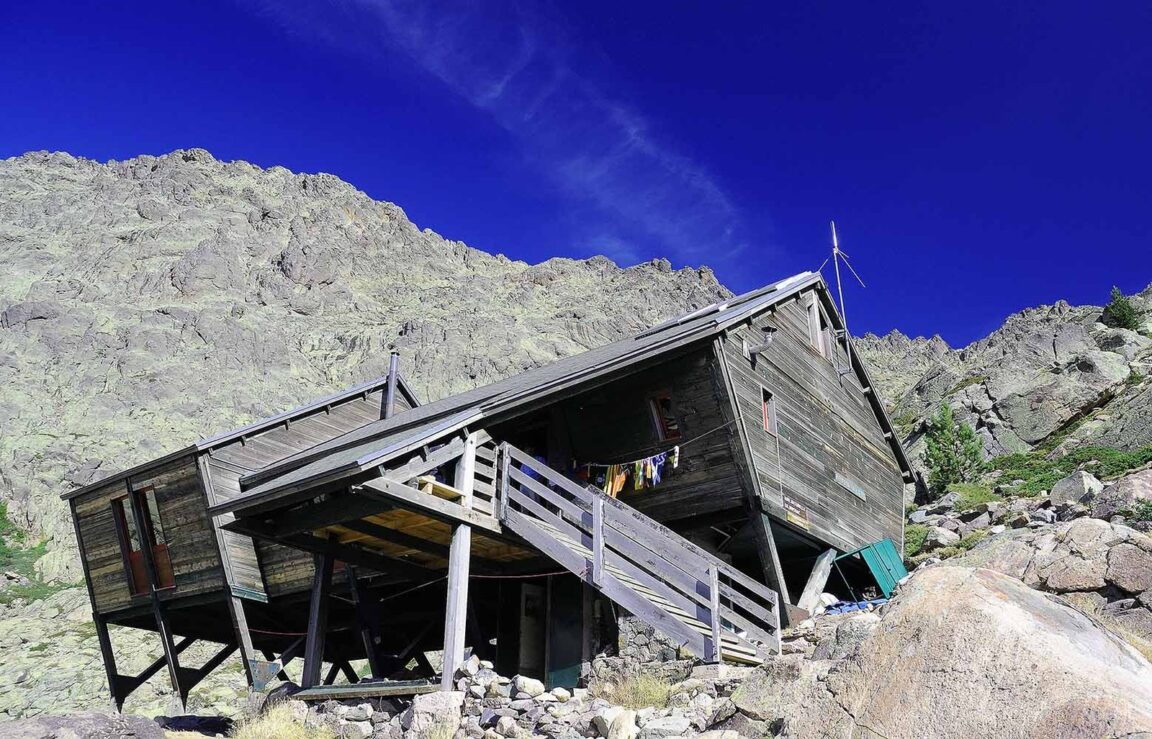
Stage four, Ascu Stagnu to Tighjettu, is among the hardest days, about eight hours by the park’s timing, climbing toward Monte Cinto, Corsica’s highest summit at 2,706 metres, which strong parties add as a side ascent in good weather. The old route through the Cirque de la Solitude is closed, and the diversion over the Cinto shoulder is now the official line, a fact older guidebooks still get wrong. Stage five drops short and steep from Tighjettu to Ciottulu di i Mori, beneath the red granite of Paglia Orba. Stage six is the long one, Ciottulu to Manganu at around 24 kilometres, usually split at Castel di Vergio, a road pass with hotel accommodation, and passing Lac de Nino, the high lake set in grassy pozzi meadows that gives tired legs the section’s gentlest scenery.
Stages seven and eight, Manganu to Petra Piana and Petra Piana to L’Onda, return to high, exposed ridge walking with big views and weather that can change the plan by lunchtime. Stage nine, L’Onda to Vizzavona, about six hours by the park’s timing, finishes with a long descent through forest to the hamlet, its refuge and gites, and its small station in the trees. Walkers who have paced the earlier stages honestly usually arrive with a day in hand. Walkers who treated stage one as a warm up usually arrive negotiating with their knees.
How does the refuge booking system work?
Simply, and without exceptions. The park runs the GR20 refuges and requires every overnight to be reserved and paid in advance on its official platform, pnr-resa.corsica, by date and by refuge. The choice at most refuges is between a bunk in a shared dormitory, a pitch for your own tent on the refuge bivouac area, charged per person, and at some sites a park rental tent. A sleeping bag is needed in every case. Two refuges, Ortu di u Piobbu and Asinau in the south, have no bunks, so tent options are the only choice there. Private gites, bergeries and hotels at the road crossings, Haut Asco, Castel di Vergio and Vizzavona among them, are booked separately with their own operators.
Three consequences follow. First, the itinerary is fixed before you walk, which is why this guide stages the north so carefully: a booked chain of refuges does not bend easily around bad weather or a slow day. Second, peak season beds sell out, and the park’s own guidance and seasoned GR20 planners agree that the first refuges on the route fill fastest, so book as soon as reservations open for your season rather than when your flights are confirmed. Third, prices and season dates change by year. The park’s staffed season in 2026 ran from 16 May to 4 October, with a refuge night priced at 20 euros and an own tent bivouac at 12 euros per person that year. Treat those figures as a scale check only, and verify the current year’s prices and dates on the park platform before budgeting. Outside the staffed season the refuges stand open as unguarded shelters, but water, food and weather turn the northern section into a different and far more serious undertaking.
Walkers used to looser Alpine systems can compare the discipline with our guide to hiking Trolltunga, where shuttles and turn back judgement decide the day, and with the five day logistics of the Otter Trail, the other great trek in our archive that must be booked as a fixed chain long before you walk it.
How hard is the northern GR20, honestly?
Harder than its distances suggest, and the park does not pretend otherwise. Daily stages of eight to eleven kilometres can take seven or eight hours because the ground is the obstacle: polished granite slabs, boulder fields, scree, exposed ridges and descents that use hands as often as feet in the steepest passages. Fixed chains and ladders assist the most exposed sections, which helps confident scramblers and does nothing for a walker who dislikes heights. There is little shade on the high stages, several stages have no reliable water between refuges, and afternoon storms are a standing summer risk on the ridges.
The honest self test is not fitness alone. A walker ready for the northern GR20 can climb and descend a thousand metres on rocky ground on consecutive days, is comfortable scrambling with a pack, and navigates by the trail’s red and white markers without needing a signal, since coverage is patchy at best. Training should include back to back hill days with the actual pack weight, kept as light as experience allows, because every surplus kilo is carried up Bocca di Pisciaghja personally. Walkers who fail that test are not excluded from Corsica. They are better served by the southern section, by the island’s Mare e Monti and Mare a Mare trails, or by walking selected northern stages from the road heads at Haut Asco and Castel di Vergio as day and overnight tasters.
Why does the train at Vizzavona make the one week version work?
Because it removes the shuttle problem that kills most half route plans. Vizzavona sits on Corsica’s central railway, the line between Ajaccio and Bastia, with connections toward Calvi for the return to the start. A walker can finish stage nine, sleep at Vizzavona, and be on a train the next morning instead of arranging a mountain road transfer across the island. The same station works in reverse: walkers short on time sometimes start at Vizzavona and walk the north backwards to Calenzana, although the classic direction, north to south, meets the hardest ground while legs and food weight are freshest in the usual telling, and refuge bookings are simpler to chain in the published order.
Vizzavona is also the section’s best reset point. It has road access, places to eat and sleep beyond the refuge, and the forest shade of the Col de Vizzavona at about 1,163 metres. Build the plan around it: a spare night there absorbs one weather delay without breaking the refuge chain behind you, and it is the last easy place to post home the gear the first nine stages proved unnecessary before deciding, honestly, whether the southern half is for this trip or the next one.
Frequently Asked Questions
How many days does the northern GR20 take?
Nine stages by the park’s division, about 57 hours of walking. Strong walkers sometimes double the shortest stages and finish in seven days; most parties should plan eight or nine days plus a contingency night, ideally at Vizzavona, rather than compressing a booked refuge chain.
Do I really have to book refuges and tent pitches in advance?
Yes. The Parc naturel regional de Corse requires advance booking for every overnight option on the GR20, including a bivouac pitch for your own tent, through its official platform at pnr-resa.corsica. Camping away from the refuge bivouac areas is not permitted.
When is the GR20 season?
The refuges are staffed in the main season, which in 2026 ran from 16 May to 4 October. Outside that window refuges are unguarded shelters and snow can linger on the high northern passes into early summer. Always check the current season’s dates on the park platform before planning.
What is the hardest stage in the northern section?
Stage four, Ascu Stagnu to Tighjettu, is widely rated among the hardest, at about eight hours with the Monte Cinto shoulder on the current official route, the old Cirque de la Solitude line being closed. Stages two and three rival it for roughness, with scree, no water en route and the Spasimata bridge crossing.
Can I walk just part of the northern GR20?
Yes. Road access at Haut Asco after stage three and at Castel di Vergio during stage six, plus the railway at Vizzavona, creates natural short versions. Any overnight on the trail still needs a refuge or bivouac booking, and day walkers should carry the same water and weather discipline as through hikers.
Image credit: The wooden Tighjettu refuge on stage four of the GR20, beneath the granite of the Monte Cinto massif. Photo by the Parc naturel regional de Corse, via pnr-resa.corsica, the park’s official GR20 reservation site, used with credit.