 Jonas Lindqvist
The 100 millilitre rule is ending in some airports and hardening in others, and the only reliable way to pack liquids in 2026 is to check the strictest airport on your itinerary and pack to it. In the European Union, certified CT scanners briefly lifted the limit to 2 litres in the summer of 2024, then the European Commission reimposed the 100 millilitre cap at those same scanners from 1 September 2024. Since July 2025, airports whose scanner software has been recertified are allowed to restore 2 litres, and a handful have: Rome Fiumicino, Milan Linate and Malpensa, and Dublin among them. The United States still runs 3-1-1, the United Kingdom is mid-transition, and much of the world never changed at all. Pack to the strictest leg and the rule cannot hurt you.
Quick Facts
The old rule: Liquids, aerosols and gels in containers of 100 millilitres or less, in a single transparent resealable bag of about one litre, presented separately at security.
The EU reversal: From 1 September 2024 the European Commission reimposed 100 millilitres at CT scanner airports that had previously allowed up to 2 litres, over technical concerns with the scanner software.
The return of 2 litres: From July 2025 the Commission has been approving scanner configurations again, airport by airport. Rome Fiumicino, Milan Linate and Malpensa and Dublin are among the airports confirmed as operating the higher limit.
The United States: The TSA 3-1-1 rule stands unchanged: 3.4 ounces, a quart bag, one per passenger.
The safe system: Pack liquids to the strictest airport rule on your route, including transit airports. Duty free bought into a sealed security bag with receipt travels under separate rules.
Where has the 100ml era actually ended?
Start with the map, because it is a patchwork, not a wave. In the EU, the story runs in three acts. Act one: airports that installed computed tomography scanners, the machines that let you leave liquids and laptops in your bag, were permitted to raise the hand luggage liquid limit to 2 litres, and several did in 2023 and early 2024. Act two: from 1 September 2024, the European Commission reimposed the 100 millilitre limit at every one of those airports, citing unresolved questions about the detection software, a decision that stranded passengers who had read the good news and not the correction. Act three: from July 2025, the Commission began approving configurations again, one airport and one scanner model at a time, so the higher limit is returning in pieces: Rome’s two big neighbours, Fiumicino and, through Milan, Linate and Malpensa, and Dublin, which operates under the same framework, are confirmed in the reporting, while other hubs work through approval.
The United Kingdom tells a similar story with different paperwork: major airports missed the June 2024 deadline to complete scanner installation, smaller airports that had completed it were told to restore the 100 millilitre rule, and the transition continues airport by airport. Germany illustrates the trap inside the patchwork: Frankfurt and Munich have CT lanes in some terminals while the classic rule still applies at others, sometimes within the same airport, so a traveller can be legal at one checkpoint and illegal at the next. The operational conclusion never changes: the airport’s own website, checked for your terminal and your date, is the only source that counts. For the transfer reality at a hub built around connections, see our Incheon layover guide, and for the pre-flight system that sits around rules like these, our Toronto Pearson winter connection explainer.
What should you pack to, if the rules differ by airport?
Pack to the strictest airport on the itinerary, full stop. A traveller flying Dublin to Rome can carry 2 litres of liquids out of Dublin and still be re-screened in Rome if the itinerary connects onward, and a bottle legal at departure can be confiscated at a transit security check run under the old rule. The maths is simple: a 100 millilitre system survives every checkpoint in the world today, while a 2 litre system survives only the checkpoints that have adopted it. Travellers with a genuine need to carry more, medication, baby food and formula, should use the exemptions that exist in every system rather than testing the checkpoint: declare them, carry documentation where the system asks for it, and expect them to be screened separately.
Duty free deserves its own sentence, because it confuses more travellers than the rule itself. Liquids bought airside, including at a previous airport on the same journey, travel in a sealed security tamper-evident bag with the receipt visible inside, and must stay sealed until the final destination if a transit screening lies ahead. Break the seal early, or lose the receipt, and the bottle becomes an ordinary liquid at the next checkpoint. Keep the bag sealed, keep the receipt, and let the checkpoint decide.
What did the September 2024 reversal actually teach?
It taught that scanner headlines travel faster than scanner approvals. Through 2024, travel media reported the end of the 100 millilitre era as a general event, while the legal reality was a list of individual airports, individual scanner models and individual approvals that could be, and was, reversed centrally in a single decision. The same pattern is now repeating in the opposite direction, as the return of 2 litres is reported as a wave when it is in fact a list. The traveller’s defence is boring and total: ignore the headline, read the list, and check the airport’s own page for your terminal before you pack. Rules like this are the packing system’s version of weather: local, changeable, and only ever checked on the day. For more system thinking of this kind, the carry-on discipline in our one bag month of business travel guide applies the same check-the-source habit to the whole bag.
Frequently Asked Questions
Can I take a 2 litre bottle through security anywhere in Europe now?
No. Only at airports whose CT scanner configuration has been approved for the higher limit, a short and changing list that includes Rome Fiumicino, Milan Linate and Malpensa and Dublin. Everywhere else in the EU the 100 millilitre rule applies, and your transit airport may differ from your departure airport.
Why did the EU bring back the 100ml rule in 2024?
The European Commission reimposed it from 1 September 2024 over technical concerns about the reliability of the new scanners’ detection software for larger liquid volumes. Approvals have been returning airport by airport since July 2025.
What is the US liquids rule in 2026?
Unchanged: the TSA 3-1-1 rule, liquids in containers of 3.4 ounces (100 millilitres) or less, in one quart sized resealable bag, one bag per passenger.
What happens to duty free liquids in transit?
They travel in a sealed tamper-evident security bag with the receipt inside and visible. Keep the bag sealed until your final destination; a broken seal or missing receipt makes the bottle an ordinary liquid at the next screening.
Are medicines and baby food exempt?
Yes, in reasonable quantities, in every major system, but they are screened separately and you should declare them and carry any documentation the local system requests. Use the exemptions rather than hoping a checkpoint will improvise.
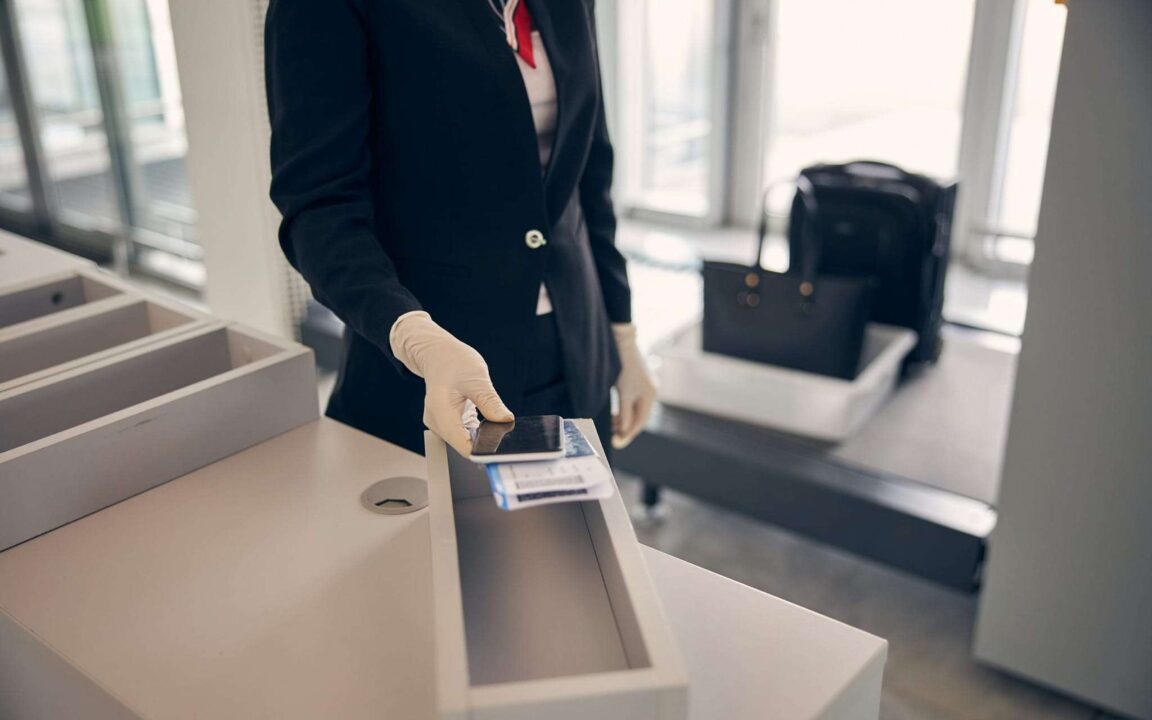
Image: Travellers passing through an airport security checkpoint with trays and a CT scanner. Photo: Getty Images, via Unsplash (hosted copy via Airial Travel), Unsplash License, used with credit.