 River Callahan
Two days is the shortest honest way to drive the Great Ocean Road: leave Melbourne in the morning, sleep in Lorne so the surf coast gets an evening and a slow start, then cross the Otways on day two, reach the Twelve Apostles in the afternoon, return at dawn before the day-trip coaches arrive, and drive home inland through Colac. The split protects the two moments the road rewards most, a quiet early morning at the Apostles and an unhurried evening in a surf town, instead of compressing the winding coast into a single exhausting day.
Quick Facts
Route: Melbourne to Torquay to Lorne on day one; Lorne to Apollo Bay, the Otways and Port Campbell on day two, with the return to Melbourne inland via Colac
Total road length: The Great Ocean Road runs about 243 kilometres from Torquay to Allansford, near Warrnambool
Key distances: Melbourne to Lorne is about 143 kilometres and roughly two hours without stops; the Twelve Apostles are about 227 kilometres and just under four hours from Melbourne along the coast
Overnight: Lorne, on Louttit Bay below the Otway Ranges
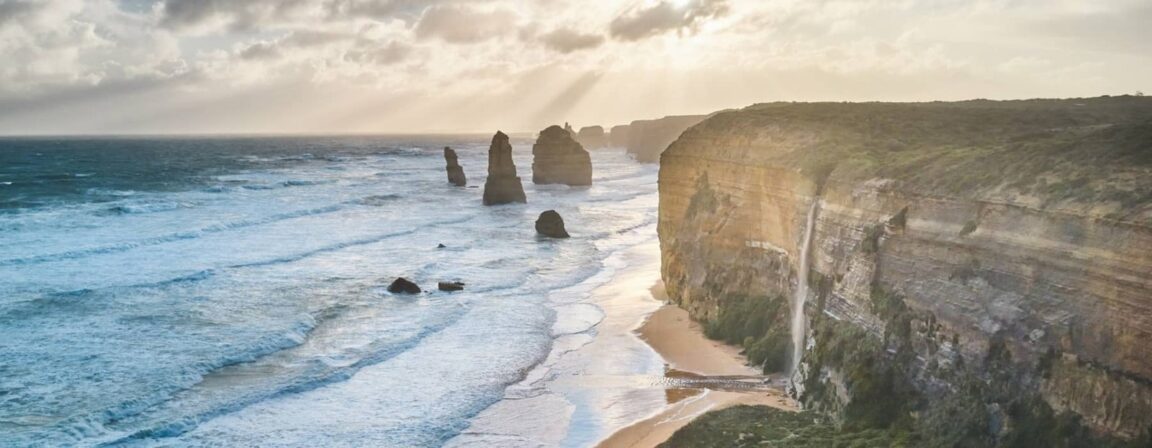
The Apostles today: Seven limestone stacks currently make up the Twelve Apostles, six of them in the classic view from the main platform, according to Parks Victoria
New booking rule: Since 16 October 2026 every visitor to the Twelve Apostles precinct needs a booking made in advance at the official site, twelveapostles.org.au; bookings are free until April 2027
Hours: The Keerray Woorroong Visitor Centre is open 8am to 8pm with last arrival at 7pm; the car park is open 6am to 9pm and cars can exit at any time
Return: Port Campbell National Park is about 230 kilometres and three hours from Melbourne by the inland route, against about four and a half hours along the coast, according to Parks Victoria
Facts checked: 25 November 2026, against Parks Victoria, the official Twelve Apostles site and Visit Great Ocean Road
Why does the Lorne overnight change the whole trip?
The day-trip version of this road is a maths problem that never quite works. The Apostles sit about 227 kilometres from Melbourne by the coast, the road beyond Torquay is winding and slow, and every worthwhile stop adds time a single day does not have. Travellers who attempt it reach the stacks at the busiest hour, alongside several coach loads of people doing the same thing, then face the long drive back in the dark.
Sleeping in Lorne breaks the problem into two humane halves. Day one becomes the surf coast at an easy pace; day two starts past the slowest stretch, so the Otways and the Shipwreck Coast get the fresh hours. Anyone still sketching the Melbourne end can pair this drive with a three day Melbourne itinerary that weighs up the Great Ocean Road decision.
Day one: Melbourne to Lorne, the surf coast at walking pace
Leave Melbourne after breakfast rather than at dawn. The freeway run west through Geelong is fast, and Torquay, the official start of the road, is about 104 kilometres and roughly an hour and a quarter from the city centre on the official Visit Great Ocean Road figures. Torquay earns a short stop: it is the home of Australian surfing culture, the place to stretch legs and buy supplies. The road ahead was built by returned soldiers after the First World War and stands as a war memorial as well as a highway, a fact the Memorial Arch at Eastern View, near Lorne, marks for every passing car.
From Torquay the road begins to behave like itself. Anglesea and Aireys Inlet follow in quick succession, and the Split Point Lighthouse at Aireys Inlet gives the first elevated view back along the cliffs. The final stretch into Lorne is the section drivers remember: the road cut into the cliff edge, the ocean directly below, and speeds that the corners, not the signs, dictate. Arriving by mid afternoon leaves the best of the town still available.
What is Lorne for, besides a bed?
Lorne sits on Louttit Bay beneath the forested slopes of the Otway Ranges, and its double identity is the point of the overnight. Facing the water is a classic surf town main street of cafes, bakeries and a long pier. Facing inland, tracks climb into tall forest, and Erskine Falls, reached by a short drive and a stepped path into a fern gully, is the standard late afternoon expedition. Doing the falls on day one means day two can leave Lorne cleanly, without a missed detour pulling the itinerary backwards.
The evening is deliberately unstructured. Eat early, walk the pier, and sleep properly: tomorrow asks for a departure that feels brisk rather than brutal only if tonight ends sensibly. Travellers building a longer Victoria stay may also find the guide to Melbourne laneway dinners and late trams useful for the city nights on either side.
Day two morning: Lorne to Apollo Bay and into the Otways
The Lorne to Apollo Bay leg is about 45 kilometres and around an hour of pure driving, and it is widely treated as the most beautiful section of the road. The highway clings to the coast through Kennett River and Wye River before Apollo Bay opens out as a working fishing town in a wide green amphitheatre of hills. At about 187 kilometres from Melbourne on the official figures, it is the correct coffee and fuel stop: beyond it, the road turns inland and services thin out.
West of Apollo Bay the road leaves the sea and climbs into Great Otway National Park country. Eucalypt forest closes over the road, the air cools, and the bends multiply as the route crosses the ranges toward Lavers Hill. This is where the two day structure pays for itself a second time: a day-tripper crosses the Otways tired and late, while a traveller who slept in Lorne crosses in the late morning, with time for short rainforest walks and fern filled gullies before the Southern Ocean returns on the descent to the coast.
When should you arrive at the Twelve Apostles?
Late afternoon on day two is the planned arrival, and it is a deliberate choice rather than a compromise. The Apostles are limestone stacks carved from the mainland cliffs by the combined work of Southern Ocean waves, wind and seeping rainwater, as Parks Victoria describes their formation, and the low western light is what turns their seaward faces gold. Arrive with enough time to walk the boardwalks properly, read the formation story at the lookouts, and understand the geography before the quieter return visit the next morning.
Two practical rules now govern this stop, and both changed recently. First, since the Keerray Woorroong Visitor Centre opened on 16 October 2026, every visitor to the precinct needs a booking made in advance through the official site, and that booking also secures parking. Bookings are free until April 2027, after which a fee applies at an amount not yet announced, so the dawn slot for the following morning should be reserved at the same time as the afternoon one. Second, respect the clock the site itself runs on: the visitor centre operates from 8am to 8pm with last arrival at 7pm, while the car park opens at 6am and closes at 9pm, with exit possible at any time. In late November the official site lists sunrise at just before 6am and sunset at about 8.30pm, which means a dawn visit uses the car park opening, not the centre, and a sunset visit needs the late booking slot rather than an assumption that the gates stay open.
The viewing area stands on the Great Ocean Road at Booringa Road, Princetown, about seven kilometres east of Port Campbell on the official site, and parking and the visitor facilities sit on the inland side of the road, with the path to the platforms passing beneath it. Note the current count before looking: Parks Victoria records seven stacks in the group, six visible in the classic view and the seventh set a short distance from the corner of the main platform. Travellers who expect twelve, or even the eight often quoted from older guides, misread the view. The name is a piece of 1920s tourism branding that the eroding coast has never felt obliged to honour.
What else fits around Port Campbell without rushing?
Base the second night in or near Port Campbell rather than pushing on. With the pressure removed, the neighbouring formations become a relaxed circuit instead of a checklist sprint. Loch Ard Gorge pairs a sheltered beach inside towering walls with the story of the ship Loch Ard, wrecked on this coast in 1878. London Bridge is the lookout over a natural arch whose inner span collapsed in 1990. The Grotto descends by a paved path and decked stairs to a viewing area above rock pools carved into the limestone.
Gibson Steps deserves its own decision. Parks Victoria describes a gentle 1.1 kilometre track from the visitor area to the lookout, with 89 steps down the cliff to a wild ocean beach when conditions allow, and the stacks known as Gog and Magog visible at low tide. The beach closes in high tides and heavy swell, and the park beaches are unpatrolled and not recommended for swimming. Treat the steps as a bonus, never an entitlement. At dusk, Parks Victoria notes, little penguins can sometimes be seen returning from the sea near the Apostles and London Bridge, one more reason the overnight pattern beats the day trip.
The dawn return: the Apostles before the crowds
The centrepiece of the whole plan is short. Return to the viewing area as early as the 6am car park opening and the booked slot allow, and take the classic view in the morning calm. The light is cooler than the evening gold, the boardwalks are at their emptiest, and the stacks read clearly against a quiet sea. It is the difference between seeing a famous view and having it, briefly, to oneself, and it costs nothing but an early alarm and a booking made in advance.
Breakfast in Port Campbell follows, unhurried, because there is no need to retrace the winding coast road eastwards. The drive home runs inland, with the scenic work already done.
How does the inland return through the Otways work?
From Port Campbell the return heads through the Otway hinterland toward Colac, then joins the Princes Highway corridor back to Melbourne through Geelong. Parks Victoria puts the park at about 230 kilometres and three hours from Melbourne by the inland route, a saving of roughly an hour and a half over the coastal drive, on straighter roads that ask far less of a tired driver. Dairy country, volcanic plains and forest edges replace the cliff edge, and the trip becomes a decompression rather than a second performance.
Two cautions belong with the shortcut. The inland roads are still rural and winding in their first section, particularly in wet weather when forest roads are shaded and slow to dry. And the route should be chosen knowingly, not by a navigation app at the last minute. In this itinerary the order is the safeguard: coast out, in full, over two days; inland back, once the coast has been properly seen.
What are the honest limits of two days?
Two days protects the Apostles, Lorne and the Otways. It does not complete the road, which continues west of Port Campbell to Warrnambool and Allansford; travellers with a third day can extend that way rather than doubling back. Within two days something is still traded away: a long surf at Lorne, a full afternoon in Apollo Bay and a deep national park detour cannot all survive. Swap within the structure rather than adding to it, because the structure, one coastal overnight, one dawn, one inland return, is the entire point.
Practical housekeeping is brief. There is no camping inside Port Campbell National Park, overnight sleeping in its car parks is not permitted, and dogs are not allowed in the park. Fuel and food are straightforward in Lorne, Apollo Bay and Port Campbell and scarce between them, so top up at Apollo Bay. Check conditions each morning: this coast closes paths and steps for swell and rockfall, and Parks Victoria and the official Apostles site carry the current position.
Frequently Asked Questions
Can the Great Ocean Road be done as a day trip from Melbourne?
It can, but the arithmetic is punishing: about 227 kilometres each way by the coast, on winding roads, with every stop adding time. Most day-trippers reach the stacks at peak crowding and drive back in the dark. The two day version replaces that with an afternoon and a dawn at the Apostles and a faster inland return of about 230 kilometres and three hours.
Do I need to book to visit the Twelve Apostles?
Yes. Since the Keerray Woorroong Visitor Centre opened on 16 October 2026, every visitor to the Twelve Apostles precinct needs a booking made in advance at twelveapostles.org.au, and the booking secures parking. Bookings are free until April 2027; a fee follows at an amount not yet announced. The visitor centre is open 8am to 8pm with last arrival at 7pm, and the car park runs 6am to 9pm.
Why stay in Lorne rather than Apollo Bay or Port Campbell on the first night?
Lorne, about 143 kilometres and two hours from Melbourne, splits the drive into two balanced halves and gives the surf coast an evening instead of a fuel stop. Port Campbell is the better second night, close to the Apostles for the dawn return.
How many of the Twelve Apostles are actually there?
Seven, on Parks Victoria’s current count: six in the classic view and a seventh set a short distance from the main platform’s corner. The stacks are still being shaped by erosion, so the name is historical branding rather than a count.
Is the inland return through Colac less scenic?
It is different rather than lesser: Otway forest, farmland and volcanic plains instead of cliff edge ocean road. It is also about an hour and a half faster to Melbourne, roughly 230 kilometres and three hours from Port Campbell National Park against about four and a half hours by the coast, which is why this itinerary drives the coast outbound and saves the inland route for the way home.
When is the best time of day to see the Apostles?
Both ends of the day work: late afternoon gives warm light on the seaward faces, while early morning gives the emptiest boardwalks. This itinerary takes both, an afternoon arrival on day two and a dawn return before the drive home, using the 6am car park opening and a booking made in advance.
Featured image: The Twelve Apostles limestone stacks off the Port Campbell coast, Great Ocean Road, Victoria. Photo via Visit Great Ocean Road, the region’s official tourism site (visitgreatoceanroad.org.au), used with credit.