 Maya Chen
Melbourne is one of the easiest big cities in the world to do well alone as a woman, and the reason is transport. Stay inside or beside the central business district, eat dinner at the counters the laneways were built for, and let the free tram zone and the late night network carry the safety planning for you. This guide sequences the base, the dinners, the evenings and the day trips so that no part of the trip depends on a car, a group or a long walk down an empty street.
Quick Facts
- Best base: The CBD grid itself, or the city end of Carlton and Fitzroy, so the free tram zone starts at the front door.
- Free Tram Zone: Tram travel is free inside the zone covering the CBD and Docklands; you do not need to touch on or off within it, per Public Transport Victoria.
- Late nights: On Friday and Saturday nights the Night Network runs trains, trams, buses and coaches all night, per PTV.
- Card: A myki card is needed for travel outside the free zone; keep it loaded before a day trip rather than at a quiet station late at night.
- Dinner format: Counter seating is a Melbourne institution, which makes eating alone a design feature rather than an awkward request.
- Key laneways: Hosier Lane for street art, Degraves Street and Centre Place for cafes and small dining rooms.
Choose a Base Inside the Tram Logic
The single best decision on a solo Melbourne trip is a room inside the free tram zone or one stop beyond it. The zone covers the CBD and Docklands, which means the grid of streets between Spring Street, Flinders Street, Harbour Esplanade and La Trobe Street becomes a free, frequent, well lit shuttle you can ride for two stops without thinking about fare or distance. For a traveller on her own, that changes the evening maths completely: a restaurant eight blocks away is not a dark walk, it is a three minute tram ride between busy stops.
Hotels and serviced apartments on the grid suit travellers who want a staffed desk at any hour. Hostels and smaller stays at the city end of Carlton, near the University and the hospital precinct, add a neighbourhood feel while keeping the tram at the corner. Fitzroy, one tram ride north, is livelier later into the evening, with Brunswick Street and Gertrude Street holding their crowds well past dinner. Any of the three works. What does not work as well solo is a bargain room in an outer suburb that turns every return trip into a train timetable problem.
For a first orientation day, pair this guide with our 3 days in Melbourne itinerary, which orders the galleries, markets and gardens across the city. This guide then handles the solo layer on top of it: where to sleep, where to eat at a counter, and how to get back.
The Free Tram Zone, Used Well
PTV publishes the free tram zone map and the rule is simple: journeys that start and end inside the zone are free, and you do not need to touch on. The moment a trip crosses the boundary, a myki is required for the whole journey, so the practical habit is to touch on whenever you board outside the zone and to treat the boundary stops, which are signed on platforms and on tram announcements, as your cue. City Circle trams loop the zone on the tourist circuit, but ordinary trams are faster and just as free inside it.
Used well, the zone becomes an evening safety tool. Plan dinner, a theatre show or a rooftop drink so that both ends of the night sit inside it. Flinders Street Station, Melbourne Central and the main interchanges stay busy late, and the streets around them hold foot traffic long after the shops close. If a venue sits just outside the zone, ride to the last in zone stop and walk the short, lit remainder on a main street rather than a side lane.
Laneway Dinners at the Counter
Melbourne dining culture quietly solves the solo dinner problem. Across the laneways and the small CBD dining rooms, counters face open kitchens, wine bars run long communal benches, and a party of one is seated in seconds at the best seat in the house. Nobody performs surprise that you are alone, because half the counter is.
Degraves Street and Centre Place, the cafe lanes between Flinders Street and Collins Street, are the daytime heart of it: coffee, small bakeries and lunch counters in a stone paved lane that is busy from early morning. By evening the action shifts to the dining lanes and basements around Flinders Lane and Little Collins Street, where small rooms serve at the pass. The solo playbook is consistent. Arrive at opening or just after the first sitting turns, ask for the counter, order the dish the kitchen is known for, and let the room provide the entertainment.
Hosier Lane, opposite Federation Square, is the famous street art lane, and it earns a daylight visit rather than a late night one. Go in the morning when the light hits the walls and the tour groups are thin, photograph the current walls, then use it as the landmark it is: the lane sits one block from Flinders Street Station, which is your anchor for the whole grid.
Evenings and the Night Network
On Friday and Saturday nights, PTV runs the Night Network, with trains, trams, buses and coaches operating through the night. That single fact should shape a solo itinerary. Put the big evening, the theatre, the late dinner, the comedy show, on Friday or Saturday, when the return trip never depends on a rideshare surge or a deserted platform. On weeknights, trams and trains run late but not all night, so check the last services on the PTV site before the second glass of wine, not after it.
The theatre district around Spring Street, the arts precinct across the river at Southbank and the cinema and gallery strip near Federation Square all sit inside or beside the zone, which keeps the walk from venue to tram stop short and populated. The standard big city habits still apply: keep the phone charged, share your live location with someone at home if that is your routine, and choose the busy carriage and the lit stop. Melbourne rewards those habits with crowds that stay out late and streets that rarely empty completely in the centre.
Day Trips That Work Without a Car
Two day trips suit a solo traveller particularly well because the transport is simple and the day runs itself. The train to Brighton takes you to the bathing boxes on Dendy Street Beach, a row of painted timber boxes along the sand that is best seen in the morning before a swim, a beachside lunch and an easy train back. Nothing about the day needs a booking, a group or a timetable more complicated than the Sandringham line.
The Yarra Valley is the organised alternative. Small group tours collect from city hotels for the wine and produce valley north east of the city, which puts a solo traveller at shared tables all day and returns her to the CBD by early evening. Book through operators listed by Visit Victoria, the state tourism authority, and confirm the pickup point is your hotel or a main street hotel nearby rather than an outer meeting point.
Planning a longer solo run through the region afterwards? Our first time Bangkok 3 day itinerary applies the same base and transport logic to a very different city, and pairs well as a stopover on the way home.
Mistakes to Avoid
The common solo mistakes in Melbourne are transport mistakes, not safety dramas. Do not assume the free zone extends to the inner suburbs: St Kilda, Fitzroy beyond the boundary stops and South Melbourne all need a myki. Do not save the one big late night for a Tuesday and then discover the last train logic at midnight. Do not book the cheapest room by the freeway and spend the savings on rideshares. And do not skip the counter dinner out of self consciousness: in this city, the counter is where the kitchen sends its regulars, and a table for one is the only downgrade on offer.
Frequently Asked Questions
Is Melbourne safe for a woman travelling alone?
The centre is busy, well lit and served by frequent trams late into the evening, and on Friday and Saturday nights the Night Network runs all night. Standard city awareness applies, as in any large city, but the transport system does much of the work: short rides between busy stops replace long walks.
How does the Free Tram Zone actually work?
Travel entirely inside the zone, which covers the CBD and Docklands, is free and you do not need to touch on or off. If any part of the journey leaves the zone, you need a loaded myki for the trip. PTV publishes the boundary map and signs the boundary stops.
Where should a solo traveller eat dinner in Melbourne?
At a counter. The laneway dining rooms and wine bars around Flinders Lane, Degraves Street and Centre Place are built around counter and bench seating, where a party of one is seated immediately and the kitchen is the view.
What is the best day trip without a car?
Brighton by train for the bathing boxes and a beach lunch is the simplest. A small group Yarra Valley tour with a city hotel pickup is the best organised option, since the group supplies the company and the driver supplies the logistics.
Do trams run all night in Melbourne?
On Friday and Saturday nights, yes, as part of the Night Network, which also runs trains, buses and coaches through the night. On other nights services run late but finish, so check last times on the PTV website.
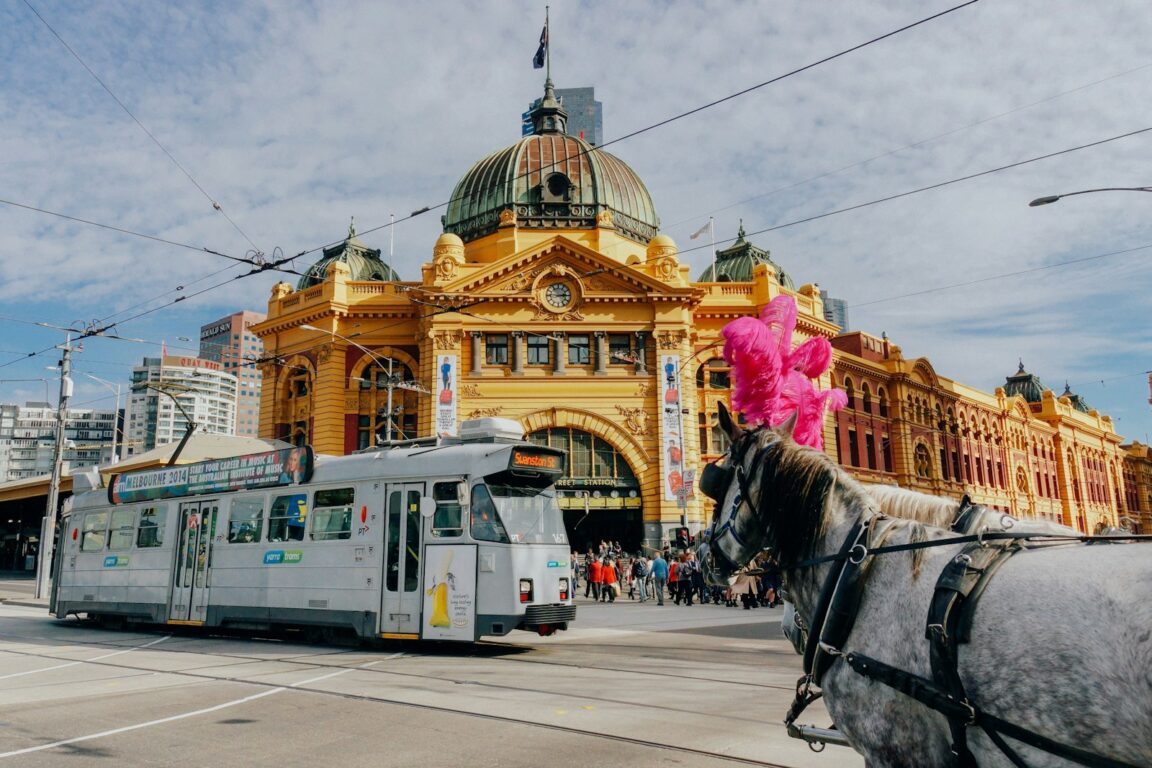
Image credit: Flinders Street Station and a Swanston Street tram in Melbourne, photographed from Flinders Street. Photo via Unsplash (photo-1514395462725-fb4566210144), Unsplash License. The photographer name for this Unsplash photo ID could not be mapped from accessible sources at the time of writing, so the verified Unsplash photo ID is recorded here and in the package data instead of a guessed name.