 Elena Vasquez
Walk Tbilisi Old Town with intent and its oldest quarter stops being a backdrop and becomes a sequence: book a private room in the Abanotubani bathhouses and learn the scrub etiquette before you go, climb to the Narikala ridge at golden hour for the view over the domes and the river, and slow down on the balcony streets of Sololaki and Betlemi, photographing the carved wooden balconies from the street without blocking the doors of the people who live behind them. That order, baths, ridge, balconies, is the difference between seeing the Old Town and understanding how this city has lived with its warm water, its hillside and its neighbours for centuries.
Quick Facts
- Where: The Old Town, or Dzveli Tbilisi, on the right bank of the Mtkvari River in Tbilisi, Georgia, below the Narikala ridge.
- The name: Tbilisi comes from the Georgian word tbili, meaning warm, a reference to the natural sulphur hot springs beneath Abanotubani.
- The baths: Chreli Abano, also called the Orbeliani Baths, at 2 Abano Street, is open from 9:00 am to 11:00 pm and takes private room bookings online through its own site. Private rooms in the district are priced per room per hour, from 130 GEL at Chreli Abano. Confirm current prices when you book.
- The water: The sulphur springs reach the baths at about 38 to 40 degrees Celsius.
- The ridge: The cable car from Rike Park crosses the river to the Narikala ridge for 2.50 GEL with a transport card. Narikala Fortress itself is closed for restoration, while the ridge viewpoints beside it are open.
- Breakfast order: Khachapuri, Georgia cheese filled bread, in its regional forms, with the boat shaped Adjaruli the richest place to start.
Why do the baths come first in the Old Town story?
Because the baths are why the city exists here at all. The founding legend tells of King Vakhtang Gorgasali, whose hunting bird fell into a hot spring on this spot in the fifth century, and the bath quarter of Abanotubani grew over those springs on the eastern edge of the Old Town. What you see from the street is mostly roofs: a field of low brick domes, each covering a bathing chamber sunk below ground and pierced with openings that drop daylight onto the water. Behind the domes, the Leghvtakhevi gorge runs back into the hill to a small waterfall, and above everything rises the ridge carrying Narikala and the Mother of Georgia statue.
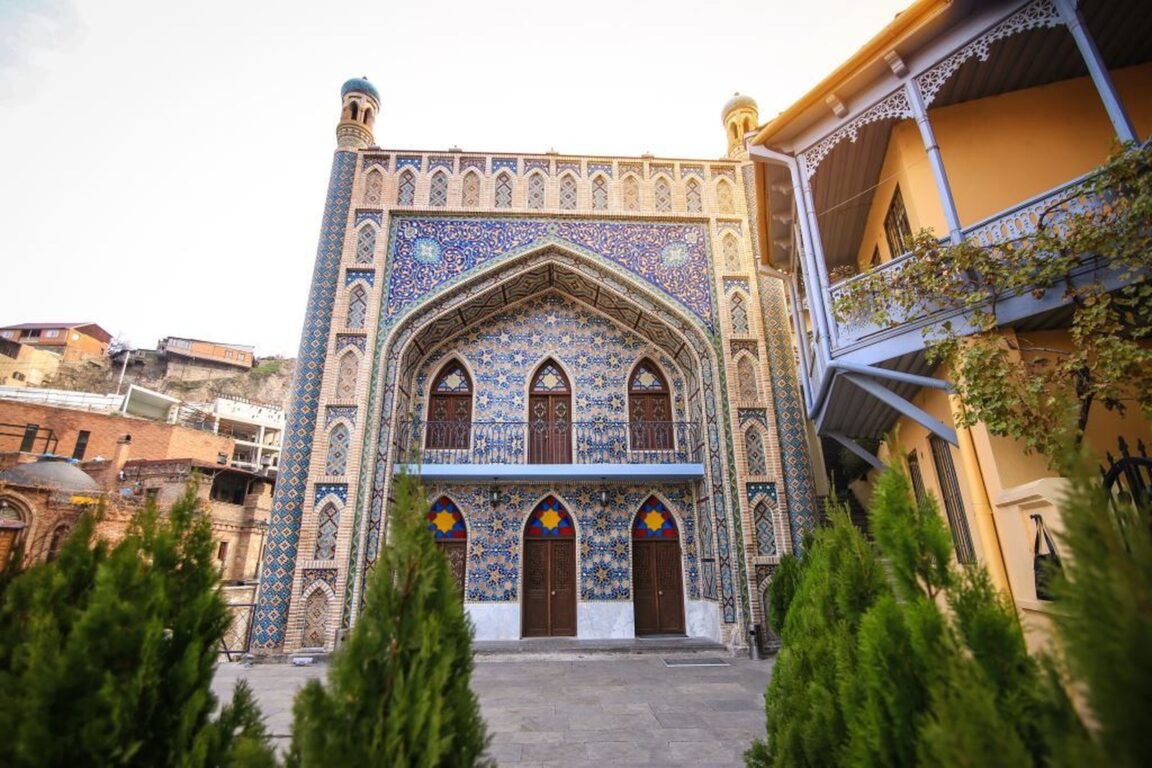
The exception to the domes is Chreli Abano, the Orbeliani Baths, whose street front is a tall facade of blue and turquoise tile in a Persian style at the top of Abano Street. It is the most photographed building in the district and the easiest landmark to navigate by. Inside, the format is private rooms only, hired by the hour, each with its own hot pool, which makes it the simplest first bath for a visitor: no shared hall etiquette to decode, a booking made online in advance, and a clear price per room rather than per person.
What is the booking etiquette for a sulphur bath?
Book ahead, book by the room, and understand the scrub before the attendant knocks. Private rooms across Abanotubani are priced per room per hour, and at Chreli Abano the smallest rooms for one or two people start from 130 GEL an hour, with larger rooms for groups rising from there. Evenings and weekends fill first, so reserve a day or two ahead through the bathhouse own booking site and arrive a few minutes early. One hour is the standard hire, and it is enough for a first visit if you arrive ready rather than spending the first quarter of it deciding what happens next.
What happens next is the kisa scrub, and it is the heart of the experience. Partway through your hour, the attendant, the mekise, knocks and enters to scrub you down on the stone slab with a coarse exfoliating mitt, followed by a soap massage and a rinse. It is vigorous, brief, and entirely routine to everyone who works there. The scrub is paid separately, in cash, directly to the mekise: around 30 GEL at Chreli Abano, and less in the simpler bathhouses. Agree to it when you book or when you arrive, tip in cash, and do not treat the knock as an interruption. A bath without the scrub is a soak. A bath with it is the Tbilisi ritual, after which the hot sulphur water, at about 38 to 40 degrees, does its loosening work on walking tired legs.
The public alternative is Bathhouse No. 5, with separate halls for men and women at a few lari per person, no booking, and everything to be brought yourself, from towel to soap. It is the most local experience in the district and the least private, and first time visitors are usually happier starting with a private room and graduating to the public hall on a second trip. For a room by room comparison of every bathhouse in the district, see our dedicated guide to Tbilisi sulphur baths, private room prices and the kisa scrub.
How should you time the Narikala climb at golden hour?
Go up in the last hour of light, and go up by cable car so that the climb down becomes the walk. The cable car leaves Rike Park, crosses the Mtkvari in about two minutes, and lands on the ridge beside Narikala for 2.50 GEL paid with a transport card. One fact needs stating plainly, because older guides still get it wrong: Narikala Fortress itself is closed for restoration and has been fenced off with no announced reopening date. The walls, whose origins reach back to the fourth century, and the rebuilt Church of St Nicholas inside them, are seen from outside for now.
That closure costs the golden hour visit almost nothing. The platforms and paths along the ridge beside the fortress are open, and the view from them is the one the climb was always for: the bath domes of Abanotubani directly below, the Old Town rooftops and church domes across the slope, the river bending past the Metekhi church on its cliff, the Bridge of Peace glowing as the lights come on, and Sameba Cathedral across the water. Walk along the ridge toward the Mother of Georgia statue as the sun drops, then descend on foot by the steps into the Betlemi streets while the lanes are still lit, and the Old Town delivers you back to the baths district in time for dinner.
Where are the balcony streets, and how do you photograph them well?
The carved wooden balconies that define Tbilisi in photographs belong mostly to the nineteenth century houses of Sololaki, on the slopes south of the Old Town, and to the lanes of Betlemi climbing toward the ridge. These are tall, painted, gloriously uneven houses, their balconies carved and latticed, propped over narrow streets, fronting shared courtyards reached through arched entrance halls that are worth a respectful look in themselves. The architecture is residential, not scenic: every balcony is someone front room, every doorway someone threshold.
So photograph like a guest. Shoot from across the street or along the lane rather than from a doorstep. Never block a door, a stair or a courtyard entrance for a shot, and step aside for residents carrying shopping up hills that tourists treat as viewpoints. Ask before photographing people, and accept no. Mornings give the quietest lanes and the softest light on the painted woodwork, while the hour after the ridge descent gives the balconies their warmest colour. The best Tbilisi photographs come from patience in two or three streets, not from racing through ten.
What should a khachapuri breakfast order look like?
Start the Old Town day the Georgian way, with khachapuri, and know the main forms before you sit down. Adjaruli, from Adjara on the Black Sea coast, is the famous one: a boat of yeasted dough filled with molten sulguni and imeruli cheese, finished with a knob of butter and a raw egg yolk stirred into the hot cheese at the table, then eaten by tearing off pieces of the crust and dipping. Imeruli, from Imereti, is a round, calmer flatbread with the cheese sealed inside, and Megruli, from Samegrelo, adds a second layer of cheese melted on top. Order one Adjaruli between two people with coffee or tea, because it is a serious breakfast, and save the others for lunch. Bakery windows and small cafes around the Old Town and Sololaki serve them from early morning, and a hot khachapuri before the baths district wakes up is one of the reliable pleasures of the city.
Build the rest of the day around those anchors and Tbilisi rewards slowness: a morning bath or a morning in the lanes, the Georgian National Museum or the Dry Bridge flea market if you extend beyond the Old Town, a late afternoon rest, the ridge at golden hour, and dinner in a Sololaki wine bar, where Georgia eight thousand year winemaking tradition is poured by the glass. Travellers combining Tbilisi with other European old towns in one trip may also enjoy our guide to Saint Cirq Lapopie in the Lot Valley, a very different hillside settlement with the same lesson: walk it slowly, and respect the doors.
Frequently Asked Questions
Are the Tbilisi sulphur baths booked by the person or the room?
By the room. Private rooms in Abanotubani are hired by the hour and priced per room, from 130 GEL for a small room at Chreli Abano. The kisa scrub is extra and is paid in cash directly to the attendant.
Is Narikala Fortress open?
No. Narikala Fortress is closed for restoration with no announced reopening date. The cable car to the ridge still runs, and the viewpoints and paths beside the fortress are open, with the same views over the Old Town.
How much is the cable car to Narikala?
2.50 GEL one way, paid with a transport card, from Rike Park across the river to the ridge. Card and fares can change, so check at the station.
What is a kisa scrub?
A vigorous exfoliating scrub performed by an attendant, the mekise, with a coarse mitt on a stone slab partway through your bath hour, followed by a soap wash. It costs around 30 GEL at Chreli Abano, paid in cash to the attendant.
Which khachapuri should I order first?
Adjaruli, the boat shaped bread filled with molten cheese, butter and an egg yolk stirred in at the table. It is rich enough to share between two as a breakfast.
Image credit: The blue tiled facade of Chreli Abano, the Orbeliani Baths, in Abanotubani, Tbilisi, with an Old Town balcony house beside it. Photo: Chreli Abano, via the Chreli Abano official website (chreliabano.ge). Prices and hours checked 25 November 2026.