 Maya Chen
The shortest route out of Waikiki pricing and into the Honolulu that residents actually eat in runs along one avenue: Kapahulu, the street that climbs away from the beach at the Diamond Head end of Waikiki. On or near it stand three of the four stops in this guide. Rainbow Drive-In has served plate lunch there since 1961, Leonard’s Bakery has fried malasadas a few blocks away since the early 1950s, and the poke counter inside Tamura’s Fine Wine and Liquors in nearby Kaimuki judges itself on fresh fish cut daily. The fourth stop, Helena’s Hawaiian Food in Kalihi, is the traditional Hawaiian table in its purest surviving form, family run since 1946. Eat in that order of logic, poke and plate lunch for substance, Helena’s for the canon, malasadas hot for dessert, and a Honolulu trip stops tasting like a resort strip.
Quick Facts
Where: Kapahulu Avenue and Kaimuki, just inland from Waikiki, plus Kalihi for Helena’s. All four businesses were verified on their own official websites on 25 November 2026.
The poke stop: Tamura’s Fine Wine and Liquors, whose official site describes a poke bar prepared fresh daily, with shoyu ahi among the named styles.
The plate lunch stop: Rainbow Drive-In, 3308 Kanaina Avenue, Honolulu, open daily 7:00 AM to 9:00 PM according to its official Kapahulu location page.
The traditional table: Helena’s Hawaiian Food, 1240 N. School Street, serving since 1946 and holder of a James Beard Foundation Regional Classic Award from 2000, both stated on its official site.
The bakery queue: Leonard’s Bakery on Kapahulu Avenue, which its official site calls Hawaii’s original malasada bakery, making malasadas continuously every day.
The plate lunch formula: At Rainbow Drive-In, plate lunches come with two scoops of rice and one scoop of macaroni salad, per the official menu.
Why does Kapahulu work as a food street?
Kapahulu solves the Waikiki problem geographically. It is close enough to walk or take a short bus ride from most Waikiki hotels, yet it developed as a neighbourhood commercial street for the residential districts behind the beach, Kapahulu, Kaimuki and Palolo, rather than as a visitor strip. Prices, portions and menus follow that audience. The street also compresses the essential Honolulu food education into a small area: a drive-in plate lunch counter, a Portuguese bakery turned island institution, and, one neighbourhood over in Kaimuki, a wine shop whose back counter sells some of the most respected poke on Oahu. Travellers short on time can cover all three in a single half day without a car, then add Helena’s as a separate, deliberate trip across town.
Budget planning helps too. Honolulu trip costs have a habit of creeping at the hotel end of the street, and our guide to Hawaii’s green fee and the 11 percent lodging tax explains the charge that now sits on the room bill. Eating where residents eat is the easiest counterweight, because plate lunch and poke counters price for repeat local customers, not for a captive audience.
How should a traveller judge a poke counter?
Poke in Hawaii is not the mainland build your own bowl format, however good that can be. In its home form it is fish first: cubed raw fish, most classically ahi tuna, seasoned rather than buried, sold by weight or in a simple bowl over rice, and eaten the same day it was cut. Judging a counter therefore starts with the fish itself. The cubes should look clean and distinct rather than slumped, the seasoning should gloss rather than pool, and the range should read like variations on good fish, shoyu, spicy, limu seaweed, onion, rather than a long list of sauces designed to disguise age. A short queue that moves is a good sign. A counter inside a busy grocery or liquor store, restocked by constant local traffic, is often a better sign than a dedicated bowl shop in a tourist mall.
Tamura’s Fine Wine and Liquors, Kaimuki
Tamura’s is the clearest illustration of that principle in Honolulu. The business presents itself, on its official site, as a wine shop established in 1995 and voted Hawaii’s Best Wine Shop for 18 consecutive years, and then states the part that matters here in plain terms: wine, spirits, beer, cigars, and fresh poke. Its dedicated poke page says the poke bar is prepared fresh daily using the highest quality fish, names Ahi Shoyu, Ahi Ginger Wasabi, Ahi Sunrise and Ahi Tamura’s Sauce among its styles, and notes that poke is available at all four of its locations across Oahu and Maui, with quantities limited and an early arrival advised for the best selection. That last detail is the practical rule for any serious poke counter in Honolulu: the best fish sells through, and a counter that can sell out is telling the truth about freshness. Go earlier in the day, take the classic shoyu ahi as the benchmark order, and add a second style only after the benchmark has been judged. Because the setting is a working liquor and grocery store on Waialae Avenue in Kaimuki, the visit doubles as a look at how Honolulu shops when it is not performing for visitors.
What exactly is a plate lunch, and where is its canon written?
The plate lunch is Hawaii’s working meal and its most democratic dish: an entree, two scoops of white rice and a scoop of macaroni salad, a format shaped by the islands’ plantation era and the Japanese, Filipino, Korean, Chinese, Portuguese and American workers who ate side by side. Its rules are consistency and generosity. The rice is plain, the mac salad is cool and mild against hot and salty mains, and the entree list runs from teriyaki style barbecue beef to breaded chicken under gravy, mahi mahi, chili and the loco moco, hamburger patties over rice under gravy with eggs on top. A first timer does not need to decode the whole tradition at once. One well chosen plate at a long running drive-in teaches the grammar of the dish.
Rainbow Drive-In, Kapahulu
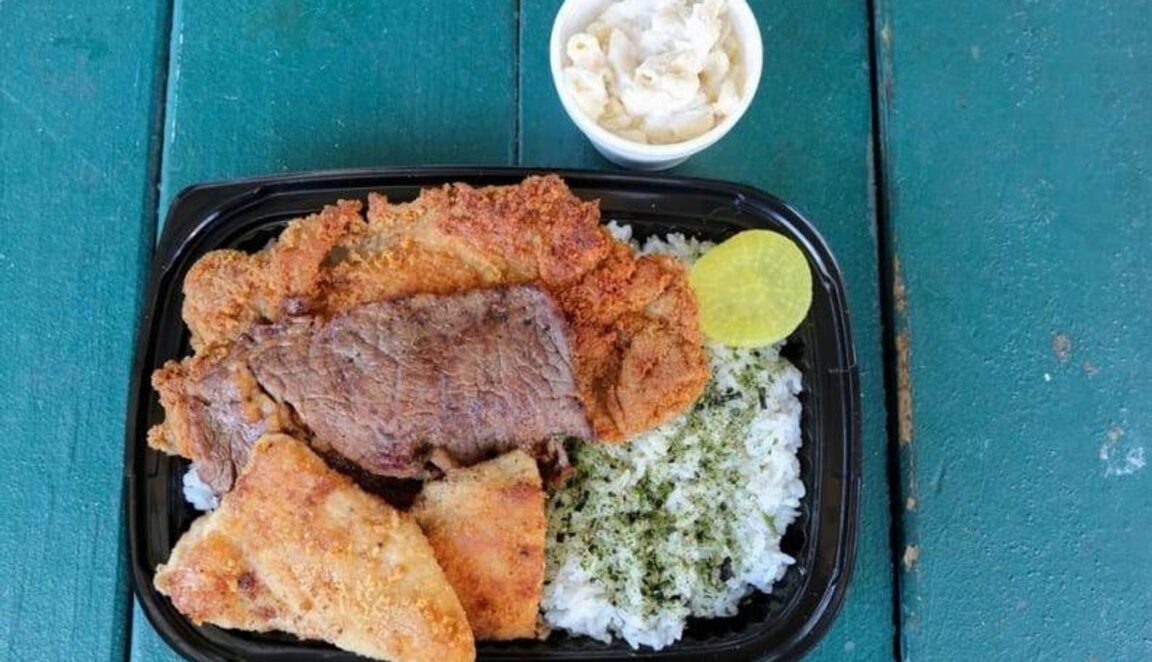
Rainbow Drive-In is that teaching plate. Its official site records that Seiju and Ayako Ifuku opened the Kapahulu original in 1961, at 3308 Kanaina Avenue, and that the location still serves daily from 7:00 AM to 9:00 PM, with breakfast until 10:30 AM. The official Kapahulu menu confirms the standard build, two scoops of rice and one scoop of macaroni salad with plate lunches, with fries substitutable for rice and coleslaw for macaroni salad. For a first order, the menu itself points to the Mix Plate, which combines BBQ Beef, Boneless Chicken and Mahi Mahi on one plate, the single most efficient survey of the kitchen. The Loco Moco Plate, two hamburger patties over rice topped with gravy and two eggs cooked to order, is the alternative for travellers who want the tradition’s most famous single dish, and the Chili Plate carries what the restaurant calls its famous chili, made with ground beef, kidney beans, garlic, herbs and spices. Daily specials rotate through dishes such as roast pork with gravy and kalua pig and cabbage on selected days, so the board on the day is worth reading before ordering. Note the practical details on the official locations page before a late November visit, since holiday schedules and an annual cleaning closure are posted there.
Where does traditional Hawaiian food survive intact?
Plate lunch is local food, the everyday cooking of modern Hawaii. Traditional Hawaiian food is the older table underneath it: kalua pig, laulau, poi, lomi salmon, squid luau, chicken long rice and haupia, dishes with roots in Native Hawaiian cooking and the generations of adaptation since. Fewer restaurants serve that table whole, and fewer still serve it unchanged. That is why Helena’s matters out of proportion to its size.
Helena’s Hawaiian Food, Kalihi
Helena’s official site tells its own story plainly. Helen Chock opened Helena’s Hawaiian Food in 1946 on North King Street in Honolulu. In 2000 the James Beard Foundation gave it the Regional Classic Award, an honour the site notes only a handful of Hawaii restaurants hold. The restaurant later moved to its current address at 1240 N. School Street in Kalihi and is now run by Helen’s grandson, Craig Katsuyoshi. The site describes it, accurately, as remaining the simple and unpretentious eatery it was decades ago. The ordering style is part of the education: dishes come in small, shareable portions built for a table to assemble its own spread, so a group can work across kalua pig, pipikaula style short ribs, laulau, lomi salmon and squid luau, with poi or rice as the base and haupia to finish. Two planning warnings belong in any honest guide. First, Helena’s keeps limited days and hours compared with a drive-in, and its official homepage posts seasonal closures, including a Thanksgiving period closure notice, so checking the site or phoning before crossing town is essential rather than optional. Second, Kalihi is a working neighbourhood well beyond the Waikiki bubble, which is precisely the point of going, but it rewards travellers who arrive with the address written down and a return ride planned.
Why is the malasada queue worth joining once?
Every food city has one queue that is genuinely part of the product, and in Honolulu it forms outside a pink fronted bakery on Kapahulu Avenue. The malasada is a Portuguese doughnut without a hole, and Leonard’s official site explains both the object and the claim: generously sized balls of dough fried until golden brown outside and light and fluffy inside, made by the bakery as part of the Portuguese tradition for Shrove Tuesday back in 1953, and now made continuously every day. The site calls Leonard’s Hawaii’s original malasada bakery, and the menu structure is simple. Malasadas come in coatings of plain sugar, cinnamon sugar and li hing, and the filled Malasada Puffs carry custard, dobash chocolate, haupia coconut, macadamia nut and guava, plus a rotating featured flavour, listed as pineapple when the site was checked for this guide. The official site also gives the queue skipping rule in writing: phone orders are welcomed at the Kapahulu Avenue store with a minimum order of one dozen, placed at least one hour ahead, and phone order customers go directly to the cashier rather than waiting in line. Travellers ordering fewer than a dozen should simply join the queue, order the plain sugar original first while it is hot, and treat any filled puff as the second act. A malasada is a food with a half life measured in minutes, and eating the first one immediately, in the car park or on the walk back toward Waikiki, is not impatience. It is correct technique.
How should the four stops be sequenced in one trip?
Split the guide across two outings rather than forcing a single marathon. On the Kapahulu day, start with poke in the late morning, when Tamura’s own advice about arriving early for the best selection still holds, then take the plate lunch at Rainbow Drive-In as the main midday meal, and finish at Leonard’s in the afternoon, when a hot box of malasadas works as both dessert and the walk back snack. On a separate day, give Helena’s its own lunch, arriving within its posted hours and ordering for the table rather than per person. Travellers continuing beyond Oahu can pair the eating with the island chain’s bigger walks, including our guide to hiking the Kalalau Trail on Kauai and its permit system, where trail food planning starts from exactly the same local counters. In all four places the etiquette is the same: order decisively, keep the line moving, and remember that these are neighbourhood institutions first and visitor attractions second.
Frequently Asked Questions
Is Kapahulu within walking distance of Waikiki hotels?
Yes for the Diamond Head end of Waikiki. Kapahulu Avenue begins at the eastern edge of the resort strip, and Rainbow Drive-In and Leonard’s Bakery both stand on or just off it. Helena’s in Kalihi and Tamura’s in Kaimuki are separate, longer trips best made by bus, taxi or car.
What should a first timer order at Rainbow Drive-In?
The Mix Plate. The official menu describes it as BBQ Beef, Boneless Chicken and Mahi Mahi together, served in the standard plate lunch format of two scoops of rice and one scoop of macaroni salad, which makes it the widest survey of the kitchen in a single order.
When is Helena’s Hawaiian Food open?
Helena’s keeps limited, weekday oriented hours and posts seasonal closures, including holiday closures, on its official homepage. Check helenashawaiianfood.com or phone ahead before travelling to 1240 N. School Street, because a wasted trip across town is the one predictable disappointment in this guide.
How can the Leonard’s Bakery queue be shortened?
Order ahead by phone. Leonard’s official site states that phone orders are welcomed at the Kapahulu store with a minimum of one dozen malasadas, placed at least one hour in advance, and that phone order pickups go directly to the cashier. Smaller orders join the regular queue, which moves steadily because malasadas are fried continuously.
What poke should a first timer try at Tamura’s?
Start with Ahi Shoyu, the classic style Tamura’s lists first among its named poke varieties on its official poke page. It is the benchmark against which every other style, including Ahi Ginger Wasabi and Ahi Sunrise, can be judged, and the site advises arriving early because quantities are limited.
Are these restaurants suitable for a tight food budget?
They are among the best value meals in Honolulu, because all four price for repeat neighbourhood customers rather than for hotel guests. Plate lunch and poke are filling formats by design, and sharing Helena’s small dishes across a table spreads the cost of the traditional menu. Check current menus on each official site on the day, since prices change.
Image: A Rainbow Drive-In Mix Plate in Honolulu, with barbecue beef, fried chicken and mahi mahi over rice and a side of macaroni salad. Photo by Rainbow Drive-In, via the restaurant’s own official website, rainbowdrivein.com, used with credit.