 James Wolfe
The way to enjoy the Metropolitan Museum of Art on a first visit is to stop trying to see it. Pick a route instead: the dated exhibition first, while its galleries are still calm, then the American Wing and the European Paintings, a quiet wing in the middle of the afternoon, and the Egyptian Art galleries and the Temple of Dendur saved for the final hour, when the crowds have gone and the temple sits almost alone in its glass wing. That single decision, Egypt last, turns the most overwhelming museum in the United States into a day with a beginning, a middle and an ending.
The Met Fifth Avenue, at 1000 Fifth Avenue on the Upper East Side, holds over 5,000 years of art from around the world, in the museum’s own words. No first visit covers it, and a first visit that tries will mostly remember corridors. The route below is built from the museum’s own collection information and visitor pages, checked on November 25, 2026 against metmuseum.org, and it is deliberately ruthless: three wings in depth, one exhibition, one quiet detour, and everything else left, happily, for a second trip.
Quick Facts
Address: The Met Fifth Avenue, 1000 Fifth Avenue, New York, NY 10028, at 82nd Street, on the eastern edge of Central Park.
Hours: Sunday, Monday, Tuesday and Thursday, 10 am to 5 pm. Friday and Saturday, 10 am to 9 pm. Closed Wednesdays, Thanksgiving Day, December 25, January 1, and the first Monday in May.
General admission: Adults $30. Seniors 65 and over $22. Visitors with a disability $22, in person only. Students $17. Children 12 and under free. Members and Patrons free.
Pay what you wish: New York State residents, and students from New York, New Jersey and Connecticut, pay what they wish, with a minimum of $0.01 per ticket. It does not apply to other visitors. Online pay what you wish tickets require a New York State billing address, and New Jersey and Connecticut students buy in person with valid student ID.
Ticket scope: Admission covers the exhibitions and same day entry to The Met Cloisters, the museum’s medieval branch in Fort Tryon Park. Do not try to do both on a first visit.
Getting there: The 4, 5 or 6 train to 86th Street, then a walk of about half a mile west to Fifth Avenue, per the museum’s directions. The M1, M2, M3 and M4 buses run along Fifth and Madison Avenues.
Roof status, checked November 25: The Iris and B. Gerald Cantor Roof Garden is closed. Its 2025 season ended on October 19, 2025, and the space then closed for construction of the new Tang Wing, with an anticipated reopening in 2030. There is no roof visit on this route, in any season, until then.
Current headline exhibitions, as listed by the museum: Krasner and Pollock: Past Continuous, through January 31, 2027, and Costume Art, through January 10, 2027. The seasonal Christmas Tree and Neapolitan Baroque Creche is on view through January 6, 2027.
Why does a first visit to the Met need a route, not a wander?
Because the building punishes wandering. The Great Hall, the vaulted entrance hall inside the Fifth Avenue steps, sends visitors off in several directions at once, and every one of them looks like the main event. Visitors who follow their noses tend to drift through the nearest galleries, double back twice, and reach the famous rooms tired, late in the day, and at the same moment as everyone else who drifted.
A route fixes three things. It puts the one exhibition with a closing date first, before its galleries fill. It spreads the three beginner friendly wings across the day instead of stacking them into one exhausting block. And it saves the Egyptian galleries for the end, which is the subject of the last section of this guide and the best crowd dodge the museum offers. For a sense of how the same discipline works across town, compare the approach in our guide to the Museum of Modern Art without the backtrack, which likewise starts at the top and works down with intent.
Step one: the dated exhibition, before its galleries fill
Start with the exhibition that has a closing date. The museum’s current exhibitions list leads with Krasner and Pollock: Past Continuous, on view through January 31, 2027, alongside Costume Art, through January 10, 2027. Either makes a strong first stop for a first timer with an interest in modern art or fashion; choose one, not both, and go straight there from the Great Hall.
Treat this as the timed section of the day, whether or not a given date uses timed entry. Exhibitions with an end date draw a steady build of visitors from late morning onward, and the opening hour is the reliable quiet window. Give the chosen exhibition a focused 45 minutes to an hour, and leave while other visitors are still arriving. Everything else on this route is permanent collection, which means it can flex around lunch, fatigue and whim. An exhibition cannot flex around its closing date, so it goes first.
If the visit falls in the Christmas season, add the museum’s seasonal fixture instead of a second exhibition: the Christmas Tree and Neapolitan Baroque Creche, listed through January 6, 2027. It is a short, self contained stop, and seeing it early avoids the family crowds that build around it later in the day. Outside, before or after the visit, the Genesis Facade Commission on the Fifth Avenue front, Liu Wei’s Speculation, listed through June 8, 2027, can be seen from the street without a ticket at all.
Step two: the American Wing, the beginner friendly block
Of the three wings that reward beginners most, the American Wing comes first on the route because it reads like a story rather than a survey. Its anchor image is the one many visitors already half know: Emanuel Leutze’s Washington Crossing the Delaware, dated 1851, a vast canvas of the Christmas night crossing of 1776 that the museum lists among its collection highlights. Around it, the wing carries American painting, sculpture, furniture and period rooms, and its ongoing presentation The American Wing at 100 marks the wing’s centenary.
The wing’s built in rest stop is the Charles Engelhard Court, the glass roofed courtyard at its heart, and its built in quiet room is the Astor Chinese Garden Court, a 17th century style garden court of Taihu rocks, granite terrace and ceramic tile that the museum’s highlights list singles out. Use the court the way the route intends: sit down, look at the map, and decide what to skip. Skipping on purpose, while seated, is the whole skill this museum teaches.
Step three: European Paintings, the greatest hits hour
After lunch, take the European Paintings galleries as a greatest hits hour, not a complete survey. The museum’s own highlights point a first timer to a tight, satisfying set: Johannes Vermeer’s Young Woman with a Water Pitcher, from about 1662, Rembrandt’s Self-Portrait of 1660, Claude Monet’s Bridge over a Pond of Water Lilies of 1899, and Vincent van Gogh’s Self-Portrait with a Straw Hat of 1887. Add Pieter Bruegel the Elder’s The Harvesters of 1565, and a first timer has seen five paintings that each anchor a century, in one connected run of galleries.
The discipline here is time, not taste. Set an hour. Paintings reward lingering, but the route still owes the day a quiet wing and the Egyptian finale, and both are worth more than a second pass through rooms already seen. Travelers pairing the Met with the city’s other single building museums will find the same greatest hits logic in our guide to the Guggenheim Museum done in one ramp and in our coverage of the Frick Collection, reopened and rehung.
Where did the roof go? The Roof Garden season, honestly stated
Older guides send first timers up to the Iris and B. Gerald Cantor Roof Garden for the view across Central Park, and in a normal year that advice is sound: the roof is a seasonal space, open roughly from spring to autumn, weather permitting, with an annual Roof Garden Commission installed for the season. In late November it would be out of season in any case.
This year there is a bigger fact. The 2025 commission, Jennie C. Jones’s Ensemble, on view from April 15 to October 19, 2025, was, in the museum’s own words, the final Roof Garden Commission before the space temporarily closes in preparation for construction of the Tang Wing, the museum’s new home for modern and contemporary art. The series will resume following the anticipated 2030 reopening of the renovated wing, which will feature an expanded Cantor Roof Garden on the fourth floor. So the honest answer for anyone visiting now is simple: the roof is closed, not for the winter but for years, and no route should promise it. Build the Central Park view into the walk to or from the museum instead, along Fifth Avenue or through the park at 79th or 85th Street, and save the roof for a trip after 2030.
Step four: a quiet wing for the mid afternoon slump
Every Met visit hits a wall in mid afternoon, and the correct response is not coffee and another blockbuster gallery. It is a quiet wing. The museum is full of rooms that most day visitors never reach, and they are at their emptiest exactly when the famous galleries are at their fullest.
Good choices, depending on taste, include the Asian Art galleries around the Astor Court, the Arts of Africa and Arts of Oceania presentations, the Medieval Art galleries, and the American Wing’s period rooms, which reward slow looking at furniture, silver and whole reconstructed interiors. None of these requires prior knowledge, all of them allow conversation at a normal volume, and 30 unhurried minutes in any one of them resets a visitor for the finale better than any espresso. Choose one, only one, and let the others go.
Step five: the Egyptian galleries at closing time
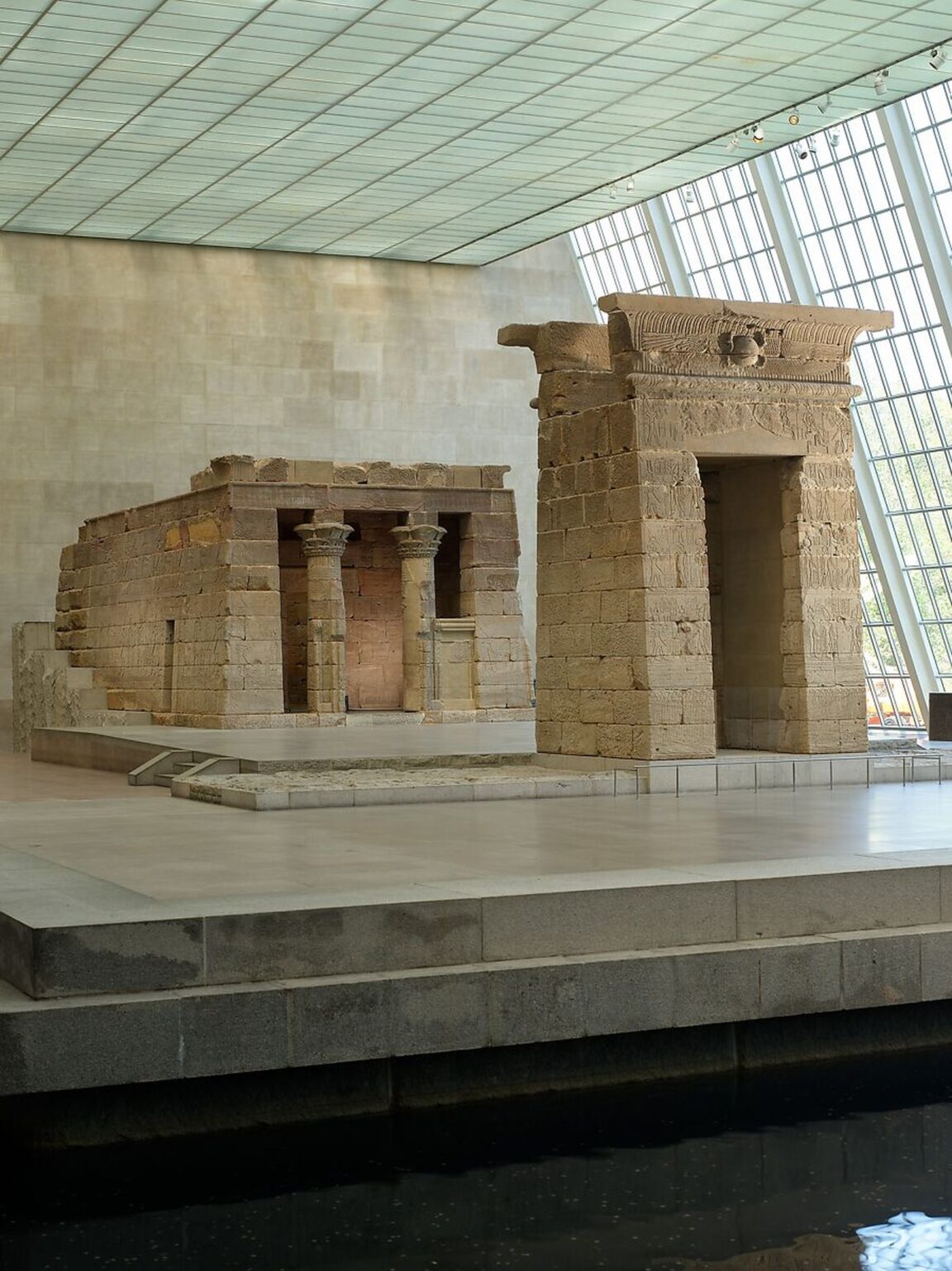
Finish where the museum itself is most theatrical: Egyptian Art, in the last hour of the day. The department’s centrepiece is the Temple of Dendur, and the museum’s collection record gives its facts plainly. The temple was built about 15 BC, in the reign of Augustus, who is shown on its reliefs in the traditional regalia of a pharaoh. It honoured the goddess Isis and, beside her, Pedesi and Pihor, deified sons of a local Nubian ruler. It is carved from Aeolian sandstone, its porch columns rise like bundles of papyrus stalks with lotus blossoms, and the sun disk flanked by the wings of Horus spreads above its gate and entrance.
Its modern history is as remarkable as its ancient one. Given to the United States by Egypt in 1965, and awarded to the Metropolitan Museum of Art in 1967, the temple was installed in a wing purpose built to house it, opening to the public on September 27, 1978. It stands beside a reflecting pool that evokes the Nile in its original Nubian setting, under a vast slanted glass wall, which is why the hour matters: late in the day the gallery empties, the light through the glass softens, and the temple can be walked around slowly, read properly, and taken in without a crowd in front of every relief.
On a Friday or Saturday, when the museum stays open until 9 pm, this strategy is at its strongest. Arrive at the Egyptian galleries in the final 60 to 90 minutes, work through the department’s sculpture, jewellery and funerary material toward the temple, and let the temple be the last room of the day. On a 5 pm closing day the same plan works, compressed: be in Egyptian Art by 4 pm, and accept a shorter pass through the quiet wing to pay for it. Leaving through the Great Hall as the museum closes, past visitors arriving for nothing and staff beginning the nightly reset, is a better ending than any gift shop.
What are the mistakes first timers make at the Met?
The first is arriving on a Wednesday, when the museum is closed, a trap built into many New York itineraries. The second is assuming pay what you wish applies to everyone: it applies to New York State residents and to New York, New Jersey and Connecticut students only, and everyone else pays the full general admission listed in the Quick Facts above. The third is trying to add The Met Cloisters on the same day because the ticket allows it. The ticket does allow same day entry to both, but the Cloisters sit in Fort Tryon Park at the northern tip of Manhattan, and combining the two turns a good day into two rushed halves. Give the Cloisters their own morning. The fourth mistake is the oldest one: entering without a route and leaving, three tired hours later, having seen a fraction of three wings and none of them properly.
Frequently Asked Questions
How much does the Met cost for a visitor from outside New York?
Full general admission: $30 for adults, $22 for seniors 65 and over, $17 for students, and free for children 12 and under, per the museum’s visitor pages. Pay what you wish does not apply: it is reserved for New York State residents and New York, New Jersey and Connecticut students, who must pay at least $0.01 per ticket.
Is the Met Roof Garden open in November?
No. The Cantor Roof Garden is seasonal in a normal year, roughly spring to autumn, and it is currently closed for a much longer period: its last season ended on October 19, 2025, and the museum states the Roof Garden Commission series will resume following the anticipated 2030 reopening of the renovated Tang Wing, with an expanded roof garden on the fourth floor.
What should a first timer see at the Met if there is only one day?
The route in this guide: one dated exhibition first, currently Krasner and Pollock: Past Continuous, through January 31, 2027, or Costume Art, through January 10, 2027; then the American Wing, anchored by Leutze’s Washington Crossing the Delaware; an hour of European Paintings highlights by Vermeer, Rembrandt, Monet, Van Gogh and Bruegel; one quiet wing in mid afternoon; and the Egyptian Art galleries and Temple of Dendur in the final hour.
When is the Met open late?
Friday and Saturday, until 9 pm. Sunday, Monday, Tuesday and Thursday it closes at 5 pm, and it is closed all day Wednesday, as well as on Thanksgiving Day, December 25, January 1 and the first Monday in May. Late opening is what makes the closing time Egyptian strategy work best.
Does one Met ticket cover both museum locations?
Yes, admission includes same day entry to The Met Fifth Avenue and The Met Cloisters, and covers the exhibitions. Same day is the limit, and first timers are better served by giving each location its own day.
How long does this first visit route take?
About five to six hours with lunch and rest stops: roughly an hour for the opening exhibition, an hour for the American Wing, an hour for European Paintings, half an hour in a quiet wing, and the final hour in Egyptian Art. On a late opening Friday or Saturday, the same route can be spread across an afternoon and evening instead.
Image: The Temple of Dendur in its purpose built wing at The Metropolitan Museum of Art, New York, beside its reflecting pool. Photo: The Metropolitan Museum of Art, via metmuseum.org, the museum’s official website, Open Access image, used with credit.
Facts checked November 25, 2026, against the Metropolitan Museum of Art’s official site, metmuseum.org: opening hours, admission and pay what you wish rules, exhibition dates, the Roof Garden closure and the Temple of Dendur collection record. Prices and gallery availability can change; confirm on metmuseum.org on the day of a visit.