 Elena Vasquez
Te Papa, the Museum of New Zealand Te Papa Tongarewa at 55 Cable Street on the Wellington waterfront, is best planned as two focused visits rather than one exhausting sweep: start on Level 2 with Gallipoli: The Scale of Our War, allow a full hour or more for its emotional weight, then work through Te Taiao | Nature and the colossal squid on the same floor before climbing to the Māori, Pacific and art galleries above. The museum is open every day from 10am to 6pm, except Christmas Day. Entry is free for New Zealanders and people living in New Zealand, while international visitors aged 16 and over pay NZ$35 for a ticket that stays valid for 48 hours, so a traveller can split the museum across two days at no extra cost. International visitors under 16 enter free.
Quick Facts
Address: Museum of New Zealand Te Papa Tongarewa, 55 Cable Street, Wellington 6011, on the waterfront in Te Aro.
Hours: Open daily 10am to 6pm, except Christmas Day, verified on Te Papa’s official site on 25 November 2026.
Entry for New Zealanders: Free for all New Zealanders and people living in Aotearoa New Zealand, including visitors from Niue, the Cook Islands and Tokelau, New Zealanders living overseas, and people living in New Zealand on a visa that allows them to study, work or live in the country.
Entry for international visitors: NZ$35 for ages 16 and over, valid for 48 hours so visitors can return the next day at no extra cost. Under 16s enter free. Tickets are sold online and at the ticket desk on Level 2.
What the entry ticket covers: Permanent exhibitions and galleries. Special paid exhibitions, guided tours, StoryPlace and paid events require separate tickets.
Do not miss: Gallipoli: The Scale of Our War on Level 2, the colossal squid in Te Taiao | Nature on Level 2, Bush City outdoors on Level 1, and Toi Art on Levels 4 and 5.
Time needed: Te Papa advises allowing 60 minutes or more for Gallipoli alone, and says most visitors spend two hours or more in the museum overall. A floor by floor visit needs half a day or two shorter visits inside the 48 hour ticket window.
Why does Te Papa need a plan at all?
Te Papa is New Zealand’s national museum, and it carries several jobs at once. It is a natural history museum, the holder of the national art collection, a Māori and Pacific cultural institution, and a social history museum, stacked across six levels in one waterfront building. A visitor who simply follows the escalators will see a great deal and understand the order of almost none of it. The building rewards a sequence: the land and its creatures first, the people and their stories next, and the art last, when the context underneath it makes more sense.
The second reason to plan is emotional rather than logistical. The museum’s most famous exhibition is also its heaviest. Gallipoli: The Scale of Our War is not a gallery to squeeze in at the end of a long afternoon when attention is thin. It asks for quiet, time and a pause afterwards. Building the day around it, rather than stumbling into it, is the single most useful decision a first time visitor can make.
Level 2 first: how should you handle Gallipoli?
Gallipoli: The Scale of Our War, listed by Te Papa as a long term exhibition on Level 2 and free with museum entry, tells the story of the eight month Gallipoli campaign in the First World War through the eyes and words of eight ordinary New Zealanders who found themselves in extraordinary circumstances. Te Papa created it working closely with Wētā Workshop, the Wellington creative studio, and it opened on 18 April 2015 to mark the centenary of the campaign. Te Papa has since extended it repeatedly, most recently announcing it will remain until April 2032.
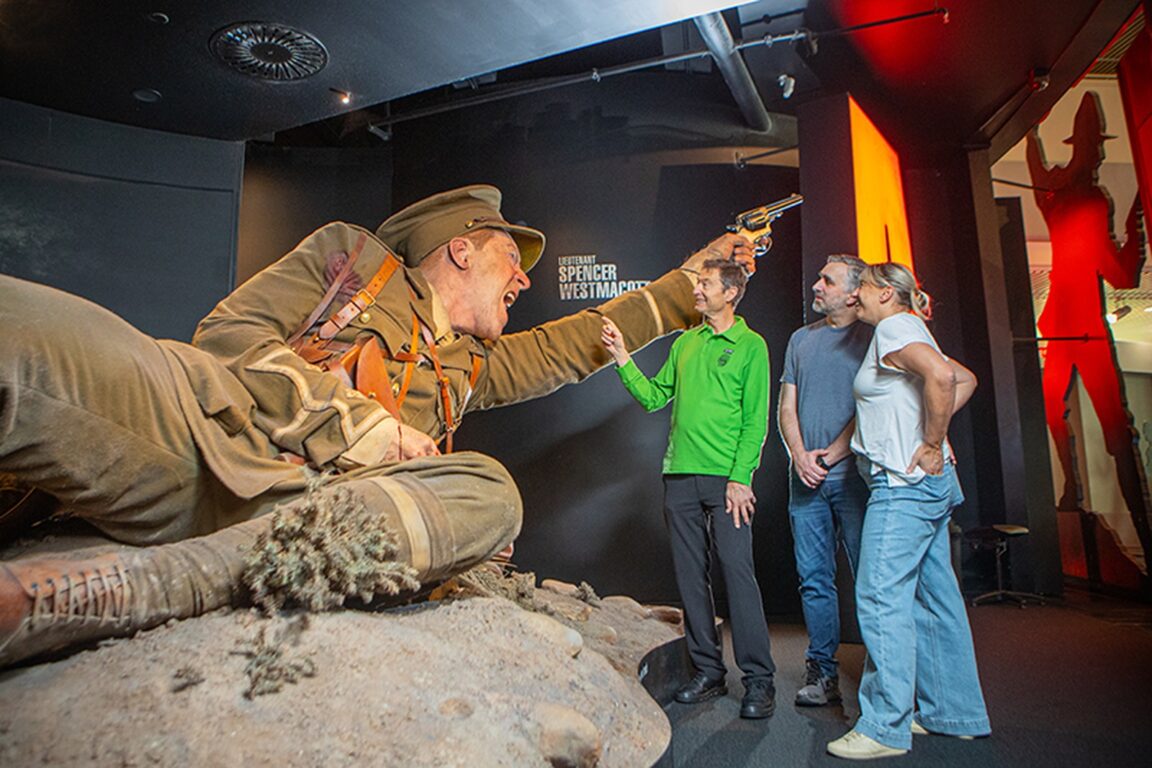
The exhibition’s centrepieces are eight hyper realistic figures, seven servicemen and a nurse, each frozen in a single moment at 2.4 times human size. Wētā Workshop spent more than 24,000 hours creating the figures, photographing and digitally scanning living models and finishing details down to individual hairs and pores. The scale is the point. A wounded soldier, a machine gun team, a nurse reading a letter marked as undeliverable because its recipient had been killed: at life size these would be moving, at two and a half times life size they are overwhelming, and visitors regularly need to sit down inside the exhibition.
Around the figures, the exhibition uses 3-D maps and projections, miniatures, models, dioramas and interactive elements to explain a campaign in which, as Te Papa states, 2,779 New Zealanders lost their lives. Te Papa advises allowing 60 minutes or more, and that should be read as a minimum rather than a target. The exhibition contains graphic content and realistic sound, variable lighting and some small spaces, and Te Papa asks adults to supervise children and to keep phones on silent with photography permitted but no flash. A one hour guided Gallipoli tour also runs from the museum, listed at 9.30am, for visitors who want the stories narrated rather than read.
Practically, go early. Arriving close to the 10am opening and heading straight to Level 2 puts Gallipoli ahead of the day’s school groups and tour parties, and it leaves the lighter floors for afterwards, when a coffee and daylight are genuinely useful. If the exhibition lands heavily, that is expected. Te Papa Cafe on Level 1 is open 9am to 5pm, with its kitchen closing at 3pm, and the waterfront outside the front door is a five minute reset whenever it is needed.
What else is on Level 2? Te Taiao | Nature and the colossal squid
Sharing Level 2 is Te Taiao | Nature, Te Papa’s natural environment zone, which brings mātauranga Māori and science together around New Zealand’s unique wildlife, geological forces and the work of caring for natural taonga. It is the right floor to visit after Gallipoli: hands on, bright and full of children testing interactive displays, including the earthquake experience that reminds visitors the museum itself stands in a seismic country and is protected by base isolators visitors can see elsewhere in the building.
Te Taiao’s star specimen is the colossal squid. Te Papa states that it is home to the world’s only complete colossal squid specimen on public display, now preserved in a specially designed tank inside Te Taiao | Nature. The squid, a female of the species Mesonychoteuthis hamiltoni, was caught in February 2007 by the New Zealand longlining vessel San Aspiring, fishing for Antarctic toothfish in the Ross Sea. Te Papa’s published figures for the displayed specimen are 4.2 metres long and 495 kilograms, with a mantle length of 2.5 metres, and the museum holds two further large intact specimens in its collection behind the scenes. August 2025 marked a century since the species was first named scientifically in 1925, and Te Papa marked the anniversary with a reminder of how little is still known about an animal that lives in deep, near freezing Antarctic water. Visitors can examine the squid’s anatomy, including models of its beak and tentacle, and the swivelling hooks on its tentacle clubs that distinguish it from the better known giant squid.
Also on Level 2 are the ticket desk, the Toa Tamariki children’s store, and StoryPlace, Te Papa’s ticketed storytelling and play space for children aged five and under, which needs its own ticket on top of museum entry.
Level 1: what is Bush City, and when should you use it?
Level 1 holds the main entrance, Te Papa Cafe, the main Te Papa Store and the museum’s outdoor living exhibition, Bush City. Bush City is a native bushwalk built into the waterfront site, with planting, a cave and fossil dig style activities that give children a run outdoors between galleries. It works best as a hinge in the visit: after Level 2’s intensity, or as the reward at the end of a morning for younger travellers before lunch in the cafe. Because it is outdoors, use it when the Wellington weather allows rather than saving it for a moment when wind or rain has closed the option down. Lockers are on Level 1 for coats and bags, for a fee, and free WiFi runs through the building under the name Free-Te-Papa-WiFi.
Levels 3 and 4: how do the land and people floors work?
Level 3’s long running exhibition Blood Earth Fire: Whāngai Whenua Ahi Kā traces how people changed New Zealand’s landscape, from burning and clearing to farming and conservation, and it pairs naturally with Te Taiao below it. Read together, the two floors tell one story from two directions: what this land was, and what its people made of it.
Level 4 is the museum’s human heart. Mana Whenua presents Māori taonga and the continuing story of Māori as tangata whenua, and Rongomaraeroa, Te Papa’s contemporary marae designed under the direction of master carver Cliff Whiting, functions as a living ceremonial space rather than a display behind glass. Pacific cultures, the Treaty of Waitangi exhibition Signs of a Nation, and New Zealand social history share the level, alongside a favourite single object: the Britten V1000 motorcycle, the record breaking machine built in Christchurch by John Britten. Visitors heading north after Wellington will find the Māori cultural groundwork laid here pays off across the country, including in geothermal Rotorua, where living villages carry the same traditions in daily practice, as our guide to Rotorua’s Māori culture experiences explains.
Levels 4 and 5: what is Toi Art?
Toi Art, spread across Levels 4 and 5, is where Te Papa performs its second job as New Zealand’s national art gallery, drawing on the national art collection for historical and contemporary exhibitions. Among the exhibitions Te Papa lists as on now is He Toi Whakairo: The Art of Māori Carving, with more than 140 whakairo, or carvings, spanning seven centuries, many never exhibited before. Art at Te Papa rotates, so the honest advice is to check the exhibitions page on the museum’s own site on the morning of a visit rather than trusting any guide, including this one, for the current hang. Give Toi Art its own block of time rather than leftovers: an hour on the upper floors, finishing with the building’s harbour outlook, is a calmer ending to the museum than a final lap of the busiest ground floors.
Are there paid exhibitions on top of entry?
Yes, and Te Papa is explicit about the split. The entry ticket, free for New Zealanders and NZ$35 for international visitors aged 16 and over, covers the permanent exhibitions and galleries, including Gallipoli and Te Taiao. Special paid exhibitions and experiences, guided tours, StoryPlace and paid events require separate tickets. The next major paid exhibition Te Papa lists is Game Worlds: Whakaaturanga Pureiapo | Playable Exhibition, a playable videogames exhibition developed by ACMI in Australia, running from 12 December 2026 to 26 April 2027, with more than 30 iconic games and 44 playable moments from the 1970s to today. Te Papa’s published ticket prices for Game Worlds are NZ$30 for adults, NZ$25 concession, NZ$15 for children under 16, free for children under 5, with family passes also listed. Travellers whose Wellington dates fall inside that window should book it separately and not assume their 48 hour museum entry covers it.
How should a Wellington day wrap around Te Papa?
The museum’s 10am to 6pm rhythm and the 48 hour international ticket make two shapes work. Shape one is the full museum day: Gallipoli at opening, Te Taiao and the squid before lunch, the cafe on Level 1, then Levels 3 and 4 in the early afternoon and Toi Art to finish, with Bush City slotted in whenever the weather is kindest. Shape two, often better with children or in unsettled weather, splits the museum: Gallipoli and Level 2 on day one, the upper floors on day two, at no extra entry cost for international ticket holders and no cost at all for New Zealanders.
Either way, Te Papa sits in Te Aro, a short walk from Cuba Street, so the museum pairs naturally with Wellington’s best eating streets before or after. Our guide to what to eat in Wellington, from Cuba Street kitchens to Hannahs Laneway, covers where to go when the museum closes at 6pm. Facts and prices checked against Te Papa’s official site on 25 November 2026.
Frequently Asked Questions
Is Te Papa free to visit?
Entry is free for all New Zealanders and people living in Aotearoa New Zealand, including people living in New Zealand on a visa that allows them to study, work or live in the country. International visitors aged 16 and over pay NZ$35, and international visitors under 16 enter free, as Te Papa’s official tickets page states.
How long is the international visitor ticket valid?
48 hours. Te Papa states that the NZ$35 ticket lets international visitors return the next day at no extra cost, which makes splitting the museum across two shorter visits the smart way to use it.
How long should visitors allow for the Gallipoli exhibition?
Te Papa advises 60 minutes or more. The exhibition is on Level 2, is free with museum entry, and contains graphic content and realistic sound, so families should prepare younger children before entering.
Where is the colossal squid, and how big is it?
The colossal squid is on display in Te Taiao | Nature on Level 2. Te Papa describes it as the world’s only complete colossal squid specimen on public display, caught in the Ross Sea in February 2007, and publishes its size as 4.2 metres long and 495 kilograms.
What are Te Papa’s opening hours?
Te Papa is open every day from 10am to 6pm, except Christmas Day, at 55 Cable Street on the Wellington waterfront.
Does museum entry include special exhibitions?
No. Entry covers the permanent exhibitions and galleries. Te Papa states that special paid exhibitions and experiences, guided tours, StoryPlace and paid events require separate tickets, as the upcoming ticketed Game Worlds exhibition from 12 December 2026 illustrates.
Image: The giant figure of Lieutenant Spencer Westmacott in Gallipoli: The Scale of Our War at Te Papa, with a museum host and visitors. Photo: Te Papa, via the Museum of New Zealand Te Papa Tongarewa official website (tepapa.govt.nz), used with credit.