 Maya Chen
Yes, the guided tour is worth booking even if you have no performance ticket, because it is the only regular way for a non ticket holder to go inside the Sydney Opera House, hear the Utzon story told in the rooms it shaped, and understand why the white shells look the way they do. The standard Sydney Opera House Tour lasts one hour, runs in English and six other languages, and costs A$50 per adult when booked ahead on the official site, rising to A$55 on the day. Pair that hour with a slow harbour walk at dusk, from the Forecourt around Bennelong Point toward Mrs Macquarie’s Point, and the building stops being a postcard and becomes a place with a difficult, human history.
Quick Facts
Location: Sydney Opera House, Bennelong Point, Sydney, NSW 2000, a 7 to 10 minute walk from Circular Quay, per the official site.
Standard tour: The Sydney Opera House Tour, about 1 hour, guided, departing from the precinct during the day. Check the booking calendar on sydneyoperahouse.com for your date.
Price, checked 25 November 2026 on sydneyoperahouse.com: A$50 adult, A$40 concession, A$30 child aged 5 to 15 and A$130 family when booked ahead, with higher on the day prices including A$55 for adults. Children under five are free. Prices are scheduled to change from 1 April 2027, so confirm your date when you book.
Languages: English, French, German, Spanish, Japanese, Korean and Mandarin, on set departures.
Effort: Up to about 2.5 kilometres of walking and around 300 stairs, with no lift or escalator access on the standard route and limited chances to sit. A step free Mobility Access Tour is the alternative for wheelchair users and visitors using walkers.
Status: Designed by Danish architect Jørn Utzon, completed under Peter Hall, opened in 1973, and inscribed on the UNESCO World Heritage List in 2007.
What does the one hour guided tour actually show?
The official description is honest about the bargain. Beneath the sails, the site says, lie incredible spaces and stories, covering the controversial history, unforgettable performances and the future of the building. In practice that means a trained guide leads the group through the foyers and into performance spaces that are available on the day, while telling the building story in sequence. The Opera House itself warns that it is one of the world’s busiest performing arts centres, staging over 2,000 shows a year on its own count, so what you see and where you go may differ each time depending on rehearsals, performances and availability. No tour can promise a particular hall, a rehearsal in progress or a backstage corridor, and any guide that promises all three should be treated with caution.
That variability is not a flaw to hide. It is the point of visiting a working house rather than a museum replica. A morning group might stand in a foyer while a stage crew works behind closed doors. An afternoon group might enter a hall that was dark an hour earlier. The constant elements are the architecture itself, the harbour light through the foyer glass, the scale of the podium and the story the guide tells against those backdrops. Judged on those constants, the hour earns its price for a first time visitor who cares about design, music or Sydney history. Judged as a guaranteed tour of every famous room, it would disappoint, because no such guarantee exists.
Allow more than the hour for the whole visit. Arrive early enough to find the Welcome Centre on the Lower Concourse, clear any bag checks, and look at the building from the Forecourt before the group sets off. After the tour, the precinct, the podium steps and the harbour edge reward another hour on their own, especially late in the day. A realistic total is two to three hours for tour, photographs, a drink and the dusk walk described below. Visitors building a wider first trip can place that half day inside the harbour to beaches structure set out in the first time in Sydney four day itinerary, which sequences the Opera House precinct with Circular Quay and the eastern beaches.
Is the standard tour physically demanding?
Yes, more than most visitors expect from a one hour city tour, and the official site states the numbers plainly. The route walks up to 2.5 kilometres and climbs and descends around 300 stairs. There is no lift or escalator access on that route, limited opportunity to sit and rest, and visitors should expect to be on their feet for the full hour. Comfortable shoes are not a courtesy tip here. They are the difference between listening to the guide and counting steps.
That does not make the building inaccessible. It makes the booking choice important. The Opera House offers a Mobility Access Tour on a step free route for wheelchair users and people using walkers, and that, not the standard tour with fingers crossed, is the correct booking for anyone for whom 300 stairs would be a barrier. Check the departure times and booking rules for that tour on the official site for your date, because they are set departures rather than every departure. Families should also note the child pricing band, ages 5 to 15, and that under fives are free, while weighing whether a younger child will enjoy an hour of standing and listening. For children who will not, the free alternative is strong: the Forecourt, the podium and the harbour walk give the shells, the scale and the setting without the stairs or the ticket.
Who was Jørn Utzon, and why did he leave?
The short version the tour tells, and the version supported by the Opera House and World Heritage accounts, runs like this. In 1956 the New South Wales Government ran an international design competition for a performing arts centre with two main halls on Bennelong Point. In January 1957 the Danish architect Jørn Utzon was announced as the winner, with a dramatic scheme of two halls side by side on a vast podium, each topped by soaring, interlocking shell shapes facing the harbour. Construction began in 1959. The shells, which looked effortless in drawings, proved extraordinarily hard to build as first conceived, and costs and delays mounted well beyond the original expectations.
Utzon’s breakthrough, retold on every tour, was geometric. The final shell shapes were derived from the surface of a single sphere, so the great ribs could be built from repeated precast concrete segments rather than as a set of unique freeform curves. The Australian Government’s World Heritage account describes the same solution: each shell is composed of precast rib segments radiating from a concrete pedestal and rising to a ridge beam, faced in glazed off white tiles. That single idea is why the building could be finished at all, and standing under the shells after hearing it changes how they read. They stop looking like sails frozen mid billow, although the sail comparison is the one every visitor brings, and start looking like a solved engineering problem of real elegance.
The human story is harder. Amid disagreements with the government authorities who had taken over the project, and disputes over costs, fees and the direction of the work, Utzon resigned in 1966 and left Australia. He never returned to see the finished building in person. An Australian team headed by Peter Hall completed the work, including the interiors and the glass walls, following modified designs. The building was formally opened by Queen Elizabeth II on 20 October 1973. In later life Utzon was reconciled with the project in an important way: in 1999 he agreed to return as the building’s architect in principle, overseeing design principles and improvement work, and the small performance space now known as the Utzon Room honours that connection. A good guide does not turn this into a simple hero and villain story. The evidence supports a more useful reading: a visionary design, an engineering problem solved brilliantly, a political and financial relationship that broke down, and a second architect who carried an unfinished masterpiece into working life.
What should you look for in the shells and the podium?
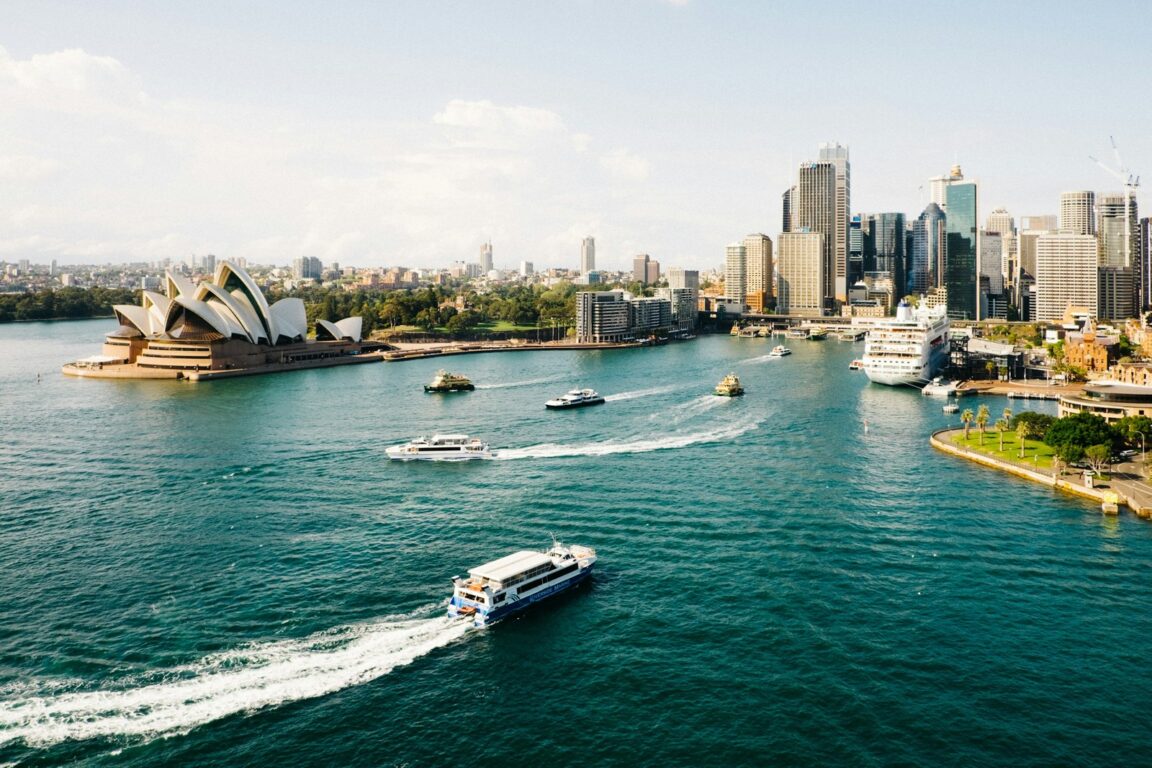
Start from a distance, then come close. From across Circular Quay or from the harbour, the three groups of interlocking vaulted shells sit on a vast terraced platform, in the World Heritage description, surrounded by terrace areas that act as pedestrian concourses. That podium is not a plinth added for grandeur. It is the building’s public ground, lifting the halls above the point and giving Sydney a stepped, open air room between city and water. Walking its full width before or after a tour makes the composition legible in a way no photograph does.
Close up, look for the tile pattern. From the water the shells read as uniformly white. At hand distance they carry a subtle chevron pattern in two tones, glossy white and matte cream, across more than a million tiles. That pattern is why the surface glows rather than glares in hard harbour sun, and why it shifts tone at dusk from white to pale gold to grey blue. Look also at the ribs fanning inside the foyer glass, the earth toned granite of the podium, and the way the glass walls frame the harbour as part of the interior. None of this needs specialist language to enjoy. It needs time, which is the strongest argument for arriving before your tour rather than running for it.
Where are the best harbour angles at dusk?
Dusk is the hour this building was, in effect, designed for, even if no architect can design a sunset. The shells face the harbour, the podium terraces face west and north, and the light changes across the tiles minute by minute. Work through four positions in order, allowing about 45 minutes, and stop at the one that suits the evening rather than rushing all four.
First, the Forecourt and podium steps, for the frontal view most visitors know, with the shells rising directly ahead and the harbour behind you. Second, the western boardwalk side on the Lower Concourse, looking back at the shells with the Sydney Harbour Bridge in the same frame. This is the classic two icon composition, and it is also where the precinct’s bars and cafes sit. Third, continue around Bennelong Point toward the Royal Botanic Garden and Mrs Macquarie’s Point, where the Opera House is seen in profile across the water with the city behind it. That eastern angle is the one that best shows the shells as a sequence rather than a single cluster. Fourth, for visitors staying into the evening in the warmer months, the Vivid season view from under and around the Harbour Bridge shows the sails as a projection canvas, a very different building again. The seasonal order for that walk is covered in the Sydney Vivid Festival light walk guide. In ordinary weeks, simply staying on the point until the foyer lights come on and the tiles lose their colour is reward enough. Ferries crossing to Manly and the harbour suburbs give one more angle on the return, from the water itself, with the shells lit against the darkening point.
What about eating and drinking in the precinct?
Only two names need care here, because the precinct changes its operators and visitors often arrive with an out of date list. Opera Bar, on the Lower Concourse, is described on the official site in its current form as the new reimagined Opera Bar, now open with a market kitchen bringing together flavours from Sydney’s suburbs, from Asian and Middle Eastern dishes to pizza and Australian classics, championing New South Wales produce, with cocktails and New South Wales wine and beer, live music every night, and front row views of the Harbour Bridge. Its official hours are Sunday to Thursday 11am to late, and Friday and Saturday 11am to midnight. That makes it the natural dusk stop after a tour: no booking logic to learn, the bridge in front of you, and the shells behind you.
Visitors looking for the House Canteen by name should know that the official Eat and Drink page no longer lists it under that name. The all day venue now listed on the Lower Concourse beneath the sails is Winnie’s, described officially as a new all day dining destination offering a dedicated coffee program, pastries, seafood driven share plates and an all Australian wine and cocktail list, with 330 seats overlooking Sydney Harbour from morning coffee to sunset drinks, and named for Winifred Atwell, the first woman to perform at the Opera House. In practical terms, plan on Winnie’s for coffee and an all day menu, and on Opera Bar for the evening drink, and confirm current hours on the official site on the day, because hospitality hours in the precinct change by season and performance schedule. The Tour and Dine package, which pairs the guided tour with a meal at a precinct venue, is the bundled alternative and is also booked through the official site.
Should you book the tour, a performance, or just walk around?
Each option answers a different question. Walk around if you want the setting, the shells and the harbour, and you want them free and unhurried. The exterior precinct delivers that completely, and for some visitors, especially repeat visitors to Sydney, it is enough. Book the guided tour if you want the interiors without committing an evening and a performance ticket price, and if the architecture and construction story is the draw. That is the visitor this guide is written for, and for that visitor the tour is the single best value hour in the precinct. Book a performance if you want to hear a hall work, because no tour, however good the guide, can substitute for music in the Concert Hall or opera in the Joan Sutherland Theatre with an audience in the seats. The three are not rivals. The complete visit, spread across a stay, is a dusk walk on arrival, a tour on a weekday morning when groups are smaller, and a performance on the night you dress for it.
Prices checked 25 November 2026 against sydneyoperahouse.com. Tour availability, language departures and precinct hours change with the performance calendar, so confirm your exact date on the official booking calendar before travelling across the city for a specific departure.
Frequently Asked Questions
How long is the Sydney Opera House guided tour and how much does it cost?
The standard Sydney Opera House Tour lasts about one hour. Booked ahead on the official site it costs A$50 per adult, A$40 concession, A$30 per child aged 5 to 15 and A$130 for a family, with A$55 for adults on the day and children under five free. Prices were checked on 25 November 2026 and are scheduled to rise slightly from 1 April 2027.
Can you go inside the Sydney Opera House without a ticket?
Not into the performance halls. The foyers and halls are seen on a guided tour or with a performance ticket. The Forecourt, podium, exterior precinct and Lower Concourse venues are open to the public without a tour ticket, which is why the dusk harbour walk works as a free visit on its own.
In which languages is the tour offered?
The official site offers the Sydney Opera House Tour in English, French, German, Spanish, Japanese, Korean and Mandarin, on set departures rather than every departure in every language. Choose your language when you book on the official calendar.
Is the standard tour suitable for wheelchair users?
No. The standard route involves up to about 2.5 kilometres and around 300 stairs, with no lift or escalator access and limited seating. The Opera House offers a step free Mobility Access Tour as the alternative, and that is the booking to make for wheelchair users and visitors using walkers.
Why is the Sydney Opera House a World Heritage Site?
It was inscribed on the UNESCO World Heritage List in 2007 as a great architectural work of the 20th century. The listing recognises Jørn Utzon’s original design, the structural innovation behind the shells, and the building’s composition in its Sydney Harbour setting, completed after Utzon’s 1966 resignation by the team headed by Peter Hall and opened in 1973.
What is the best time of day to photograph the Opera House?
Late afternoon into dusk, for most visitors. The tile pattern on the shells shifts from white to gold to grey blue as the light falls, the foyer lights come on, and the angles from the podium steps, the western Lower Concourse and Mrs Macquarie’s Point each give a different composition within a short walk.
Image: Sydney Opera House and Sydney Harbour, by Dan Freeman via Unsplash, Unsplash License. Prices and tour details checked 25 November 2026 against the Sydney Opera House official site, sydneyoperahouse.com.