 Jordan Ellis
Arriving at JFK right now means arriving at a construction site that also happens to be one of the world’s busiest airports, and the passengers who cope best are the ones who know three things before they land: which terminal they are actually using, where their ride is now allowed to collect them, and why the Port Authority keeps telling everyone to take the train. The airport is in the middle of a $19 billion redevelopment that will shrink six working terminals into four anchor complexes. The Port Authority’s weekly JFK travel advisory is blunt about the consequences: roadway detours and closures, relocated pickups, periodic overnight AirTrain suspensions with free shuttle buses, and a standing instruction to use mass transit and allow additional time. This guide turns that advisory language into an arrivals plan.
Quick Facts
Project: The Port Authority’s $19 billion JFK redevelopment: a new Terminal 1, a new Terminal 6 beside Terminal 5, an expanded Terminal 4 and Terminal 8, a new ground transportation centre and a simplified roadway network.
Road access now: Use the Van Wyck Expressway for direct access to Terminals 1 and 4, and the JFK Expressway for Terminals 5, 7 and 8, per the current Port Authority advisory.
Rideshare change: Arriving passengers at Terminals 5 and 7 who want a for-hire vehicle or car service must ride the AirTrain to the Howard Beach AirTrain Station pickup lot. Departing passengers are still dropped off at the terminal, and ADA-accessible rides remain at the terminal front.
AirTrain: Free for travel within the airport, including trips to the Howard Beach pickup lot; the standard fare applies at the Jamaica and Howard Beach exits to the subway and LIRR, with periodic overnight full suspensions replaced by free shuttle buses.
Fastest Manhattan link: AirTrain to Jamaica, then Long Island Rail Road, with trains of about 20 minutes from Jamaica to Penn Station or Grand Central, per the Port Authority.
Drop-off workaround: The free drop-off and pickup lot at the AirTrain Lefferts Blvd station connects to the terminals by a free AirTrain ride of about eight minutes.
The terminal picture, without the nostalgia
JFK’s terminal numbers no longer describe a tidy ring. Terminals 1, 4, 5, 7 and 8 handle today’s flights while the new Terminal 1 rises on the south side and the new Terminal 6 rises beside Terminal 5 on the north side, on and around the old Terminal 6 and Terminal 7 sites. Airlines have already moved once in this programme and some will move again, which is why the terminal printed on a booking made months ago is a rumour, not a fact. Check the terminal in your airline’s app on the day of travel, and again on the departure board at your origin if you are connecting. Our earlier JFK terminal and AirTrain guide walks the airport terminal by terminal and remains the right companion piece to this arrivals briefing. The airport’s own site, JFK Airport’s official homepage, carries the live terminal and airline listings to check against.
For arriving passengers the terminal matters less for the building than for what waits outside it. Terminal frontages are the choke points of the whole redevelopment: lanes close, merge and reroute as roadway work advances, and the Port Authority warns motorists and for-hire vehicles to expect delays and detours as a matter of routine. That is the context for every other change in this article. Nothing at JFK has been moved to annoy you; it has been moved because the kerb cannot hold both a rebuilding programme and the old traffic pattern at once.
The rideshare relocation that catches Terminal 5 and 7 arrivals
The single most expensive mistake an arriving passenger can make is standing at the Terminal 5 or Terminal 7 kerb waiting for a car that is not allowed to come to them. Under the current arrangement, arriving passengers at those two terminals who want a ride app, for-hire vehicle or car service must take the AirTrain to the Howard Beach AirTrain Station, where the pickup lot has numbered spaces and staff on hand to help with luggage. The AirTrain trip to that lot is free, as all within-airport AirTrain travel is, even though Howard Beach is normally a paid exit station. Two boundaries keep the rule proportionate: it applies to arrivals only, so a departing passenger can still be dropped directly at the terminal, and ADA-accessible rideshare vehicles continue to collect at the terminal front. If you land at Terminal 1, 4 or 8, pickup generally remains at the terminal, though the advisory warns that exact arrangements can vary by time of day, so follow the signs and the app instructions on the day rather than a screenshot from a previous trip.
AirTrain disruptions: planned, overnight and replaced by buses
The AirTrain itself is periodically taken out of service for essential maintenance, typically overnight, and the Port Authority’s pattern in its weekly advisories is consistent: a full suspension in the late-night hours, free shuttle buses running between all AirTrain stations and terminals in its place, and an instruction to plan additional travel time. The lesson for arrivals is timing. A flight landing at 11 p.m. on a maintenance night does not connect to a silent, empty train; it connects to a bus queue. That is still a workable journey, and the buses are free, but it changes the maths on a tight last train from Jamaica or a pre-booked car at Howard Beach. Check the advisory for your exact arrival date in the week you travel, not the week you booked, because these suspensions are scheduled in weekly notices. Travellers with a long scheduled layover rather than a city stay should read our JFK long layover guide for how to use the airport’s own hours well.
Into Manhattan: the routes ranked by reliability
The Port Authority’s advice to use mass transit is self-interested and also correct. The most reliable arrival route is AirTrain to Jamaica Station, then the Long Island Rail Road into Penn Station or Grand Central, a rail leg the Port Authority puts at about 20 minutes, with the MTA’s official site carrying the timetables and fares for both the LIRR and the subway alternatives. The subway from Jamaica (the E train from Sutphin Boulevard) or from Howard Beach (the A train) is cheaper and slower, and at night it is slower still; it suits travellers with time, light bags and a destination on those lines. Taxis and rideshares suit travellers whose destination, luggage or mobility makes the train genuinely impractical, and they should be taken with the construction delays priced in: a car from JFK in this period is a commitment of well over an hour on a bad evening, plus tolls and tip. The free Lefferts Blvd drop-off and pickup lot exists for the mirror problem on departure day and is worth remembering if a friend is driving you back: they skip the terminal roadways entirely and you ride the AirTrain in for the last eight minutes.
Once you are in the city, the airport stops being the story. First-timers can build the days from our New York in three days first-timer itinerary, and anyone basing across the East River should compare neighbourhoods in our guide to where to stay in Brooklyn. If your arrival day has a free afternoon and the weather is kind, the ferry ride in our Governors Island ferry day guide is the gentlest possible landing in the city. The common thread is the same as at the airport: in New York right now, the train and the ferry beat the car almost every time.
Frequently asked questions
Where do I meet my Uber or Lyft if I land at Terminal 5 or 7?
At the Howard Beach AirTrain Station pickup lot. Ride app and car service pickups for arriving Terminal 5 and 7 passengers were relocated there because of construction. The AirTrain ride to the lot is free, and ADA-accessible rides remain available at the terminal front.
Is the AirTrain running all night?
Usually, but not always. The Port Authority schedules periodic overnight full suspensions for maintenance, replaced by free shuttle buses between all stations and terminals. Check the weekly travel advisory for your arrival date.
What is the fastest way from JFK to Manhattan right now?
AirTrain to Jamaica, then a Long Island Rail Road train to Penn Station or Grand Central. The Port Authority puts the Jamaica to Manhattan rail leg at about 20 minutes, and the route avoids the construction-hit roadways entirely.
Which expressway should my driver use?
Under the current roadway configuration, the Van Wyck Expressway gives direct access to Terminals 1 and 4, and the JFK Expressway serves Terminals 5, 7 and 8. Follow live signs on the day, since detours change with the works.
My booking shows a different terminal from the airline app. Which is right?
The airline app on the day of travel. Terminal assignments have shifted during the redevelopment and will shift again as the new Terminal 1 and Terminal 6 open in phases, so treat any older confirmation as out of date.
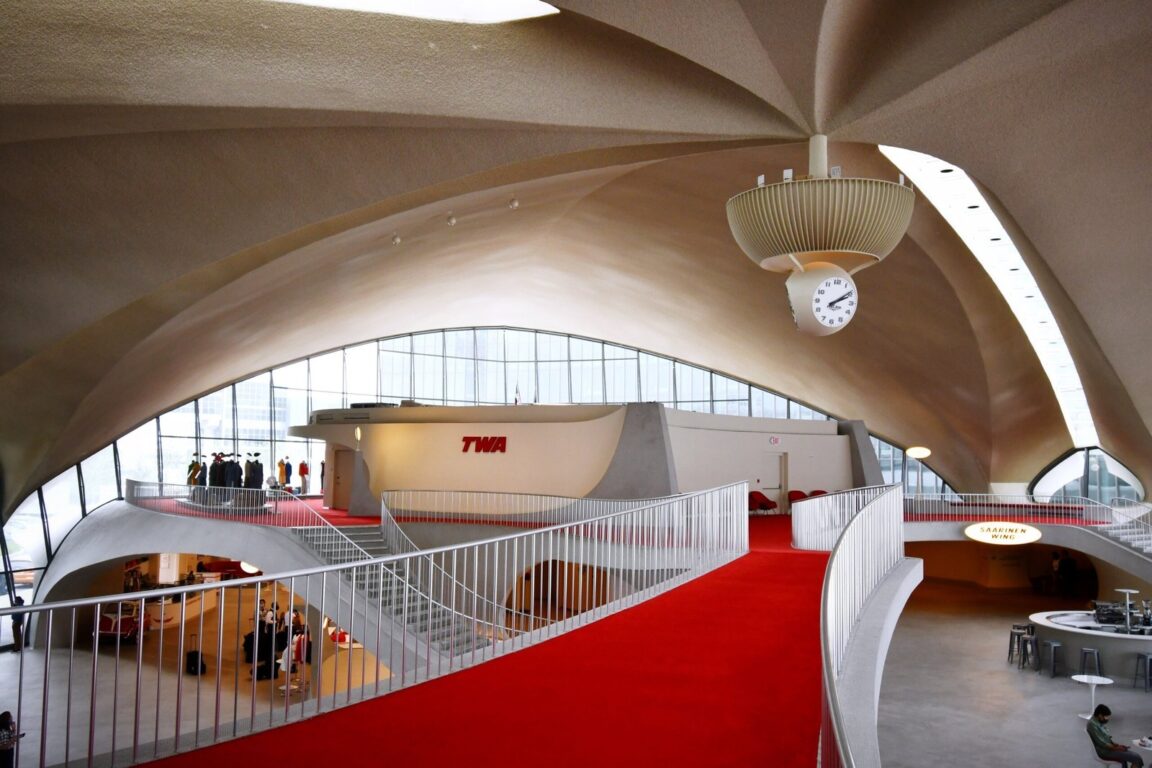
Image credit: Interior of the TWA Flight Center at JFK, by Max Harlynking, via Unsplash. Facts checked against Port Authority of New York and New Jersey advisories on 25 November 2026.