 River Callahan
Deadwood works as a Black Hills base if you want your evenings in a real gulch town with the history under your feet, and you accept the trade: the monuments sit a scenic hour or more away, while Rapid City’s chain-hotel convenience is exactly what you are giving up. This is the town where Wild Bill Hickok was shot in 1876, where Calamity Jane asked to be buried beside him, and where the whole historic district is a National Historic Landmark. The official Deadwood visitor site sells the casinos and the reenactments, and both are genuinely there, but the stronger case for basing here is older and quieter: the Adams Museum’s three floors of frontier evidence, the Mount Moriah cemetery on the hill above town, the Mickelson Trail starting at the depot, and Main Street’s brick 1890s rebuild, put up after the fires and floods of the camp’s first lawless decade. Stay here for the story, day-trip out for the stone faces and the caves, and Deadwood stops being a stopover and becomes the point.
Quick Facts
Setting: A former gold camp in a steep gulch in the northern Black Hills of South Dakota, at the northern end of the hills rather than in their centre.
Founded: 1876, during the Black Hills gold rush, on land guaranteed to the Lakota by the 1868 Treaty of Fort Laramie; the town’s illegal first years are part of the story its museums tell.
Historic status: The Deadwood Historic District is a National Historic Landmark District, covering the rebuilt brick downtown of the 1890s and early 1900s.
Core sights: Adams Museum, the Adams House, Mount Moriah Cemetery, the Days of ’76 Museum, Broken Boot Gold Mine, and Main Street’s Deadwood Alive reenactments in season.
Trail access: The George S. Mickelson Trail, a rail trail of more than 100 miles through the Black Hills, has its northern trailhead in Deadwood.
Gaming: Legalised in Deadwood in 1989 with the proceeds directed to historic preservation, which is why the casinos and the restored facades are the same story.
Base maths: Mount Rushmore, Crazy Horse, Custer State Park and Spearfish Canyon are all day trips from town; none is next door, and the drives are part of the holiday rather than a commute to minimise.
Start at the Adams Museum, not at a gaming table
The order matters in Deadwood, because the town explains itself in one building. Deadwood History, the organisation behind the town’s museums, runs the Adams Museum on Sherman Street, Deadwood’s oldest museum, built around three floors of exhibits on the legends and outlaws, the notorious businesses, the city’s progress and the frontier transport that fed the camp. Give it the first morning, before the reenactment crowds thicken, and the rest of the town becomes legible: you will know which saloon names are history and which are branding, why the Chinese community here was once among the largest in the inland West, and what the gold actually paid for. The same organisation’s Adams House, a restored 1892 Queen Anne mansion, shows the other end of the boom, the mine-owner domesticity that the camp grew into, and the Days of ’76 Museum covers the rodeo and parade tradition that still organises the town’s summer. Book the combination of sights through Deadwood History’s own listings rather than resellers, and check seasonal hours there too, because winter shortens everything in the northern hills.
Mount Moriah: the hill that holds the town’s conscience
Above the gulch, reached by a steep walk or a short drive up Mount Moriah Drive, the cemetery is the visit that rearranges most people’s sense of Deadwood. The City of Deadwood’s Mount Moriah Cemetery page gives the practical frame, including its address at 10 Mount Moriah Drive and its seasonal gate arrangements. Inside, the graves do the narrating. Wild Bill Hickok, shot holding the hand poker players still call aces and eights, is buried here with a monument far grander than anything he owned in life. Martha Jane Canary, Calamity Jane, lies beside him, honouring the wish attributed to her on her deathbed in 1903. Seth Bullock, the sheriff who became Theodore Roosevelt’s friend, is buried higher still, with a memorial positioned to look toward Mount Roosevelt across the hills. There is a modest admission charge at the gate in season and a self-guided map; take the map, because the cemetery is a hillside maze, and allow the better part of an hour. Go in the morning for the light over the gulch and for the quiet, and wear shoes that respect the slope.
Main Street, the reenactments and the casino question
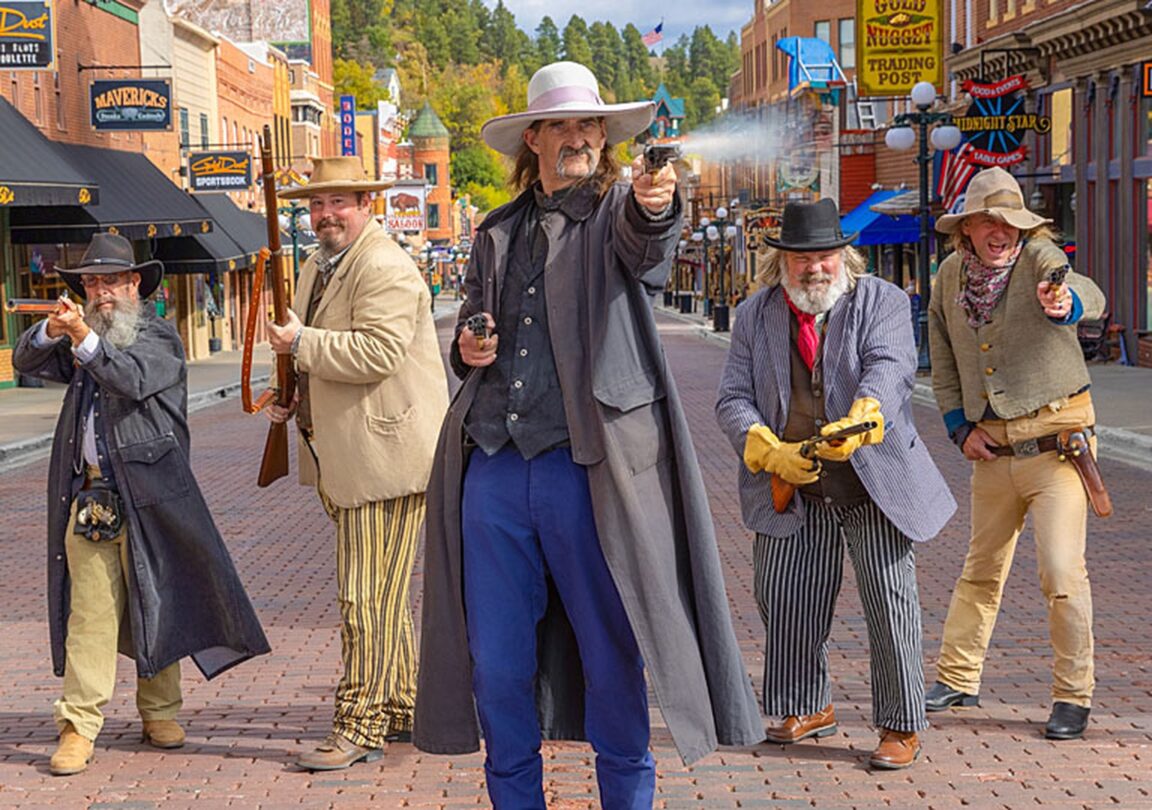
Main Street today is brick, not boardwalk: after the 1879 fire and the floods that followed, Deadwood rebuilt in masonry, and the result is an unusually intact Victorian mining-town streetscape of saloons, hotels and storefronts. In season, Deadwood Alive’s reenactors stage the trial of Jack McCall and street performances that lean into the Hickok story; they are theatre, openly, and better for it. Gaming arrived in 1989 as a preservation bargain, legal in Deadwood alone in South Dakota, with tax revenue committed to restoring the historic district. That is why the honest way to judge the casinos is architectural: they funded the facades you came to photograph. Play if you enjoy it, in the saloons where the history happened, but the town does not need your losses to justify the stay. Eat early or late to dodge the tour-group middle of the evening, and walk the side streets up the gulch walls, where the residential Deadwood of churches, schools and painted houses explains how a camp became a town that raised families.
Using Deadwood as the base: the day-trip maths, honestly
Here is the candour the board asked for. Deadwood sits in the northern hills. Spearfish Canyon, the limestone gorge west of town, is close and glorious, and our route guide to the Spearfish Canyon Byway and its waterfalls in order pairs with a Deadwood base perfectly. The southern hills are a different calculation: Mount Rushmore and Crazy Horse Memorial are roughly an hour to an hour and a half by the scenic routes, Custer State Park further in spirit than in miles, and Wind Cave and the Badlands are full-day commitments. None of that disqualifies the base; it defines it. Deadwood suits travellers who want one anchor, long scenic driving days and historic evenings, and who will rise early for the monuments and be back for dinner. It suits less well a family trying to be at Rushmore by opening every morning, for whom Rapid City or Keystone shortens the days. Choose with your eyes open and either base works.
The Mickelson Trail changes the maths for active travellers. Its northern trailhead is in Deadwood itself, and the rail trail runs south through the hills on a gentle grade past trestles, tunnels and old mining stops, with trail passes and seasonal shuttle arrangements detailed by the state park system. Even a half-day out-and-back toward Lead, the sister town up the gulch whose Homestake Mine made the region’s real fortunes, gives a Deadwood stay a dimension Rapid City cannot copy. Travellers building a wider western small-town route will recognise the pattern from our guides to Tombstone, Arizona, assessed honestly, to the silver town in our Wallace, Idaho silver town guide, and to Bisbee, Arizona’s copper and art town: mining towns that outlived their mines by turning the story itself into the economy. Deadwood did it earliest and, arguably, best. For a gentler counterpoint on the same trip, our Fredericksburg, Texas Hill Country main street guide shows the food-and-wine version of the same American small-town craft.
When to go, and the history to hold alongside the fun
Late spring through early autumn is the full town: museums on long hours, reenactments on the street, the Days of ’76 in midsummer and motorcyclists everywhere in early August, when the Sturgis rally fills the northern hills and prices and noise both spike. Winter is the connoisseur’s Deadwood, quiet, snowy and honest, with skiing at Terry Peak nearby and some sights on reduced hours. Whenever you come, hold one fact alongside the poker and the pageantry: Deadwood was founded in violation of the Treaty of Fort Laramie, in hills sacred to the Lakota, and the gold rush that built it dispossessed them. The town’s museums do not hide that origin, and a good visit does not either. It costs nothing to know it, and it makes the brick streets below Mount Moriah mean more, not less.
Frequently asked questions
Is Deadwood or Rapid City the better Black Hills base?
Deadwood for history, evenings and the northern hills, including Spearfish Canyon and the Mickelson Trail. Rapid City for shorter drives to Mount Rushmore, the Badlands and the southern parks. Pick by which days matter most, not by hotel count.
How long do I need in Deadwood itself?
One full day covers the Adams Museum, Main Street and Mount Moriah without rushing. Two days add the Adams House, the Days of ’76 Museum and a Mickelson Trail ride. As a base, three to four nights works well.
Where are Wild Bill Hickok and Calamity Jane buried?
Side by side in Mount Moriah Cemetery above the town, where Seth Bullock is also buried. The city cemetery page lists the address and visiting arrangements; there is a small admission charge in season.
Is Deadwood just casinos now?
No. Gaming funds the preservation that keeps the historic district intact, and the museums, cemetery, trailhead and streetscape are the substance of a visit. The casinos occupy historic saloon buildings, but nobody is required to play.
What is the closest major sight to Deadwood?
Spearfish Canyon, west of town, with its byway waterfalls and limestone walls. Lead, the Homestake mining town, is minutes away up the gulch. The famous carved mountains are southern-hills day trips.
Image credit: Deadwood Alive reenactors on Main Street, Deadwood, via the official Deadwood visitor site, deadwood.com. Facts checked against Deadwood History, the City of Deadwood and the official visitor site on 25 November 2026.