 Rafael Santos
Booking a stargazing tour in San Pedro de Atacama now comes with a layer of rules that did not exist a few years ago, but they are probably not the rules you have heard about. Chile has not created a visitor permit for looking at the stars, and no law blacks out tours around the full moon. What has changed is the light itself. Chile’s updated national lighting standard, the Norma Lumínica, now applies across the whole country, and San Pedro de Atacama sits inside one of 29 communes formally declared to hold scientific value for astronomical observation. The practical effects for a traveller are warmer, dimmer street lighting, decorative and advertising lights switched off in the small hours, and a booking process where the checks that matter are your operator’s registration with SERNATUR, the moon phase on your dates, and the fact that the great observatories near town are closed research sites rather than nighttime attractions. This explainer separates the law from the tour-operator practice, so you know which rules are real and which questions to ask before you pay.
Quick Facts
The law: Chile’s Norma Lumínica (Supreme Decree No. 1 of 2022, Ministry of the Environment) was published on 18 October 2023 and extended dark-sky lighting rules from the three northern regions to the entire country.
The protected zone: Supreme Decree No. 2 of 2023, from the Ministry of Science, declared 29 communes in the Antofagasta, Atacama and Coquimbo regions as areas of scientific and research value for astronomical observation. San Pedro de Atacama is on the list.
The strictest tier: Those astronomical areas count as Special Protection Areas under the lighting standard, where the cap on blue light in outdoor fixtures drops to 1 percent of the emitted spectrum, against 7 percent nationwide.
The switch-off: Ornamental, recreational and advertising lighting must be off between midnight and 7 a.m. under the standard, unless authorised.
The permit reality: There is no stargazing permit for visitors. The registration that matters is your tour operator’s listing with SERNATUR, Chile’s national tourism service.
The moon rule: No law bans tours at full moon. Operators pause or reshape tours around bright moonlight as a matter of practice, because moonlight washes out faint stars.
The observatories: ALMA’s public visit programme is currently suspended, and ESO’s Paranal Observatory runs free guided visits on Saturdays in daytime only, with compulsory advance registration.
What Chile Actually Changed, and When
Chile has regulated outdoor lighting in its north since a 2012 decree that covered only the regions of Antofagasta, Atacama and Coquimbo, the three regions that host the country’s great observatories. The replacement standard is broader in every direction. According to the European Southern Observatory, which operates three sites in Chile and worked on the reform through the Office for the Protection of the Sky Quality in Northern Chile, the new standard issued by the Ministry of the Environment in October 2023 controls emissions from outdoor lighting and signs nationwide, protecting the astronomical quality of the night sky, human health and biodiversity. It favours amber-toned public lighting, limits blue light, and puts advertising and sports lighting under schedule control.
The companion measure came from the Ministry of Science. Its Supreme Decree No. 2 of 2023 declared 29 communes across the three northern regions as areas with scientific and research value for astronomical observation, a category created by Law 21.162 of 2019. The Ministry of the Environment’s own lighting standard pages list the communes by region, and San Pedro de Atacama appears among the eight in the Antofagasta Region, alongside Antofagasta, Calama, María Elena, Mejillones, Ollagüe, Sierra Gorda and Taltal. The updated Norma Lumínica recognises these astronomical areas as Special Protection Areas, where the strictest emission spectrum requirements apply.
The protection also has teeth for development. Chile’s Environmental Assessment Service (SEA) published technical criteria in May 2024 for deciding when a project’s artificial light emissions are significant enough to affect an astronomical area and therefore require a full environmental impact study. None of this regulates what a visitor does on holiday. It regulates the light around you, which is precisely why the Atacama sky stays dark enough to sell tours under.
The Lighting Limits You Will Actually Notice in Town
Three elements of the standard translate into things a traveller can see. The first is direction: outdoor fixtures are limited in how much light they may send upward, above the horizontal. The second is colour: the standard caps the blue share of a light source’s spectrum at 7 percent nationwide, down from 15 percent under the old norm, and at 1 percent inside Special Protection Areas such as the San Pedro commune. In practice that pushes street and public lighting toward warm amber tones, which scatter less and disturb observing conditions least. The third is timing: ornamental, recreational and advertising lights, including lit signs, must switch off between midnight and 7 a.m. unless authorised, and industrial lighting where no work is under way must be off or reduced.
For a visitor, the effect is a town that gets visibly darker as the night deepens, and tour sites a short drive out of town that start from an already dark baseline. It is worth setting expectations correctly, though. The standard governs fixtures and signage, not behaviour. It does not fine you for a phone torch, and it does not impose a curfew. The dark-sky etiquette you will meet on a tour, red lights only, no flash, screens dimmed, comes from operators protecting the group’s night vision, not from the decree.
The Permit Question: What to Check Before You Book
Search results and social posts sometimes describe Atacama stargazing as permit-controlled. No Chilean source supports a visitor permit, and none of the instruments above creates one. What exists instead is operator registration. Chile Travel, the country’s official tourism portal, advises travellers that it is essential to hire tourism services registered with SERNATUR, and SERNATUR maintains a searchable national registry of tourism services where a company can be checked before money changes hands. Registration is the meaningful filter in a town where dozens of storefronts on the main street sell near-identical night tours at near-identical prices.
So the booking checks that substitute for a permit are these. Confirm the operator appears in SERNATUR’s registry of tourism services. Ask how many guests share each telescope, because that ratio decides how much eyepiece time you get. Ask what happens on a cloudy night, since reputable operators offer a refund or a new date rather than a shrug. Confirm the language of the guiding, the pickup arrangement inside San Pedro, and whether the price includes transport out to the observing site. Chile Travel describes the standard product as running about two and a half hours, at sites roughly 10 kilometres from town, combining telescope observing with talks on the Andean worldview of the sky. Anything far from that shape deserves a second look.
The Moon-Phase Blackout, Explained Honestly
The closest thing to a blackout in San Pedro is real, but it is astronomy, not law. A bright moon floods the sky with reflected sunlight and erases exactly the faint objects most travellers come for: the Milky Way’s dust lanes, distant galaxies, nebulae and the Magellanic Clouds at their best. Chile Travel states the local convention plainly: astronomical tours run every night except on full moon nights, because the light makes it difficult to see the constellations clearly. Individual operators draw the line differently. Some pause for several nights either side of the full moon, others run lunar-themed sessions built around the moon itself and the brighter planets, and others keep operating with adjusted targets. None of that is a government blackout, and any operator who blames a regulation for a cancellation is dressing up a commercial choice as a legal one.
The booking strategy follows from the physics. If the Milky Way core is the point of the trip, target the week around the new moon and put the stargazing night early in your stay, so a cloudy night can be moved rather than lost. If your dates are fixed near a full moon, book a moon-and-planets session with open eyes, or spend the night budget on a daytime observatory visit instead. Travellers comparing dark-sky destinations will find the same moon logic at work in our guide to stargazing in Joshua Tree National Park, where the park’s dark zones reward exactly the same new-moon planning.
Photography Near the Observatory Zones: Access Is the Limit
Travellers also ask what photography is allowed near the observatory zones, and the honest answer is that the limit is access, not cameras. The professional observatories around San Pedro are working research sites with no public nighttime presence. ALMA, the great millimetre array on the Chajnantor plateau, states on its official visits page that its public visit programme is currently suspended, with a limited programme continuing for educational and research institutions and the media. Even when public visits run, they go to the Operations Support Facility at about 2,900 metres; the antenna site on the plateau at about 5,000 metres is not open to visitors. ESO’s Paranal Observatory, home of the Very Large Telescope, welcomes the public on Saturdays at 10 a.m. and 2 p.m., free of charge, but registration is compulsory, places are limited, and ESO provides no transport. Those are daytime engineering tours, not observing nights, and they sit hours from San Pedro by road, so they are a separate day in the itinerary rather than an add-on to a stargazing tour.
Your own photography is therefore something you arrange in the open desert, on a commercial tour that includes a portrait under the Milky Way, or independently outside town, observing land access rules and common sense about private property and protected areas. What the protection framework changes for photographers is indirect but real: the lighting limits keep the horizon glow down, so long exposures from legal vantage points near town face less skyglow than they would almost anywhere else on Earth with this much infrastructure nearby. For a second comparison point on shooting under protected skies, see our piece on Great Sand Dunes after dark, where the same discipline of dark adaptation and red light applies.
How to Book Well Under the New Rules
Put together, the framework rewards a specific order of operations. Choose your dates against the lunar calendar first, because no operator can sell you darkness the moon has already taken. Verify the operator in SERNATUR’s registry second. Third, confirm the moon and cloud policy in writing before paying, including whether a souvenir photograph is part of the product. Fourth, dress for the desert night: San Pedro sits at about 2,400 metres, temperatures fall hard after sunset in every season, and the standard advice to give altitude a day before strenuous excursions applies to comfort on a still, cold observing field too. Finally, keep one evening unbooked. The Atacama’s clear-sky statistics are the best in world tourism, but a spare night is what converts a weather cancellation from a loss into a reshuffle.
Frequently Asked Questions
Do I need a permit to go stargazing in San Pedro de Atacama?
No. No Chilean rule creates a visitor permit for stargazing. The check that matters is whether your tour operator is registered with SERNATUR, Chile’s national tourism service, which keeps a public registry of tourism services.
What exactly does the Norma Lumínica change for visitors?
It changes the light, not the traveller. Outdoor lighting nationwide must limit upward spill and blue content, with the strictest blue-light cap of 1 percent in Special Protection Areas such as the San Pedro de Atacama commune, and decorative and advertising lighting must switch off between midnight and 7 a.m.
Are stargazing tours banned around the full moon?
Not by law. Operators pause or redesign tours around bright moonlight because it washes out faint stars. Chile Travel notes that astronomical tours run every night except full moon nights, and each operator sets its own window, so ask about the moon policy before booking dates near a full moon.
Can I visit ALMA or Paranal at night with a camera?
No public nighttime visiting exists at either site. ALMA’s public visit programme is currently suspended, and its high antenna site is never open to visitors. Paranal offers free guided tours on Saturdays in daytime, with compulsory advance registration and no transport provided.
Why is San Pedro de Atacama specially protected?
Supreme Decree No. 2 of 2023 declared it one of 29 communes with scientific and research value for astronomical observation, reflecting the concentration of world-class observatories in northern Chile and the exceptional clarity and darkness of its skies.
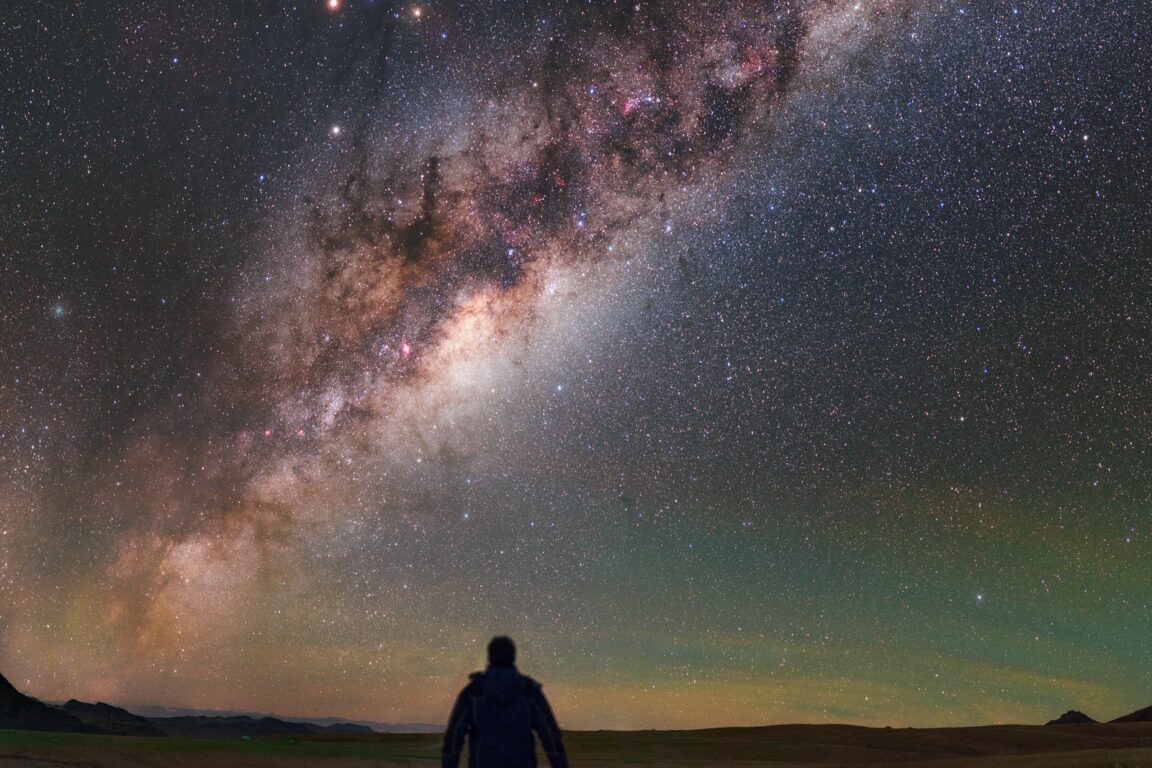
Image: The Milky Way over the Chajnantor plateau in Chile’s Atacama Desert, home of the ALMA observatory. Credit: ESO/P. Horálek, via ESO (eso.org), licensed under CC BY 4.0.
Facts checked 25 November 2026 against the Chilean Ministry of the Environment’s Norma Lumínica pages, the Ministry of Science decree reporting, ESO, ALMA and Chile Travel.