 Hana Kim
Go to Albi for one overwhelming building and everything that gathers around it: Sainte-Cecile, the largest brick cathedral in the world, rising over the river Tarn beside the fortress palace that now holds the worlds most important Toulouse-Lautrec collection. Albi rewards a full day on its own terms and makes an unusually satisfying overnight base, red brick glowing at dusk, long after the day trippers have caught the train back to Toulouse.
Quick Facts
- Where: On the river Tarn in south west France, about 85 kilometres north east of Toulouse and roughly an hour by train.
- Best for: Architecture lovers, art travellers, and anyone building a slower Occitanie route.
- Headline sights: Sainte-Cecile Cathedral, the Palais de la Berbie and Toulouse-Lautrec Museum, the Pont Vieux, the old town lanes and the Tarn banks.
- Time needed: One long day covers the cathedral and museum well. An overnight stay adds the river at its best hours.
- Getting around: The historic centre is compact and walkable. Arrive by train from Toulouse or park at the centre edge.
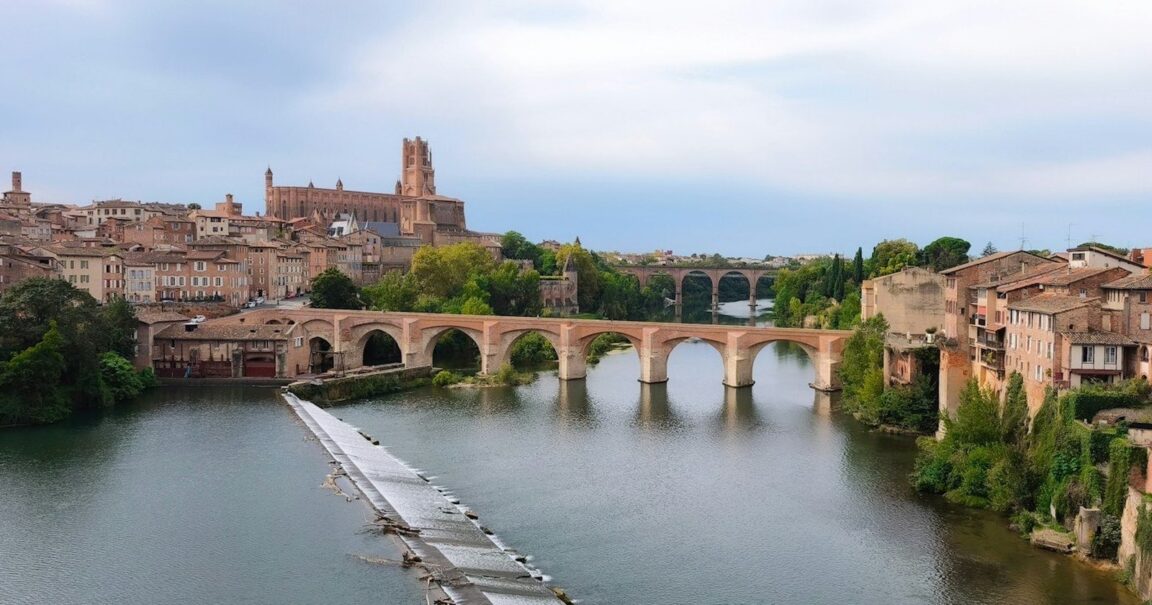
- Do not miss: The view from the far bank of the Tarn, with the Pont Vieux in front and the cathedral stacked above it.
What makes Sainte-Cecile different from every other French cathedral?
Most great French cathedrals are stone, lacy and grey. Sainte-Cecile is brick, blunt and red, built like a fortress because it was meant to read as one. Construction began in 1282, in the aftermath of the Albigensian Crusade against the Cathars, and the building took around 200 years to complete. The result, as the Albi tourist office sets out, is the largest brick cathedral in the world: 113 metres long, 35 metres wide, with a bell tower 78 metres high completed in 1480.
Then the interior reverses every expectation set by that austere shell. Sainte-Cecile is also the largest fully painted cathedral in Europe, with some 18,500 square metres of frescoes and decoration covering walls and vaults in blue and gold, a vast Last Judgment, and an intricately carved stone choir screen. The contrast is the experience: a fortress outside, a painted jewel box inside. Give it a full hour at minimum, and treat the choir and treasury as part of the visit rather than an optional extra. The cathedral anchors the Episcopal City that UNESCO listed as a World Heritage Site in 2010.
Why does the Toulouse-Lautrec Museum deserve equal billing?
Next door, and sharing the same brick mass above the river, the Palais de la Berbie was the bishops fortified palace. It now houses the Toulouse-Lautrec Museum, and the fit is perfect: Henri de Toulouse-Lautrec was born in Albi in 1864, and the museum holds the largest public collection of his work anywhere. The core arrived in 1922, when the artists mother, Adele, donated 227 works, and the collection has grown since to cover the full arc from youthful studies to the Paris posters that made him famous.
Seeing Lautrec here, rather than in a Paris blockbuster show, changes the visit. The rooms are calmer, the early work gets proper space, and the palace itself, with its terraced gardens above the Tarn, is half the pleasure. Plan the museum for late morning, after the cathedral, then take the gardens slowly: the formal terraces give the best elevated view along the river and back to the cathedral apse. Travellers pairing Albi with a wider south west route will find it sits naturally alongside our three days in Bordeaux as the inland, art led counterweight to the Atlantic coast.
What does a well paced day in Albi look like?
Arrive early and go straight to the cathedral, when the brick is at its most pink and the interior is quiet. Follow it with the Toulouse-Lautrec Museum and the Berbie gardens before lunch. Eat in the old town: the cooking of the Tarn is hearty south western fare built on duck, sausage and beans, with pink garlic from nearby Lautrec a regional signature and crisp almond gimblettes from the bakeries for afterwards. A glass of Gaillac, the local wine produced around the town since long before it was fashionable, belongs with lunch rather than as an afterthought.
The afternoon belongs to the river. Cross the Pont Vieux, the brick bridge dating from the 11th century and among the oldest bridges in France still in use, and walk the far bank for the postcard composition of bridge, palace and cathedral. Then drift back through the old town lanes of half timbered houses, the cloister of Saint Salvi, and the small squares that make Albi feel lived in rather than staged. Food travellers continuing north can compare this regional cooking with the bouchon tradition in our Lyon food guide, two very different answers to the same French question.
Is Albi a day trip or a base?
Honestly, both work, but they are different trips. As a day trip from Toulouse it is efficient: an hour on the train, the two big sights, the bridge, home by dinner. As a base it becomes something better. The evening light on the brick is the citys finest hour and day trippers miss it entirely, the restaurants empty of tour groups, and the Tarn walks at dawn are close to silent. One night is enough to capture that version. Two nights let you add Gaillac vineyards or the hilltop villages of the Tarn without rushing the city itself. What Albi is not is a hub for the whole region: distances to the Mediterranean and the Pyrenees are long enough that it should anchor its own corner of a route, not serve as a compromise base for everywhere.
What do travellers most often get wrong about Albi?
Two mistakes recur. The first is treating Albi as a 90 minute photo stop on the way somewhere else, which reduces the largest brick cathedral in the world to a single exterior shot and skips the painted interior that is the entire point of the building. The second is skipping the old town in favour of the two headline sights alone. The lanes between the cathedral and the river, the market squares, the cloister and the small museums of the historic centre are what turn Albi from a monument visit into a place, and they cost nothing but an extra hour of unhurried walking. Build that hour in before you arrive, not after you have already run out of day.
Frequently Asked Questions
Why is Albi cathedral famous?
It is the largest brick cathedral in the world and the largest fully painted cathedral in Europe, a fortress like Southern Gothic building begun in 1282 and now part of a UNESCO World Heritage Site.
How do you get to Albi from Toulouse?
Regional trains take roughly an hour, and the drive is about 85 kilometres. The historic centre is walkable from the station and the edge of centre car parks.
How long do you need in Albi?
One full day covers the cathedral, the Toulouse-Lautrec Museum and the river. Stay overnight to see the brick at dusk and dawn, when the city is at its best.
Where is the Toulouse-Lautrec Museum?
Inside the Palais de la Berbie, the former bishops palace directly beside the cathedral, with terraced gardens overlooking the Tarn.
What should you eat in Albi?
South western dishes built on duck, sausage and beans, pink garlic specialities from Lautrec, almond gimblettes, and a glass of local Gaillac wine.
Is Albi worth visiting in winter?
Yes. The sights are indoors friendly, the city is quiet, and the cathedral and museum carry a short visit on their own. Summer brings heat that argues for early starts and long lunches.