 Hana Kim
Wear a full hanbok, a traditional top worn with a traditional skirt or trousers, and entry to Gyeongbokgung Palace is free. Otherwise an adult ticket costs 3,000 won, the palace is closed every Tuesday, and the Royal Guard Changing Ceremony runs at 10:00 and 14:00 in front of the gates, free to watch with no ticket at all. In November the palace opens at 9:00 and closes at 17:00, with last entry an hour before closing, so the visit that works is a ceremony first, then a south to north walk through the halls, ending at the pavilion on the pond.
Quick Facts
- Admission: 3,000 won for adults. Free for visitors aged 18 and under and 65 and over, and free for anyone wearing a full hanbok that meets the palace guidelines.
- Closed: Every Tuesday. Visit Changdeokgung or another palace on a Tuesday instead.
- Hours: Opens 9:00 year round. Closing is seasonal: 17:00 from November to February, 18:00 in March to May and September to October, 18:30 in June to August. Last entry one hour before closing.
- Guard ceremony: Royal Guard Changing Ceremony at 10:00 and 14:00, about 20 minutes, at Gwanghwamun and Heungnyemun gates. Guard on duty performances at 11:00 and 13:00. No ceremony on Tuesdays, and cancellations happen in severe weather.
- Hanbok rule: Free entry requires the complete outfit, a jeogori top with a chima skirt or baji trousers. A top alone, or modern clothing with a hanbok accessory, does not qualify.
- Free English tours: Guided tours in English start at 11:00, 13:30 and 15:30 on open days, from the information point inside Heungnyemun Gate.
- Time needed: Two to three hours for the main axis, the pavilion and the folk museum grounds.
How does the hanbok free entry rule actually work?
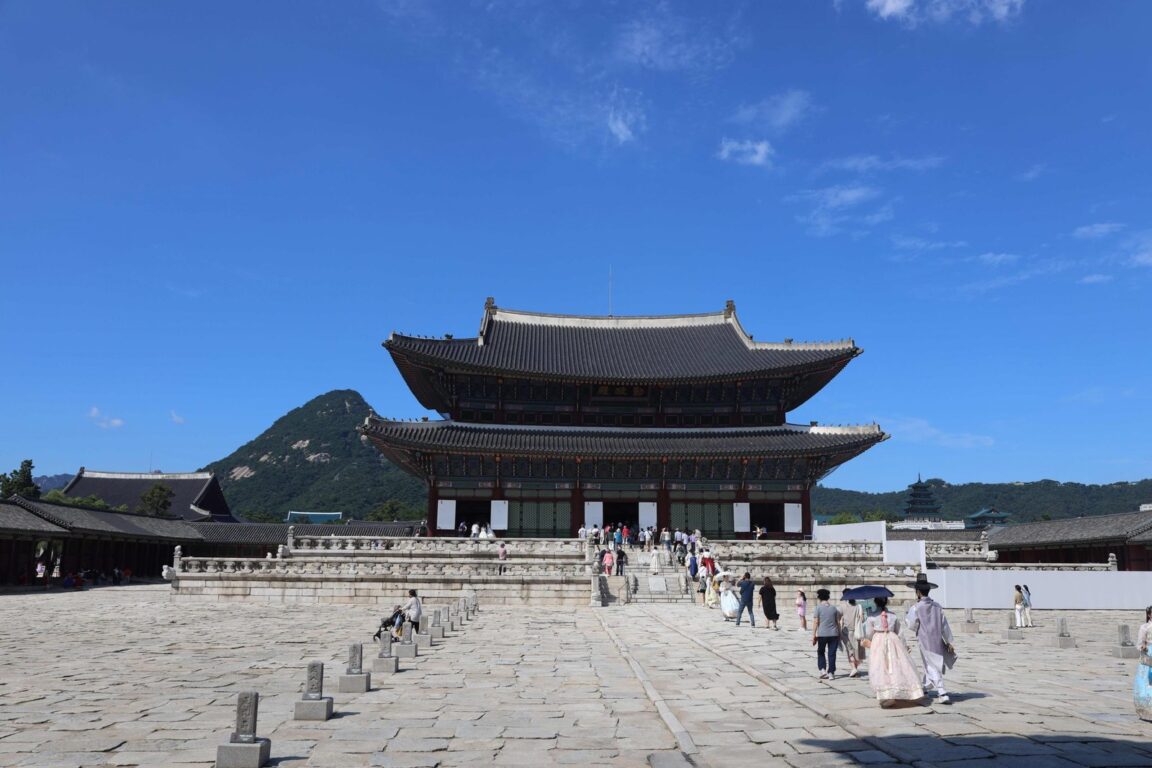
The free entry scheme, run by the Korea Heritage Service across the royal palaces since 2013, is exactly what it looks like from the street: Seoul’s grandest palace filled with visitors in silk colours. The condition is completeness. The palace guidelines require the traditional upper garment and the traditional lower garment together, a jeogori with a chima for women or baji for men. Rental shops cluster around Gyeongbokgung and Anguk stations and dress customers to the standard all day, every day, so a properly rented hanbok passes the gate check without discussion. What fails is improvisation: a hanbok jacket over jeans, a decorative vest, or a costume that the gate staff judge to be fancy dress rather than hanbok.
Hanbok wearers skip the ticket purchase entirely and go straight to the entry gate, which on a busy weekend is worth as much time as the 3,000 won saved. Two cautions keep the scheme pleasant. The free entry covers the palace grounds only, not separately ticketed special exhibitions or night openings. And the heritage agency has publicly discussed revising palace fees and reviewing the hanbok scheme, with reporting in October 2026 describing any change as undecided and no earlier than 2027. The figures and rules here were checked against Korea Heritage Service sources on 14 November 2026, but a visit planned for 2027 should recheck the official royal palaces site before relying on them.
What happens at the guard ceremony, and where do you stand?
The Royal Guard Changing Ceremony, the Sumunjang ceremony, recreates the Joseon dynasty protocol for handing over the palace gate watch: commanders in bright period uniform, drummers, flag bearers and a formal exchange of the watch, announced in Korean and English. It runs twice a day, at 10:00 and 14:00, for about 20 minutes, in the gate zone between Gwanghwamun, the great southern gate, and Heungnyemun, the second gate. Crucially for planning, the ceremony area sits before the ticket barrier, so it can be watched by anyone, ticket holder or not, and it is the natural opening scene of the visit: arrive by 9:45, watch the 10:00 ceremony, then enter and walk the grounds as the crowd disperses into them.
The shorter guard on duty performances at 11:00 and 13:00 place guards at their posts for about ten minutes and are the better photo opportunity of the two formats. All ceremonies are cancelled on Tuesdays with the palace closure, and the palace cancels or shortens them in heavy rain, extreme heat, severe cold and poor air quality warnings. A ceremony is a promise the weather can break, so a visit built entirely around it needs a fallback, and the grounds themselves are that fallback.
What is the best order to walk the palace?
Gyeongbokgung reads south to north, and walking it in its ceremonial order makes the architecture explain itself. Enter under Gwanghwamun and through Heungnyemun into the outer court. The axis then climbs gently through Geunjeongmun to Geunjeongjeon, the throne hall, raised on its double stone platform, where coronations and great audiences were held. Behind it, Sajeongjeon is the king’s working office cluster, and behind that again the halls turn domestic: Gangnyeongjeon and Gyotaejeon, the king’s and queen’s living quarters, with the queen’s garden at Amisan behind, its ornamental chimneys among the most photographed details on the site.
Where do most visitors stop too early?
At the throne hall. The grounds continue well beyond the domestic quarters, west to Gyeonghoeru, the great banqueting pavilion standing on 48 stone pillars in its square pond, the single finest view in the palace and the image on old 10,000 won notes, and north to Hyangwonjeong, a two storey hexagonal pavilion on an island in a lotus pond, with the modern building of the National Folk Museum of Korea at the northern edge of the grounds. Allow the visit to reach the water. A palace of this scale, the largest of Seoul’s five grand palaces, founded in 1395, destroyed in the invasions of the 1590s and rebuilt in the 19th century, needs its full depth to make sense, and the northern half is also where the crowds thin out.
For travellers building a Korea itinerary, pair this visit with our 3 days in Busan itinerary for the coastal counterpoint, and compare the free entry logic with the sunrise ticket planning in our Angkor Wat sunrise guide, where arriving before the main flow matters just as much.
What are the practical details, tickets, tours and timing?
Tickets are bought on arrival at kiosks by the gates, and the palace advises last entry a full hour before closing, which in November means 16:00 for a 17:00 close. That winter timetable shapes the day: a morning visit is strongly preferable in the November to February season, both for the 10:00 ceremony in daylight and because the northern grounds lose the light early. The free English guided tours, at 11:00, 13:30 and 15:30 from inside Heungnyemun, last about an hour and are the cheapest possible upgrade to the visit, adding the rebuilding history and the court rituals that the bare halls cannot tell on their own. Visitors aged 18 and under and 65 and over should carry a passport as proof of age for their free entry.
Getting there is simple: Gyeongbokgung Station on Line 3, exit toward the palace, or Gwanghwamun Station on Line 5 for the great square and the gate approach. The square itself, with its statues of Admiral Yi Sun-sin and King Sejong, is worth 20 minutes before the palace. Hanbok rental is walk in and competitive around both stations; allow 30 minutes for fitting, longer on weekend mornings, and note that most rental periods run two to four hours, which maps neatly onto the palace visit itself.
Frequently Asked Questions
Is entry really free in a hanbok?
Yes, for a complete hanbok: a traditional top with a traditional skirt or trousers, meeting the palace guidelines. The scheme covers all the royal palaces and has run since 2013. Partial outfits and fancy dress do not qualify.
What time is the changing of the guard?
10:00 and 14:00, for about 20 minutes, at the Gwanghwamun and Heungnyemun gate area, free to watch without a palace ticket. Shorter guard on duty performances run at 11:00 and 13:00. Nothing runs on Tuesdays.
Why is the palace closed on Tuesdays?
Tuesday is Gyeongbokgung’s regular weekly closing day under the Korea Heritage Service rotation. Other Seoul palaces close on different days, so a Tuesday in Seoul is the day for Changdeokgung, which closes on Mondays.
How much is a normal adult ticket?
3,000 won. Visitors aged 18 and under and 65 and over enter free with proof of age. A fee revision has been discussed for 2027 at the earliest, with the timing undecided as of October 2026 reporting.
How long should you allow?
Two to three hours covers the ceremony, the throne hall axis, the living quarters, Gyeonghoeru Pavilion and Hyangwonjeong Pavilion. Add 30 minutes before entry if renting a hanbok.
Can the ceremony be cancelled?
Yes. Severe weather, including heavy rain, extreme heat or cold and poor air quality alerts, can cancel or shorten the ceremonies without long notice. The palace grounds remain the visit on those days.
Fees, hours and ceremony times checked against Korea Heritage Service and Royal Palaces and Tombs Center sources on 14 November 2026. Seasonal hours change through the year, so confirm the closing time for the visit date.