 Rafael Santos
Visit both sides if time allows, but know the status before booking anything: as of mid November 2026 the Argentine Devil’s Throat circuit has been closed since 3 August 2026, its walkways dismantled as a flood precaution with no reopening date, while the Brazilian walkway facing the Devil’s Throat reopened on 31 October after its own flood closure. Argentina gives the immersive day, about 80 percent of the falls, the Upper Circuit along the brink and the Lower Circuit at the base, reached by the included Rainforest Ecological Train. Brazil gives the panoramic half day, one great trail facing the whole system. The parks are separate, in two countries, with two tickets, and the border crossing between them is part of the plan, not an afterthought.
Quick Facts
- Devil’s Throat, Argentine side: Closed since 3 August 2026. Walkways removed as a precaution against high river flow. No reopening date announced by Iguazu Argentina or the National Parks Administration.
- Devil’s Throat viewpoint, Brazilian side: The walkway into the spray facing the Throat closed 11 to 30 October 2026 and reopened on 31 October. It follows a flow based safety protocol and can close again when the river rises.
- Open in Argentina: Upper Circuit, Lower Circuit and the Green Trail, plus the Rainforest Ecological Train to Cataratas Station. The Macuco Trail was listed closed in early November 2026 checks.
- Open in Brazil: The Falls Trail, Trilha das Cataratas, with its viewpoints and the Devil’s Throat walkway, subject to daily conditions.
- Argentine park hours: Generally 8:00 to 18:00, with last admission around 16:00. International visitor ticket listed at 60,000 Argentine pesos on the official fee schedule in 2026. Train included.
- Brazilian park hours: Generally 9:00 to 16:00 on weekdays and from 8:30 at weekends, every day of the year, with online timed tickets through the official Urbia Cataratas channel.
- Border: A passport is required to cross between Puerto Iguazu, Argentina and Foz do Iguacu, Brazil. Each park charges its own admission in its own currency. Allow half a day for Brazil and a full day for Argentina.
What is actually open right now, and why does it keep changing?
Iguazu is a river before it is a viewpoint, and the river has been running far above normal through the second half of 2026, fed by heavy rain in southern Brazil. Both park operators manage their walkways against measured flow. Argentina took the most drastic step first: on 3 August 2026 the concessionaire dismantled the metal walkways to the Devil’s Throat balcony and moved them to dry ground before the expected flood peak, and the circuit has stayed closed since, with the parks administration stating the walkways will be reassembled when the state of the river allows it technically. No official reopening date exists, and any source quoting one is guessing.
Brazil’s equivalent structure, the walkway that reaches into the gorge facing the Devil’s Throat, closed on 11 October under its safety protocol as the flow climbed, and reopened on 31 October after inspection, once the flow had fallen. The distinction matters for trip planning in November 2026: the famous U shaped chasm can currently be seen face on from the Brazilian walkway, but cannot be stood over from the Argentine balcony. Everything else on both sides is operating: the Argentine Upper and Lower Circuits, the train, the Brazilian Falls Trail and its viewpoints. Status can change with the river within days, so the official park channels must be checked the day before each visit, a rule this guide follows itself, with the status above reflecting official operator reporting checked on 14 November 2026.
How do the Argentine circuits work?
The Argentine park, Iguazu National Park, administered by the National Parks Administration with visitor services run by Iguazu Argentina, is the side where the falls are experienced from inside the system. From the visitor centre, the Rainforest Ecological Train, included in the ticket, runs from Central Station to Cataratas Station, the hub for the two great circuits, and onward to Garganta Station for the Devil’s Throat when that circuit operates. The Upper Circuit, about 1,850 metres of flat walkway, runs along the top of the long line of falls, with the river sliding under the grates and dropping away at viewpoint after viewpoint. The Lower Circuit, about 1,450 metres with more steps and gradients, descends to the base, where the spray is constant, the rainbows form in the morning light and boat trips toward San Martin Island depart from the lower dock area, conditions permitting.
With the Devil’s Throat closed, the Argentine day reorganises itself well: train to Cataratas, the Upper Circuit in the earlier, quieter hours, lunch at the station area, then the Lower Circuit as the light improves at the base. The Green Trail offers the shaded walk alternative between the centre and Cataratas Station for those avoiding a train queue. What the closure costs the day is its climax, not its substance; the two circuits together still deliver the closest water level experience of any major falls system in the world. Travellers continuing through the region can set this park day inside our 3 days in Buenos Aires itinerary, the usual gateway city, and compare jungle river landscapes in our Salento and Cocora Valley guide.
How does the Brazilian panoramic day work?
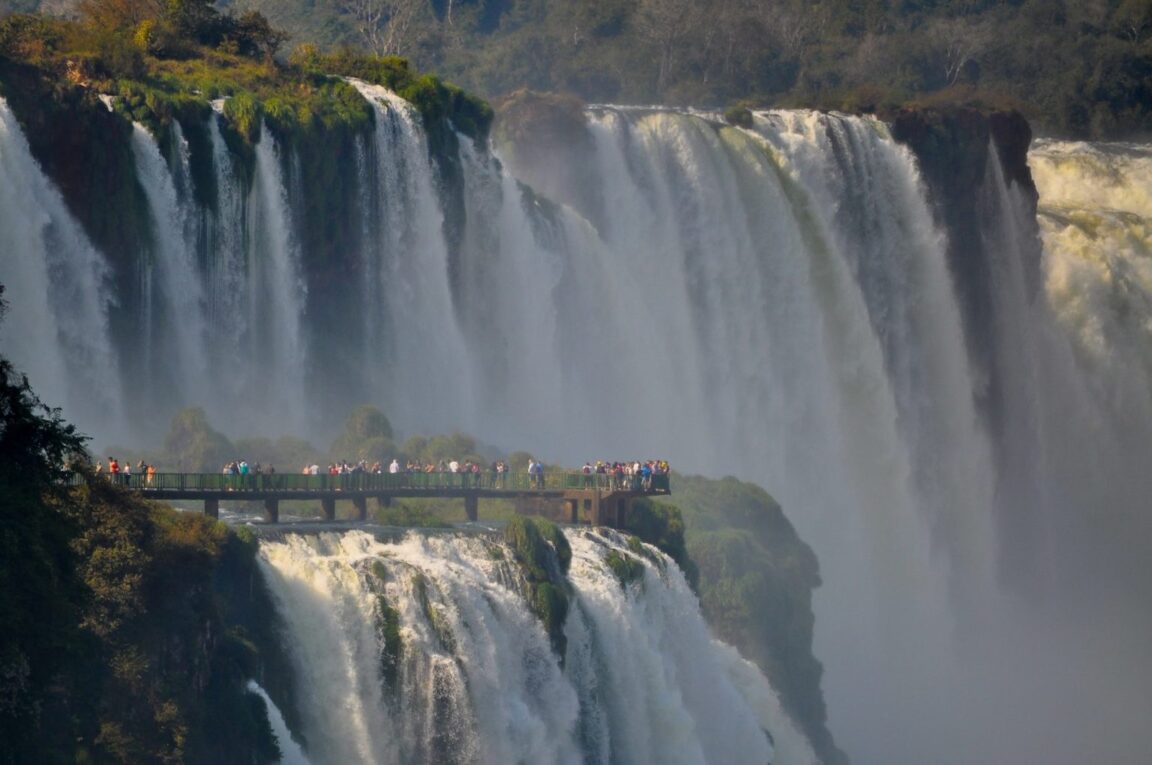
Brazil’s Iguacu National Park, managed by ICMBio with visits run by the Urbia Cataratas concessionaire, protects about 20 percent of the falls and nearly 100 percent of the classic view. Its single main route, the Falls Trail of about 1,200 metres, begins opposite the pink Belmond Hotel das Cataratas and walks the gorge rim facing the Argentine falls, so the system assembles itself progressively: first individual falls across the river, then the long curtain, and finally the trail’s end at the Devil’s Throat complex, where walkways reach out over the lower gorge into the spray at the foot of the U, with a lift and tower viewpoint completing the scene. It is the photograph the Argentine side cannot take of itself, and on a clear morning it justifies the border crossing on its own.
The Brazilian visit is shorter and simpler: timed online tickets, park buses from the visitor centre to the trailhead, two to three hours on the trail at a photographic pace, and optional add ons such as the Macuco boat safari on the Brazilian side and the Parque das Aves bird park just outside the gate. Because the day is compact, it pairs naturally with an afternoon flight or the Argentine park on the following day, and because its headline walkway is flow dependent, it should be scheduled first in a two day window if the Devil’s Throat view is the priority, so a closure day can be swapped.
What does crossing the border involve?
The two parks sit in two countries and there is no ticket, path or shortcut that combines them. Visitors sleep in Puerto Iguazu in Argentina or Foz do Iguacu in Brazil, cross the Tancredo Neves Bridge over the Iguazu River by bus, taxi or tour transfer, and complete immigration formalities each way, with a passport carried at all times. Visa requirements depend on nationality and have changed in recent years for several major passports, so check the current Argentine and Brazilian rules for the specific passport well before the trip rather than relying on any guide. Each park then charges its own admission, in pesos in Argentina and reais in Brazil, through its own official channel, and neither ticket includes anything in the other park.
Practically: do not attempt both parks in one day unless the trip truly allows nothing else, and if forced, do Brazil first at opening and Argentina until close, accepting a truncated Lower Circuit. The comfortable pattern is two nights minimum on either side of the border, a full Argentine day, a Brazilian morning, and a buffer half day against the weather and river closures that this destination, more than most, treats as normal operations.
Frequently Asked Questions
Is the Devil’s Throat open?
From Brazil, yes at the time of checking: the walkway facing the Throat reopened on 31 October 2026 after a 20 day flood closure, and it can close again when the river rises. From Argentina, no: the Devil’s Throat circuit has been closed since 3 August 2026, its walkways dismantled, with no reopening date announced.
Which side is better if you can only do one?
With the Argentine Devil’s Throat closed, the honest answer narrows. Argentina still offers the fuller, more immersive day across the Upper and Lower Circuits. Brazil offers the single great panorama and the only current Devil’s Throat view, in half a day. Photographers chasing the classic wide shot should choose Brazil; travellers wanting to walk inside the falls system should choose Argentina.
How many days do you need for both sides?
Two park days, one per side, plus arrival and departure time. Three nights in the area gives a weather buffer, which the river makes genuinely useful in 2026.
Do you need a passport to visit both sides?
Yes. The parks are in different countries and the crossing involves full immigration control in both directions. Carry the passport on both park days, and verify visa rules for the specific nationality in advance.
Are the two parks’ tickets interchangeable?
No. Iguazu National Park in Argentina and Iguacu National Park in Brazil are separate parks under separate administrations and concessionaires, each with its own ticket, currency and booking channel.
Can closures change between booking and visiting?
Yes, and in 2026 they repeatedly have. Walkways on both sides follow river flow protocols and can close or reopen within days. Check the official park channels the day before each visit and keep the itinerary order flexible.
Circuit status, hours and fee information checked against Iguazu Argentina, the Argentine National Parks Administration and the Brazilian park’s official concessionaire reporting on 14 November 2026. River conditions control openings, so recheck immediately before visiting.