 Maya Chen
Two days in Orvieto is enough to do the town in the right order: the Duomo first thing, before the day trip crowds reach the piazza, then the underground city and St Patrick’s Well, and on the second day the Etruscan necropolis, the Torre del Moro and the slow lanes that most visitors never reach. Orvieto stands on a flat topped mesa of volcanic tuff in Umbria, roughly an hour or so by train from Rome, and its scale is deceptive. The sights are close together, but each one, the cathedral, the well, the caves, deserves an unhurried hour, which is exactly what an overnight stay buys.
Quick Facts
- Best base: Inside the historic centre on or near Corso Cavour, so the Duomo, the underground tours and the evening restaurants are all on foot.
- Do not miss: The Duomo facade and the San Brizio Chapel, the Pozzo di San Patrizio, and a guided Orvieto Underground tour.
- Money saver: The Carta Unica pass covers eight sites including the cathedral, the well, the underground tour and the Torre del Moro, and is valid for one year from first use. Check the current price before buying individual tickets.
- Getting in: Trains stop at Orvieto Scalo at the foot of the rock. The funicular normally links the station with Piazza Cahen at the edge of the old town. Check its status on the day, as engineering works can substitute a shuttle bus.
- The well in November: The Pozzo di San Patrizio opens daily, with shorter winter hours from November to February, listed by the operator as 10 am to 5 pm. Confirm times before walking over.
- Prices checked: November 2026. Admission prices change, so verify on the operator and Carta Unica pages before travelling.
Day 1: Duomo Mornings, the Underground and the Well
Morning: The Duomo and the San Brizio Chapel
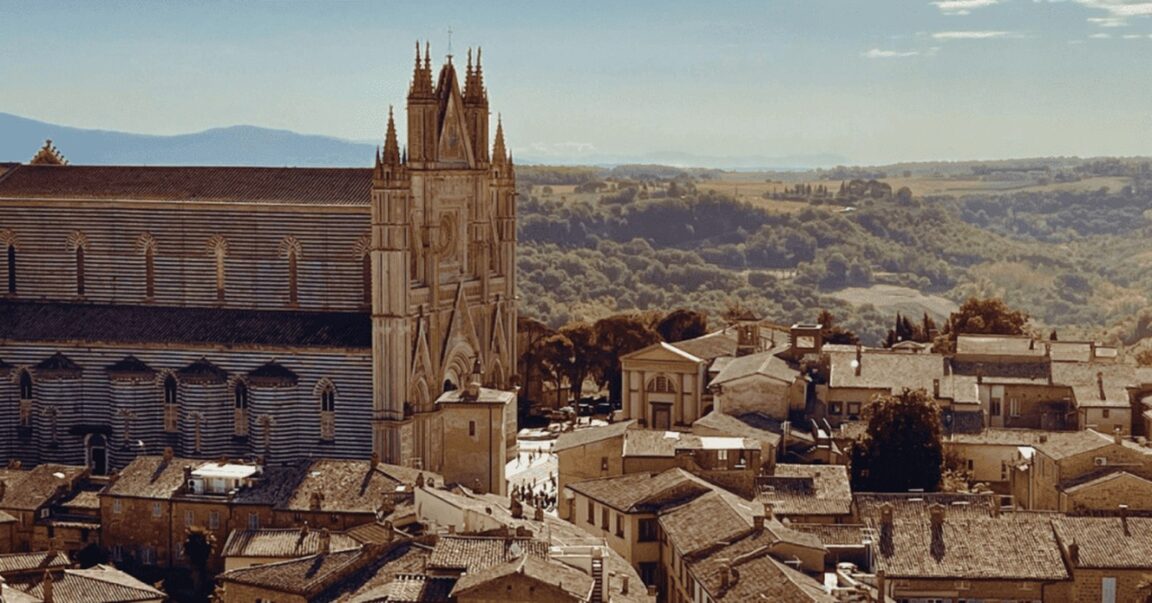
Go to the Duomo first. The cathedral, begun in 1290 to house the Corporal of Bolsena, the relic of a eucharistic miracle in nearby Bolsena, presents the most celebrated facade in Umbria: a triptych front of golden mosaics, carved marble reliefs narrating biblical history, a great rose window and bronze doors, designed under Lorenzo Maitani, who took charge of the works in 1310. Morning light hits the mosaics at their best, and arriving at opening time means standing in the piazza with the facade almost to yourself. Inside, the striped nave leads to two frescoed chapels. The Chapel of the Corporal holds the relic itself. The San Brizio Chapel holds Luca Signorelli’s fresco cycle of the Apocalypse and the Last Judgment, painted between 1499 and 1504, among the most powerful Renaissance works in Italy and a direct influence on Michelangelo. The cathedral ticket also covers the Emilio Greco museum of modern sculpture across the piazza, an easy and surprising contrast.
Midday: Orvieto Underground
Orvieto’s second city is underneath the first. The tuff beneath the town is honeycombed with caves, wells, tunnels, olive presses, dovecotes and workshops dug from Etruscan times through the Middle Ages. The way in is the guided Orvieto Underground tour, which leaves from near the Duomo and takes about an hour through the largest accessible complexes. Tours run at set times in the morning and afternoon, and places are limited, so book at the office or through Orvieto Underground when you arrive in town, not at the end of the day. The temperature underground stays cool all year, which makes this the natural midday slot in summer and a good shelter slot in a wet November.
Afternoon: The Pozzo di San Patrizio
Walk the length of Corso Cavour to Piazza Cahen for St Patrick’s Well, the Pozzo di San Patrizio, commissioned by Pope Clement VII and built between 1527 and 1537 to guarantee the town’s water in a siege. Its engineering is the spectacle: two separate spiral staircases, each of 248 wide steps, wind around the shaft in a double helix, one for going down and one for coming up, so the mule trains carrying water never had to pass each other. Seventy windows light the descent. It is 53 metres deep, the climb back up is steady rather than hard, and it is not suitable for visitors with serious mobility difficulties. Current hours and ticket prices are published by the operator at CoopCulture’s Pozzo di San Patrizio page. Beside the well, the gardens of the Albornoz fortress and the remains of the Etruscan temple of Belvedere fill the time before dinner.
Day 2: The Necropolis, the Tower and the Quiet Lanes
Morning: The Etruscan Necropolis of Crocifisso del Tufo
Start below the rock. The Crocifisso del Tufo necropolis, on the northern slope beneath the town walls, is Orvieto’s Etruscan layer made visible: rows of small chamber tombs built from tuff blocks in a regular street grid, each lintel once inscribed with the family name. The Etruscans knew this city as Velzna, one of the twelve cities of their federation, and the necropolis, together with the Etruscan and Roman collections of the Museo Claudio Faina back on Piazza del Duomo, gives Day 2 its depth. The Faina palace also holds one of Italy’s finest private archaeological collections and a view of the facade from its windows that photographers prize.
Midday: Torre del Moro and the Quartiere Medievale
Climb the Torre del Moro, the 47 metre civic tower at the crossroads of the town, for the panorama that explains the mesa: rooftops, the Duomo rising over them, and the Umbrian hills in every direction. Then walk west into the Quartiere Medievale, the oldest quarter, where the lanes narrow, the tour groups vanish and the Romanesque church of San Giovenale, among the oldest in Orvieto, stands at the edge of the rock with a frescoed interior and a terrace view over the valley. This is the part of town to get deliberately lost in.
Afternoon: Pozzo della Cava and Orvieto Classico
In the same quarter, the Pozzo della Cava offers a second, more intimate underground: a deep Etruscan well and a chain of caves under a family run complex, with medieval pottery workshops and a Christmas crib tradition in season. It pairs well with the larger Underground tour rather than duplicating it. Finish the trip as the town finishes its day, with a glass of Orvieto Classico, the white wine made around the town for centuries, at a table on Via del Duomo as the facade catches the last light. Travellers building a wider Umbria and Tuscany route can continue with our Lucca travel guide and our Matera Sassi guide for two very different Italian old towns.
Where to Stay and How to Move Around
Stay inside the walls, ideally between Piazza Cahen and the Duomo, and the whole two days unfold on foot. The historic centre is a limited traffic zone, so drivers should use the car parks at the edge of the rock, including the Campo della Fiera below the centre with lifts and escalators up into town. Orvieto is a popular day trip, which is precisely why staying overnight changes it: the town is at its best before 10 am and after 5 pm, and with two full days you own both ends of it.
Frequently Asked Questions
Is one day enough for Orvieto?
One long day covers the Duomo, the well and one underground experience, and many visitors do exactly that from Rome. The second day is what adds the necropolis, the medieval quarter and the town at a local pace. If the choice is between rushing Orvieto in a day and skipping it, rush it. If you can sleep over, do.
How many steps are in St Patrick’s Well?
Each of the two spiral staircases has 248 steps. You descend one staircase and climb the other, so the full visit means 496 steps in total, on wide, low treads lit by windows. Allow about 45 minutes and wear shoes with grip.
Is the Carta Unica worth buying?
For this itinerary, usually yes. It covers the cathedral, St Patrick’s Well, the Underground tour, the Torre del Moro and other sites, and it is valid for a year, which suits anyone returning or splitting visits across days. Compare its current price against the individual tickets you actually plan to use before buying.
Do you need to book Orvieto Underground in advance?
The guided tours run at fixed times with limited group sizes, and they sell out on busy days. Book on arrival in town at the latest, and earlier in high season. The tour lasts about an hour and runs in most weather.
When is the best time to visit the Duomo?
At opening time, for the quietest interior and the best light on the facade mosaics. The San Brizio Chapel is the most popular part of the building, so seeing it first, before the midday groups arrive, makes a real difference.
Can you visit Orvieto without a car?
Easily. The train and funicular combination was designed for it, the centre is compact and walkable, and the necropolis is reached on foot from the walls. A car is only useful for continuing into rural Umbria afterwards.