 Rafael Santos
The biggest weekend of the year at Aztec Ruins National Monument is the American Indian Cultural Arts Festival, a free summer gathering of artists, dancers and musicians from Southwest tribal nations held in the picnic area and plaza of a 900 year old ancestral Pueblo great house. Entry to the monument is free every day of the year, the grounds open from 7:00 a.m. to 5:00 p.m. and the visitor center from 9:00 a.m. to 5:00 p.m., so the planning that decides a festival weekend is not tickets. It is timing your walk through the West Ruin and its reconstructed Great Kiva around the performances, booking a Farmington or Aztec bed early, and arriving before the small site fills.
Quick Facts
- Entrance fee: Free. Aztec Ruins is a fee free park and no entrance pass is required.
- Grounds hours: Parking areas, archeological sites, picnic areas and trails are open daily 7:00 a.m. to 5:00 p.m.
- Visitor center hours: Daily 9:00 a.m. to 5:00 p.m. The monument and visitor center close on Thanksgiving, Christmas and New Years Day.
- The headline event: The American Indian Cultural Arts Festival, held annually in summer. The centennial edition in 2023 ran two days, Saturday and Sunday 15 and 16 July, starting at 10:00 a.m. each day, and was free to attend.
- The main walk: A self guided half mile trail through the Aztec West great house of more than 400 masonry rooms and into the reconstructed Great Kiva, over 40 feet in diameter.
- Time needed: One to two hours for the monument on a normal day. Allow a full half day on festival weekend.
- Address: 725 Ruins Road, Aztec, New Mexico. Visitor center phone 505 334 6174.
What actually happens on the festival weekend?
The American Indian Cultural Arts Festival is the monument signature annual event, and the Park Service event record for the centennial edition in 2023 shows the shape of it: artists from Dine, Laguna, Zuni, Hopi, Jemez, Santa Clara, Jicarilla Apache and Santo Domingo communities demonstrating and selling their work in the picnic area, dance performances in the plaza, and, new for that year, live music. The Pueblo Enchantment Dancers performed at 10:30 a.m. on each day of that edition, with further performances in the early afternoon, and the festival ran across two full days for the first time because the monument was marking its centennial. Earlier editions were single day events running roughly 10:00 a.m. to mid afternoon, also free. The honest planning point is that the festival is annual but its exact dates are set each year, and the Park Service posts program times and locations on the park calendar about a month in advance. Treat a mid July weekend as the pattern to plan around, then confirm the confirmed dates and the performance schedule on the park calendar before you book travel around them.
What makes the weekend distinctive, beyond the market and the dancing, is the setting it activates. The Great Kiva, the ceremonial heart of the West Ruin, hosts traditional dance performances and ranger programs during the summer season, and hearing and seeing the plaza used as a gathering place again changes how the archaeology reads. The festival is run with assistance from the Chaco Culture Conservancy, the park partner organization, and it is deliberately a cultural event led by Indigenous artists rather than a reenactment: the work on the tables, the dances and the music are contemporary practice by descendant and regional communities, presented at a site their ancestors built.
How should you order a festival day at Aztec Ruins?
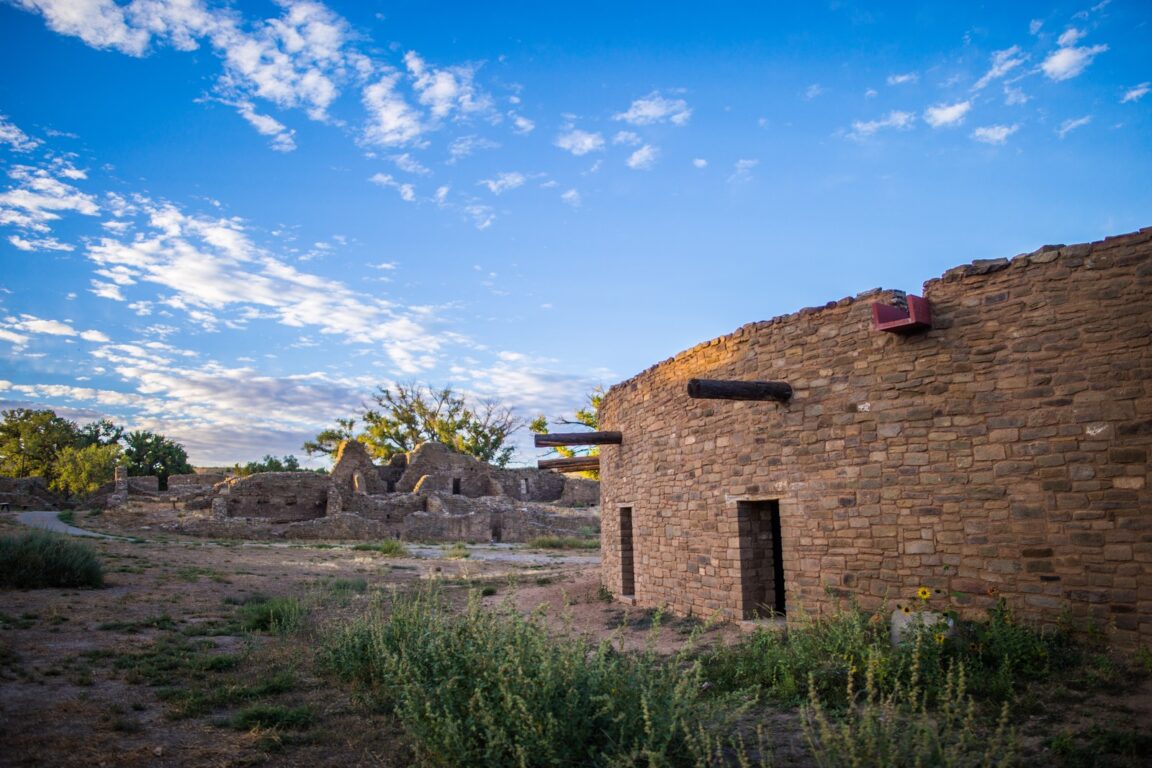
Arrive early and walk the ruin first. The grounds open at 7:00 a.m., hours before the visitor center and long before festival programming begins at around 10:00 a.m., and the West Ruin trail in cool morning light, before the plaza fills, is the best version of the site. The self guided half mile trail winds through original rooms with remarkably well preserved wood roofing and original mortar, then brings you into the Great Kiva, a semi subterranean ceremonial chamber over 40 feet across that the Park Service describes as the oldest and largest reconstructed building of its kind. It was rebuilt in the 1930s on its original footprint, and it is the one space at the monument you step inside and feel at full scale, bench, wall niches and roof timbers included.
Then work backwards into the festival. Do the museum before the crowds reach it: the visitor center, open from 9:00 a.m., holds exhibits and 900 year old cultural items, and the 15 minute film, Aztec Ruins: Footprints of the Past, plays every hour and half hour. When the festival opens, you are free to give it the middle of the day, which is when the artists demonstrations, plaza dances and any music sets concentrate. Keep the Heritage Garden and Native Plants Walk, in the shady picnic area, for the hot part of the afternoon, and remember there is no after hours access on a normal day: unless a scheduled program is underway, the site closes at 5:00 p.m. and vehicles may not be left in the parking lot after closing.
Where should you base yourself, Aztec or Farmington?
The monument sits inside the city limits of Aztec, on the north bank of the Animas River, which makes this one of the easiest national monument visits in the Southwest to stage. Aztec itself has a small stock of motels and vacation rentals and puts you minutes from the gate, which matters on a festival morning. Farmington, the larger city a short drive south, carries the deeper bench: the chain hotels, the wider restaurant choice and the services of the Four Corners region hub, at the cost of a slightly longer drive in. Durango, Colorado, is the third option many travelers use, pairing Aztec with a mountain town stay and a Mesa Verde day, but on festival weekend the simpler play is to sleep in Aztec or Farmington and keep the morning short. Book early for the festival weekend whichever base you choose: the event is free and regional, room stock in Aztec is thin, and the same weekend draws visitors combining the monument with Chaco Culture National Historical Park, the partner site to the south with which Aztec shares its World Heritage listing.
That World Heritage status is worth understanding before you go. Aztec Ruins was inscribed in 1987 as part of the Chaco Culture World Heritage Site, because the West Ruin began as a satellite of the Chaco world and later became the social, economic and political center of its region after Chaco declined. The name, incidentally, is a 19th century settler mistake: the builders were ancestral Pueblo people, with no connection to the Aztec empire of central Mexico. Travelers sequencing the wider Chaco story across several days will find our guide to national park reservations in 2026 useful for the sites on the loop that do charge and book.
What else runs at the monument across the summer?
The festival is the peak, not the whole calendar. From May through September, rangers offer interpretive talks and tours at scheduled times, staff and weather permitting, often held in the Great Kiva, with topics that range across engineering, astronomy, geology, plants and bats. Other annual and seasonal programming in the Park Service listings includes ranger led tours to Aztec East, the less visited second great house, cultural lectures, ethnobotanical plant walks, workshops and demonstrations, and solstice related observations. The consistent rule is the one the park itself states: times and locations are posted about a month in advance on the calendar. A traveler who builds a trip around any single program other than the festival should confirm it there, and anyone visiting on a festival weekend should recheck the calendar in the final week, since performance times are the detail most likely to move.
How do you handle heat, crowds and parking on the big weekend?
Mid July in the San Juan Basin is hot, and the West Ruin trail is an exposed walk between stone walls that hold the heat. Walk the ruin before 10:00 a.m., carry water even though the trail is only half a mile, and plan your shade for the middle of the day: the museum, the Great Kiva interior and the picnic area trees are the cool spaces on site. Parking is the pinch point on festival days because the monument lot serves a city sized site, not a stadium, so the early arrival that suits the archaeology also solves the car. There is no entrance fee and no reservation system to fall back on, which makes the whole weekend first come in the friendliest sense: the visitors who get the quiet ruin, the front row at the plaza dances and the unhurried conversations with artists are simply the ones who started earliest.
What should you not miss inside the West Ruin itself?
Give the masonry your attention. Aztec West preserves some of the finest Chacoan style stonework anywhere, banded walls of shaped sandstone, original wooden roof beams still in place after nine centuries, and doorways aligned so that you look through room after room in a single sightline. The trail guide, which combines archaeological findings with traditional Native American perspectives, is worth picking up at the visitor center before you walk, because the site rewards reading as you go: fingerprints of the builders survive in mortar, and the room blocks around the plaza explain how a community of this scale fed, stored and governed itself on the Animas River. Stay on the designated trail and do not climb the walls, rules the park states plainly and that matter more, not less, when the site is busy. Photography is welcome, with no flash inside the museum. If the monument sparks the wider story, the bridge over the Animas River behind the picnic area carries the Old Spanish National Historic Trail into historic downtown Aztec, an easy extra half mile that rounds out a festival afternoon.
Readers planning a wider season of ancient site visits will find the same arrive early, read as you go discipline rewarded in our guide to visiting Angkor Wat, where timing and order shape the experience just as much as they do at Aztec.
Frequently asked questions about Aztec Ruins on festival weekend
When is the American Indian Cultural Arts Festival at Aztec Ruins?
It is held annually in summer. The centennial edition ran on Saturday and Sunday 15 and 16 July 2023, starting at 10:00 a.m. each day, and earlier editions were single day July events. The Park Service posts each year dates and program times on the park calendar about a month in advance, so confirm the current year dates there before booking travel.
Is Aztec Ruins National Monument free?
Yes. The monument is a fee free park, the festival is free to attend, and no entrance pass or reservation is required. The earlier 5 dollar per person fee was removed in 2018.
What are the opening hours on a festival day?
The grounds, trails, picnic area and parking open from 7:00 a.m. to 5:00 p.m. and the visitor center and museum from 9:00 a.m. to 5:00 p.m. There is no after hours access unless a scheduled program is underway. The monument closes on Thanksgiving, Christmas and New Years Day.
How big is the Great Kiva and can you go inside?
Yes, you can enter it on the self guided trail. The reconstructed Great Kiva is over 40 feet in diameter, semi subterranean, and described by the Park Service as the oldest and largest reconstructed building of its kind. It also hosts dance performances and ranger programs in summer.
How long do you need at Aztec Ruins?
One to two hours covers the visitor center, museum and the half mile West Ruin trail on a normal day. On festival weekend, allow at least half a day so the ruin walk, the museum and the performances and artist demonstrations are not rushed.
Where is the best place to stay for the festival?
Aztec puts you minutes from the gate but has limited rooms. Farmington, a short drive south, has the widest choice of hotels and restaurants. Book early for festival weekend either way, since the free event draws regional visitors and Aztec room stock is small.
Hours, fees and event details checked against National Park Service pages for Aztec Ruins National Monument, including its event listings, on 16 November 2026. Festival dates are set annually, so recheck the park calendar for the current year schedule before traveling.