 Wei Chen
Kayaking the Nam Song at Vang Vieng works best as a paced half day, not a full day thrash: paddle the calmer town reach and the karst lined stretch north of town in the cool of the morning, stop for a cave on the west bank, then save the steep viewpoint climbs for a separate late afternoon when the heat has dropped. The river is the gentle centre of a much more demanding landscape, and travellers who treat the kayak day and the climbing day as one outing usually end it sunburnt, dehydrated and too tired to enjoy either. This guide breaks the Nam Song into its usable segments, explains how the cave stops and west bank viewpoints fit around a paddle, and sets out the fitness, booking and recovery pacing an active trip actually needs.
Quick Facts
- Where: Vang Vieng, Vientiane Province, Laos, on the Nam Song River, about 130 kilometres north of Vientiane
- Best season: The dry season from November to April, when water levels are lower, the current is predictable and viewpoint trails are not slippery
- Signature paddle: Guided half day trips combining a Nam Song kayak section with Tham Nam, the water cave entered by tube on a fixed rope
- West bank stops: Tham Chang cave just south of town, the Blue Lagoons and Tham Phu Kham cave, and the Nam Xay and Pha Ngern viewpoints
- Key safety rule: Confirm the operator provides life vests and headlamps, and do not get on the river when it runs high after heavy rain
- Recovery note: Viewpoint climbs are steep and exposed, so schedule them at sunrise or late afternoon, never in the midday heat after paddling
How is the Nam Song divided into kayak segments?
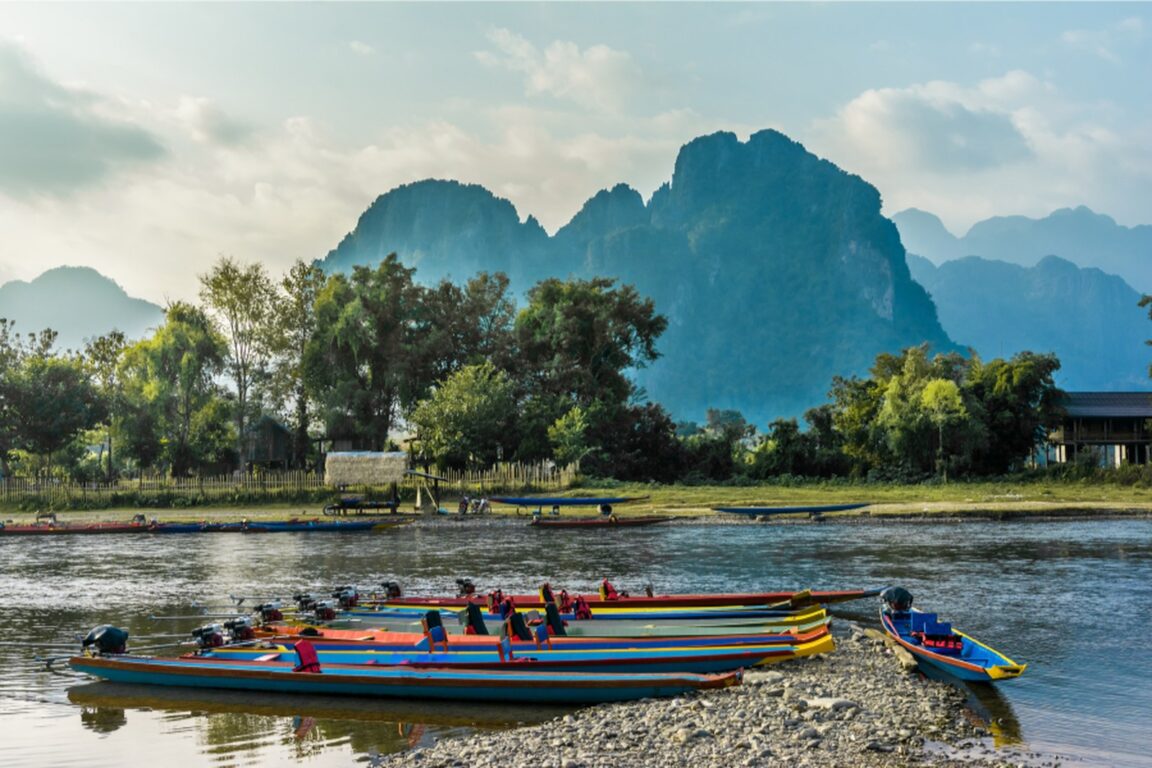
The Nam Song is not one uniform float, and understanding its segments is what turns a random rental into a planned active day. Through town, the river is wide, slow and overlooked by the karst wall that forms the backdrop to every Vang Vieng photograph. This town reach is the beginner friendly section, where the current does most of the work and the main skills are steering around sandbanks and giving longtail boats a wide berth. North of town the valley narrows, the cliffs close in and short, mild riffles appear between longer calm pools. This is the scenic heart of the standard guided route, close enough to the caves and lagoons of the west bank to combine paddling with stops, and far enough from town to feel genuinely rural, with rice paddies, water buffalo and small riverside villages along the banks.
South of town the river passes Tham Chang cave and opens into a quieter agricultural stretch. Fewer tours run this way, which makes it attractive for a second, slower paddle, but put in and take out points are less formalised, so it suits travellers who arrange a guided trip with a clear pickup plan rather than an informal rental. In the wet season, roughly May to October, every segment changes character. The river rises, the current quickens, submerged obstacles move and the famous blue of the lagoons clouds over. Operators may shorten routes or cancel outright, and that decision should be respected rather than argued with. The dry season river, by contrast, can run low enough in March and April that kayaks scrape on gravel bars, which is tiring in a different way and another reason to take local advice on which segment is running best on the day.
Which cave stops pair naturally with a kayak day?
Tham Nam, the water cave north of town, is the classic pairing. A branch of the Nam Song flows out of the cave mouth, and visitors enter sitting in an inner tube, pulling themselves along a fixed rope into the dark with a headlamp on, a trip of about 500 metres into the hill. In the dry season parts can be waded, while higher water makes the tube essential. Most half day kayak tours build Tham Nam in as the turnaround point, which gives the day a satisfying structure: paddle, float through a cave, eat, paddle back or get collected. It is cool, strange and genuinely memorable, and it also rests the shoulders for an hour in the middle of the outing.
Tham Chang, just south of town across a small toll bridge, works better as a gentle add on than as part of the paddle itself. A lit stairway of roughly 150 steps climbs to the cave entrance, the interior is walkable on paths with lighting, and a spring pool at the base is made for a cooling dip afterwards. Because it sits so close to town, Tham Chang suits the afternoon of arrival or a recovery morning rather than the main kayak day. Tham Phu Kham, above Blue Lagoon 1 on the west bank, is the more adventurous cave, reached by a steep scramble and explored by head torch around a chamber with a reclining Buddha. Pair it with a lagoon swim on a non paddling day, when legs are fresh for the climb and there is no schedule pressure from a tour pickup.
How should the west bank viewpoints be paced?
The two viewpoints that matter are Nam Xay and Pha Ngern, sometimes written Pha Ngeun, and they are the reason the pacing advice in this guide exists. Nam Xay is the famous one: a steep, rough path with rocky sections and fixed ropes in places, climbing about 130 metres to a summit platform marked by a rusted motorbike, with the postcard view over the karst valley and the winding Nam Song. Most fit walkers need 30 to 45 minutes up. Pha Ngern is the longer, higher and quieter alternative, a more demanding climb of one to one and a half hours to the summit, with a first viewpoint partway up where a small hut sells drinks. Its panorama is wider and emptier, and it rewards an early start more than any other walk in the valley.
The pacing rule is simple: never stack a viewpoint climb directly after a morning on the river in the hot season. Shoulders and grip strength are spent from paddling, trails are at their most slippery and exposed at midday, and the summit photos are worse in flat noon light anyway. Instead, climb Nam Xay at sunrise on the day after kayaking, or take Pha Ngern at first light and paddle the following morning. Small entry fees apply at the trailheads, reported in recent seasons in the range of 10,000 to 20,000 kip, so carry small notes. Footwear matters more than fitness here: the limestone is polished and sharp, and trail runners with real tread beat both sandals and heavy boots.
What fitness does a Nam Song kayak day actually require?
Less than the marketing suggests, but more than the tubing era implied. A standard half day guided trip involves two to three hours of intermittent paddling, mostly downstream, with the current helping. A reasonably active traveller who can swim, sit in a kayak for an hour at a stretch and haul themselves up a cave rope will manage it comfortably. The honest demands are heat management, sun exposure on reflective water and the short portages or gravel bar drags of late dry season. Full day trips double the paddling and add lagoon and cave stops, and they suit travellers who have already done the half day and know they enjoy it. Anyone with a shoulder or wrist problem should choose the half day, sit in the front of a double kayak with a stronger partner behind, and tell the guide at booking, not at the put in.
For wider context on how the town rebuilt itself around this landscape, read our Vang Vieng guide to its lagoons, caves and viewpoints, and for the natural onward journey north, see our Luang Prabang travel guide.
How do bookings work, and what should be checked before paying?
Vang Vieng runs on walk in booking. Guesthouses, agencies on the main strip and operators by the river all sell near identical kayak and cave combinations, typically as half day trips of about four hours or full day trips that add a lagoon. Recent seasons have seen half day combinations quoted around 120,000 to 180,000 kip per person, but prices move with season and group size, so treat any figure as a starting point for a same week check rather than a promise. What matters more than squeezing the price is the checklist: life vests for every paddler, headlamps for the cave, a dry bag for phones, drinking water included, a named pickup point and time, and a straight answer about river conditions that day. An operator who waves away the life vest question has answered the only question that counts.
Two risks deserve plain words. The first is the river itself after rain, when a placid stream can carry real force and hidden debris; if locals are not swimming, do not paddle. The second is alcohol. Vang Vieng has rebuilt its reputation since the authorities closed the riverside tubing bars in 2012, and the modern kayak day is a sober, scenery led activity. Keep it that way: drink after the paddle, at a riverside table, watching the cliffs turn gold, which is a better end to the day than any bar stop on the water ever was.
What does a well paced three day active plan look like?
Day one is arrival and orientation: settle in, walk the riverside, visit Tham Chang late in the afternoon and swim in its spring pool, then eat early and sleep. Day two is the river day: the guided kayak and Tham Nam combination starting in the morning cool, a long lunch, a lagoon swim at Blue Lagoon 1 or the quieter Lagoon 3 in the late afternoon, and nothing more ambitious than dinner. Day three is the climbing day: Pha Ngern or Nam Xay at sunrise, a slow breakfast, then Tham Phu Kham and its lagoon, with the afternoon kept deliberately empty for a massage, a hammock or a balloon flight at dawn the next morning for those staying longer. This rhythm, paddle, rest, climb, rest, is what an active trip means in a hot limestone valley: the landscape is demanding enough that recovery is not wasted time, it is the mechanism that makes the next highlight possible.
Frequently Asked Questions
Is Nam Song kayaking suitable for beginners?
Yes, in the dry season on a guided half day trip. The standard route is mostly downstream with mild riffles, guides set the pace, and the town reach is wide and slow. Beginners should choose the guided combination over an unguided rental, wear the life vest provided and avoid the river entirely when it runs high after rain.
What is the best month for kayaking in Vang Vieng?
November to February offers the best balance: dry trails, a clear and manageable river, and cooler air for the viewpoint climbs. March and April are hotter and the river can run low, while the wet season from May to October brings faster water, clouded lagoons and slippery trails.
Can kayaking and a viewpoint climb be done on the same day?
They can, but they should not be stacked back to back. Climb at sunrise and paddle the next morning, or paddle first and climb the following day. If the schedule forces one day, climb Nam Xay, the shorter viewpoint, at first light, rest through midday and take only the gentle town reach by kayak late in the afternoon.
What should be brought on a Nam Song kayak trip?
A dry bag for phone and money, reef safe sunscreen, a hat that stays on, water shoes or strapped sandals, a refillable bottle and small kip notes for trailhead and bridge fees. Operators should supply life vests and headlamps for the water cave; confirm both before paying.
Is tubing through Tham Nam cave included in kayak tours?
Usually, yes. Most half day combinations pair the Nam Song paddle with tubing into Tham Nam on a fixed rope, entering the flooded cave by headlamp. In low water parts of the cave can be waded. Ask at booking whether the cave is on the itinerary that day, since high water can close it.