 Sofia Rossi
The Dana to Petra trek is the celebrated heart of the Jordan Trail: roughly 75 kilometres of walking over four to five days, from the stone village of Dana on its highland rim, down through the Dana Biosphere Reserve to the candle lit Feynan Ecolodge, then across empty sandstone country to Little Petra, and finally into Petra itself through the back door, arriving at the Monastery before the crowds ever see you coming. The Jordan Tourism Board measures the section at 72.6 kilometres over four hiking days, operators stretch it to five or six with shorter stages, and either way it is a guided, supported walk, not a signposted stroll. Book a licensed operator, walk it in spring or autumn, and treat the Feynan night and the back door arrival as the two moments the whole route is built around.
Quick Facts: The Dana to Petra Trek at a Glance
- Route: Dana village to Petra, Jordan, the classic Region 6 section of the Jordan Trail
- The full trail: The Jordan Trail runs about 675 kilometres from Umm Qais in the north to Aqaba on the Red Sea, in eight regions
- Distance: About 72.6 kilometres by the Jordan Tourism Board measure, around 75 kilometres on most operator itineraries
- Duration: Four hiking days at the board’s pace, five days on the most common supported itineraries, plus the final walk into Petra
- Daily walking: Roughly 14 to 19 kilometres a day, five to seven hours on foot
- Key night: Feynan Ecolodge at the foot of the Dana descent, solar powered and lit by candles after dark
- The finish: Little Petra, then the back door trail to the Monastery, Ad Deir, entering Petra from the west
- Guiding: A local guide and logistics support are strongly advised. The southern Jordan Trail is largely unmarked
- Best seasons: March to May and October to November. Summer heat in the low Wadi Araba section is severe
- Checked: November 19, 2026, against the Jordan Trail Association, the Jordan Tourism Board figures and RSCN reserve information
Why Is This Section of the Jordan Trail the Famous One?
Most long trails have one stretch that carries the reputation, and on the Jordan Trail it is this one. National Geographic has listed the Dana to Petra walk among the best hikes in the world, and the reason is compression: in under a week you cross from Mediterranean style highland forest at Dana, down a great canyon system into the desert floor of Wadi Araba, and back up into the sandstone mountains of Petra, passing through four distinct climate and vegetation zones on the first day alone. The route also strings together places that road based trips see separately, if at all: Jordan’s largest nature reserve, an off grid ecolodge staffed by local Bedouin, Nabataean ruins scattered far from any ticket gate, and the single most dramatic arrival at Petra available to anyone on foot.
It is also a route, not a stop. Petra at the end is earned at walking pace, and Little Petra the night before acts as a quiet overture, a smaller carved canyon city that almost every day visitor to the main site never sees. Travellers weighing it against a standard Petra day trip should understand the trade plainly: four to five days of real walking, wild camps after the first night, and no daily showers, in exchange for arriving at the Monastery with the landscape already in your legs.
How Do the Stages Split, Day by Day?
Operators draw the stage lines in slightly different places, and distances vary by a kilometre or two between sources, so use the split below as the standard shape and confirm your operator’s exact camps before you book. The four stage logic follows the Jordan Tourism Board’s four hiking day structure, with the most common five day pacing noted where it differs.
Day 1, Dana to Feynan, about 14 to 16 kilometres. The walk begins in Dana village, perched at around 1,200 metres on the edge of the reserve, and drops away down Wadi Dana. One operator’s figures put the day at roughly 230 metres of ascent against about 1,140 metres of descent, which tells you the story: a long, knee testing descent through the reserve’s canyon scenery that levels into a broad valley walk to Feynan. This is the Wadi Dana Trail, the reserve’s classic hike at about 14 kilometres and five to six hours, and it ends at the only full service lodge on the whole trek.
Day 2, Feynan to the Furon area, about 16 to 19 kilometres. The climbing day. The route leaves the Wadi Araba floor and works back up into the mountains through dry riverbeds and stony desert, undoing much of the first day’s descent. Nights from here on are in supported wild camps or small Bedouin camps, with luggage moved by vehicle between camps by your operator.
Day 3, Furon to Ghbour Whedat and on towards Little Petra, about 14 to 17 kilometres. High, remote sandstone country, with the first Nabataean traces appearing along the way: old water channels, presses and ruins that mark how engineered this landscape was two thousand years ago. Five day itineraries sleep at Ghbour Whedat and walk to Little Petra on day 4; four day pacings push through.
Day 4 or 5, Little Petra to Petra, about 14 kilometres. From the camp near Little Petra, the back door trail crosses a plateau and descends an ancient Nabataean route until the Monastery, Ad Deir, Petra’s largest monument, appears ahead of you. You then walk down through the main site past the Treasury and out, or arrange your exit with your operator. Walking in this way reverses the usual visitor flow, so the Monastery comes first and nearly empty.
What Is the Feynan Ecolodge Night Actually Like?
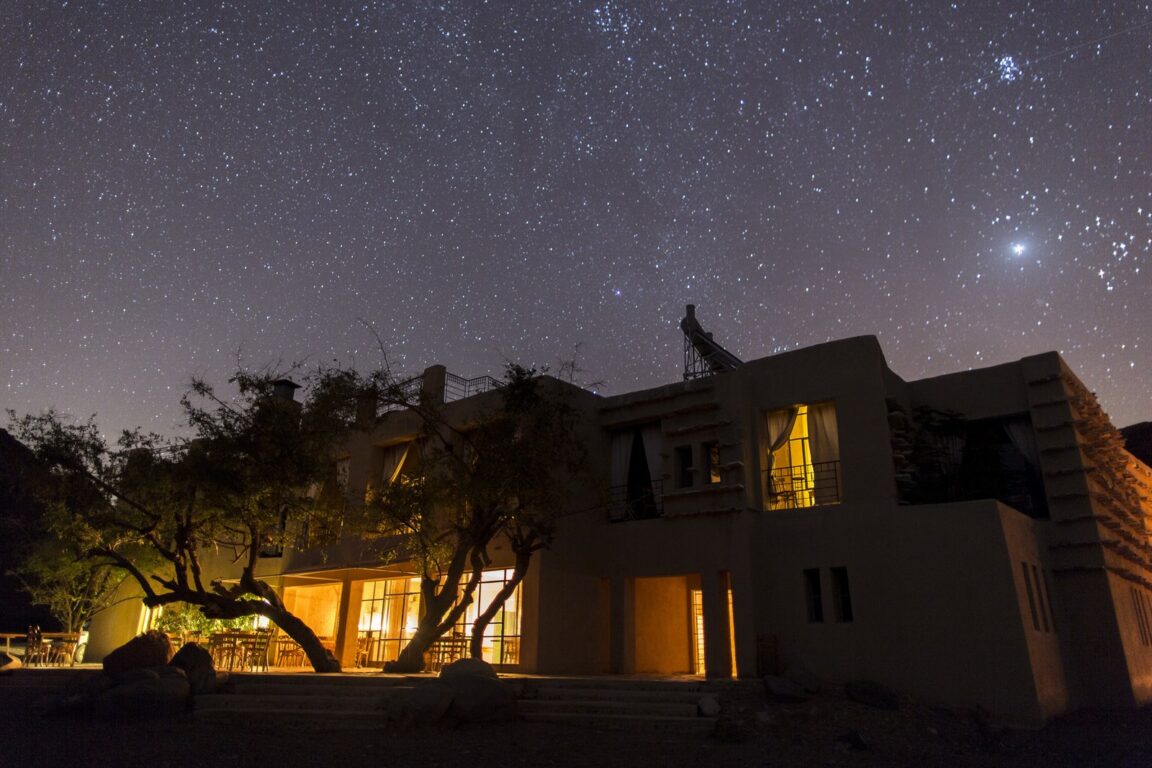
Feynan Ecolodge, at the western foot of the Dana reserve where the canyon opens into Wadi Araba, is the trek’s one true lodge night and its emotional centre. Opened in 2005, it runs on solar power and is lit by candles once the sun goes, which in a desert valley with no neighbouring light source means serious stars. Rooms are simple and cool walled, meals are vegetarian and served communally, and the staff and guides are drawn from the local Bedouin community, whose members also lead the lodge’s experiences: bread making, coffee ceremonies, shepherd walks and sunset tea in the hills.
Practically, Feynan is also your last reliable hot shower, phone charge and luggage reshuffle before the camp nights begin, so treat the evening as logistics as well as atmosphere. The lodge can be reached by vehicle on a rough track from the Dead Sea highway side, which is how operators position luggage and how non walking companions could meet the group, but for trekkers the point is arriving on foot down the wadi as the light fails. Book the Feynan night as part of your operator package rather than separately, because room inventory is small and trek groups take priority in season.
Do You Need a Guide, and How Does the Logistics Work?
Plan on a guide. The northern Jordan Trail has some marking, but the Dana to Petra section crosses open desert and canyon country where the path is frequently a line of cairns, a GPS track or local knowledge, and water sources are seasonal. Every mainstream operator runs this section guided, with a support vehicle moving bags between camps, setting up tents and carrying water and food, so you walk with a daypack. That support is what makes the route accessible to fit recreational walkers rather than only self sufficient backpackers.
Paperwork is light but real. Dana Biosphere Reserve charges foreign visitors an entry fee, listed by the Jordan Tourism Board at 10 Jordanian dinars plus tax as of November 2026, and the reserve is not covered by the Jordan Pass. Petra at the far end is covered by the Jordan Pass, which also waives the tourist visa fee when bought before arrival, so most trekkers carry the pass for the finish. Confirm with your operator exactly which fees your package includes, because reserve fees, the Petra ticket and lodge nights are bundled differently across companies. For a comparison of how booking windows and hut logistics work on another great walk, see our guide to walking the Milford Track, and for a one day mountain crossing with shuttle maths, our Tongariro Alpine Crossing guide.
When Should You Walk It, and How Fit Do You Need to Be?
Walk it in spring, March to May, or autumn, October to November. Those windows give you cool highland mornings at Dana, tolerable temperatures on the Wadi Araba floor, and long enough days for the Monastery arrival. Summer inverts the route’s pleasures: the low section around Feynan sits in one of the hottest corridors in Jordan, and winter brings cold nights at altitude, short days and the risk of flash flooding in the canyons, which can close wadi routes at short notice.
Fitness is moderate to demanding rather than technical. There is no scrambling that needs ropes, but the days are 14 to 19 kilometres on rough ground with serious ascent totals on the middle days, and the first day’s long descent punishes knees and quads. Trekking poles earn their place on day 1 alone. Anyone who can walk six hours a day on consecutive days in hills, and who trains a little beforehand, is in the right range. Altitude is never an issue in the alpine sense, but the swing from around 1,200 metres at Dana to below sea level near Feynan and back up to Petra’s heights is felt in the legs if not the lungs.
What Should You Pack for Four Biomes in One Walk?
Pack for layers and dust. Broken in walking boots or sturdy trail shoes, poles, a sun hat and high factor sunscreen for the exposed desert stages, a warm layer and a windproof for highland mornings and camp nights, and a head torch, which you will want at candle lit Feynan as much as in your tent. Your operator carries the camp kit, food and water, so the daypack stays light: two litres of water capacity minimum, snacks, camera and the day’s layers. Modest dress matters at camps and in villages, and cash in dinars covers tips and small purchases where cards do not reach. Everything else, including the decision about which camp variant your operator uses each night, should be confirmed in writing before you fly, because there is no resupply town between Dana and Little Petra.
Frequently Asked Questions
How many days does the Dana to Petra trek take?
Four hiking days by the Jordan Tourism Board’s measure of the 72.6 kilometre section, and five days on the most common supported itineraries, which split the middle stages more gently and walk into Petra on the fifth day. Add travel days to Dana and out of Petra at both ends.
How far is it from Dana to Petra on foot?
About 72.6 kilometres by the Jordan Tourism Board figure, and around 75 kilometres on most operator itineraries, walked at roughly 14 to 19 kilometres a day. The full Jordan Trail, of which this is one section, runs about 675 kilometres from Umm Qais to Aqaba.
Can you hike Dana to Petra without a guide?
It is not recommended. The southern trail is largely unmarked, water is seasonal and the stages cross remote desert and canyon country. Operators run the route guided with vehicle supported camps, and the Dana reserve section itself has guided and self guided options only for its shorter day trails.
Where do you sleep on the trek?
Typically Dana village before the start, Feynan Ecolodge on the first night, then supported wild camps or Bedouin camps for the middle nights, and a camp or small hotel near Little Petra before the final walk in. Only Feynan is a full service lodge.
Do you enter Petra through the main gate?
No. The trek arrives by the back door trail from Little Petra, reaching the Monastery first and walking down through the site against the usual visitor flow. You still need a valid Petra ticket or Jordan Pass for the site.
What is the hardest day?
For most walkers, day 1’s long descent from Dana to Feynan tests the knees, and day 2’s climb back out of Wadi Araba tests the lungs. Neither is technical, but together they are why consecutive day fitness matters more than speed.
Sources checked November 19, 2026: Jordan Trail Association route information at jordantrail.org, Jordan Tourism Board section distances and Dana reserve entry figures, RSCN Dana Biosphere Reserve and Feynan Ecolodge information at feynan.com, and operator stage data. Distances vary slightly by source and camp choice, so confirm your operator’s itinerary in writing.