 LeVar Thomas
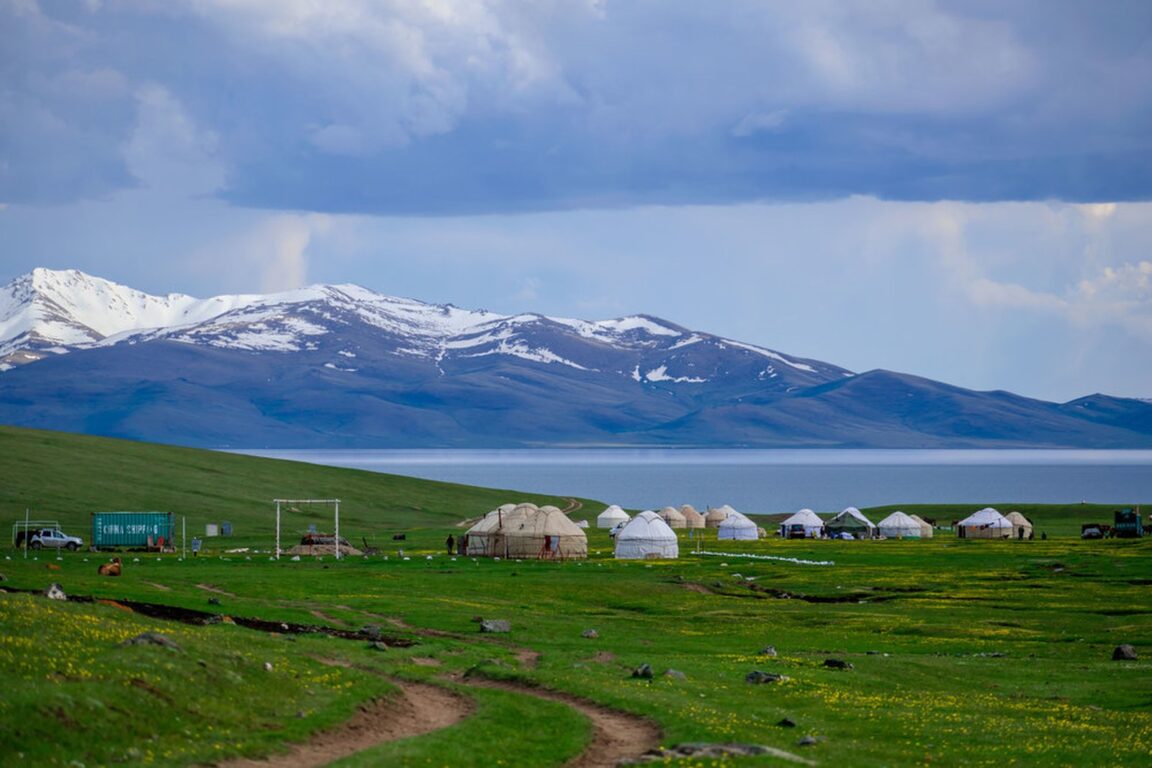
Song Kul is a summer only lake, and everything useful about visiting it follows from that single fact. The alpine lake sits at 3,016 metres in Kyrgyzstan’s Naryn region, covers about 270 square kilometres of a high grass plateau, and is inaccessible in winter, when it freezes under more than a metre of ice. Herders bring their livestock up to the jailoo, the summer pastures, from June, yurt camps open for a season that runs from mid June to the end of September, and the visit is sequenced through community based tourism: book the yurt through the CBT network, travel up from Kochkor or on a horse trek, and spend a night at altitude on the way if you can. Get the order right, season first, booking channel second, road or trail third, and Song Kul is the great Central Asian pasture lake rather than a long drive to a closed shore.
Quick Facts
- Lake: Song Kul (Son Kul), Naryn region, Kyrgyzstan, at 3,016 metres above sea level, about 270 square kilometres, per CBT Kyrgyzstan
- Season: Mid June to the end of September. Inaccessible in winter; the lake freezes over with ice more than a metre thick
- Sleeping: Yurt camps only. There is no village and no hotel at the lake; camps are run by herder families and tour operators
- Booking channel: CBT, the Community Based Tourism network. CBT Kochkor is the primary gateway for yurt stays and transport; CBT’s head office is at 58 Gorky Street, Bishkek
- Access: By 4WD from Kochkor over high passes, or on multi day horse treks. No public transport reaches the lake
- Altitude: 3,016 metres at the shore, with passes above 3,400 metres on trek routes. A night in Kochkor, at about 1,800 metres, first is the standard precaution
- Signature events: Summer horse games, including kok boru and at chabysh racing, played at gatherings on the pastures
- Facts checked: November 20, 2026, against CBT Kyrgyzstan and the national Visit Kyrgyzstan portal
Why is the season the first decision, not the last?
Because outside the season there is nothing to book. CBT Kyrgyzstan, the community tourism association that coordinates yurt stays at the lake, describes Song Kul as inaccessible during the winter months, freezing over with ice more than a metre thick, and lists the best season for its Song Kul programmes as mid June to the end of September. Even inside that window the edges are soft: passes can hold snow into June, camps strike their yurts as September ends, and CBT warns that even in summer the weather at 3,016 metres can change rapidly. July and August are the reliable core, when the herder families are fully installed on the jailoo, the horse games season runs, and every camp on the shore is operating. June and September trade certainty for solitude. A traveller who fixes flights before checking the camp calendar has the sequence backwards; the lake’s calendar is set by ice and grass, and it does not negotiate. The same altitude logic shapes trips across the region, and our Almaty, Kazakhstan guide shows the Tian Shan working to the same seasonal rules on the other side of the range.
How does booking a yurt through community tourism actually work?
Song Kul has no booking engine, no reception desk and no walk in hotel trade. What it has is CBT, a network of local community tourism groups that matches travellers with herder families, yurt camps, drivers and horse guides, with income staying in the communities that host. The practical gateway is CBT Kochkor, the office in the town below the lake, which arranges yurt stays, 4WD transport and horse treks; the national association, CBT Kyrgyzstan, runs programmes from its Bishkek office at 58 Gorky Street. Its published Pearls of Kyrgyzstan programme, which strings Issyk Kul and Song Kul together over eight days with two days of trekking to the lake, is priced from US$1,075 per person for groups of four or more, checked on the CBT Kyrgyzstan Song Kul programme page today, and simpler yurt stays are arranged directly through the Kochkor office at seasonal rates. For July and August, contact the office one to two weeks ahead, state your dates, group size and whether you want a family camp or a larger operator camp, and confirm meals, bedding and the walk to the toilet in writing. Family camps are the authentic end of the range: felt yurts on the pasture, mattresses and heavy blankets, a stove, shared facilities a short walk away, and dinner with the family that owns the herd outside.
What is the right road order from Bishkek to the lake?
Travel in stages, and let the stages do altitude work for you. Bishkek to Kochkor is the easy leg, about three hours on asphalt to the town that serves as the lake’s gateway. Sleep in Kochkor, at about 1,800 metres, rather than pushing on: the national tourism portal’s advice for Song Kul is explicit that altitude sickness is possible at just over 3,000 metres and that a night in Kochkor first helps you acclimatise. From Kochkor, the road climbs by 4WD over high passes to the shore, a rough three to four hour drive with no public transport alternative, arranged through CBT Kochkor or your camp host. CBT’s own trek itineraries show the geography honestly: its programme drives to Kochkor, then treks from the Kyzart side through Kilemche pasture and over the Jalgyz Karagai pass at 3,400 metres down to the lake, stays with a shepherd family at Batai Aral on the shore, and drives out over the Kalmak Ashuu pass back toward Bishkek. Whether you ride, trek or drive, Kochkor is the hinge. Trips that skip it save a night and spend the saving on headaches, in both senses, at the lake.
Beyond the yurt photo, what actually happens on the jailoo?
The yurts are accommodation; the jailoo is the destination. These pastures have been summer grazing since ancient times, as CBT puts it, and the working life of the lake continues around the camps: herds moving to water, horses tethered by the yurts, families milking, baking and repairing tack. The set piece events are the horse games. At summer gatherings, riders play kok boru, in which teams on horseback contest a goat carcass toward a goal, and at chabysh, flat out horse racing across the pasture, with wrestling and other traditional games filling out a festival day. Ask in Kochkor what is scheduled during your dates rather than expecting a daily show; games belong to gatherings, not to a timetable. The quieter hours have their own programme: ride out with a camp horseman for two or three hours, walk the shore toward the bird rich eastern end of the lake, and be outside after dark, when a sky with no competing light source anywhere in the valley does the thing every visitor ends up describing first. Travellers building a wider high altitude itinerary can pair this planning style with our first time in Kathmandu itinerary, another trip where altitude and sequencing decide whether the plan works.
What is the honest altitude and comfort reality?
Song Kul sits at 3,016 metres, high enough that most sea level visitors feel it on the first evening: a headache that water and rest usually settle, sleep that comes in lighter stretches, and a walk to the toilet that counts as exercise. Nights are cold in every month of the season, dropping toward freezing even in midsummer, and the yurt stove is lit in the evening rather than through the night, so the warm layer you pack is the one you sleep in. Facilities at family camps are basic by design: outdoor toilets, limited washing water, no showers, and electricity that ranges from a solar panel and a charging socket to none at all, with phone signal to match. None of this is a defect; it is the product, a working nomad summer camp that takes guests. But it should be chosen knowingly. Travellers who need an ensuite and a mattress with a brand name should book an operator camp with beds and dining yurts, or accept that this particular lake is not for them, rather than arriving at a family camp and grading it against a hotel it never claimed to be.
Frequently Asked Questions
When is the best time to visit Song Kul?
The season runs from mid June to the end of September, and July and August are the reliable core, with all camps open and horse games gatherings under way. The lake is inaccessible in winter and freezes under more than a metre of ice. June and September are quieter but carry more weather and camp availability risk.
How do I book a yurt camp at Song Kul?
Book through the Community Based Tourism network: CBT Kochkor for yurt stays, transport and treks arranged directly, or CBT Kyrgyzstan in Bishkek for packaged programmes. For July and August, contact the office one to two weeks ahead with dates and group size, and confirm meals and facilities in writing.
How do I get to Song Kul from Bishkek?
Travel to Kochkor first, about three hours by road, and spend a night there. From Kochkor, continue by arranged 4WD over the passes, roughly three to four hours, or join a two to three day horse trek. No public transport reaches the lake, so the Kochkor leg is arranged through CBT or your camp.
Will the altitude at Song Kul affect me?
Possibly. The lake is at 3,016 metres and trek passes rise above 3,400 metres. A night in Kochkor at about 1,800 metres first, a gentle first evening, water and warm layers handle it for most visitors. Nights are cold even in midsummer, and snow is possible in any month.
What are the horse games at Song Kul?
Summer gatherings on the jailoo feature traditional Kyrgyz horse games, principally kok boru, a team game played on horseback with a goat carcass, and at chabysh horse racing. They are tied to festivals and gatherings rather than a daily schedule, so ask CBT Kochkor what falls inside your dates.
Featured image: Yurt camps on the shore of Song Kul, Kyrgyzstan, with the lake and snow capped ranges behind. Photo from CBT Kyrgyzstan, the Community Based Tourism association’s official website (cbtkyrgyzstan.kg), used with credit.