 Thandiwe Nkosi
For a two night stay in Granada, book Realejo if you want calm streets and an easy walk to dinner, Centro if you want flat ground, taxis at the door and every sight within a short walk, and the Alhambra hill only if an early palace entry matters more to you than evenings in town. The Albaicin, the famous Moorish quarter across the Darro valley, delivers the postcard view of the Alhambra and the hardest luggage walk in the city. None of these bases is far from the others on a map. What separates them is slope, noise and how your mornings and evenings actually run, so choose by routine rather than by distance.
Quick Facts
- Best all round base: Realejo, the old Jewish quarter on the lower southern slope, flat at its centre and quieter on its hillsides.
- Best for first timers and luggage: Centro, the flat commercial heart around the cathedral, Plaza Nueva and Plaza Bib-Rambla.
- Best for an early Alhambra entry: The Alhambra hill itself, or Realejo and Centro near Plaza Nueva, both served by the C30 minibus to the ticket offices.
- Best view, hardest logistics: The Albaicin, a World Heritage Site since 1994, with steep cobbled lanes, stepped alleys and limited car access.
- Key transport: Minibus C30 links the centre with the Alhambra, C32 links the Alhambra with the Albaicin, and C31 loops through the Albaicin from Plaza Nueva.
- Ticket timing that shapes your base: Entry to the Nasrid Palaces runs on a fixed half hour slot named on your ticket, so your walk or bus ride to the gate needs a buffer, not a guess.
- Prices checked: November 21, 2026. Hotel rates in Granada move sharply with season and festival dates, so this guide compares areas rather than quoting room rates that will date within weeks.
Why does the neighbourhood decision matter so much in Granada?
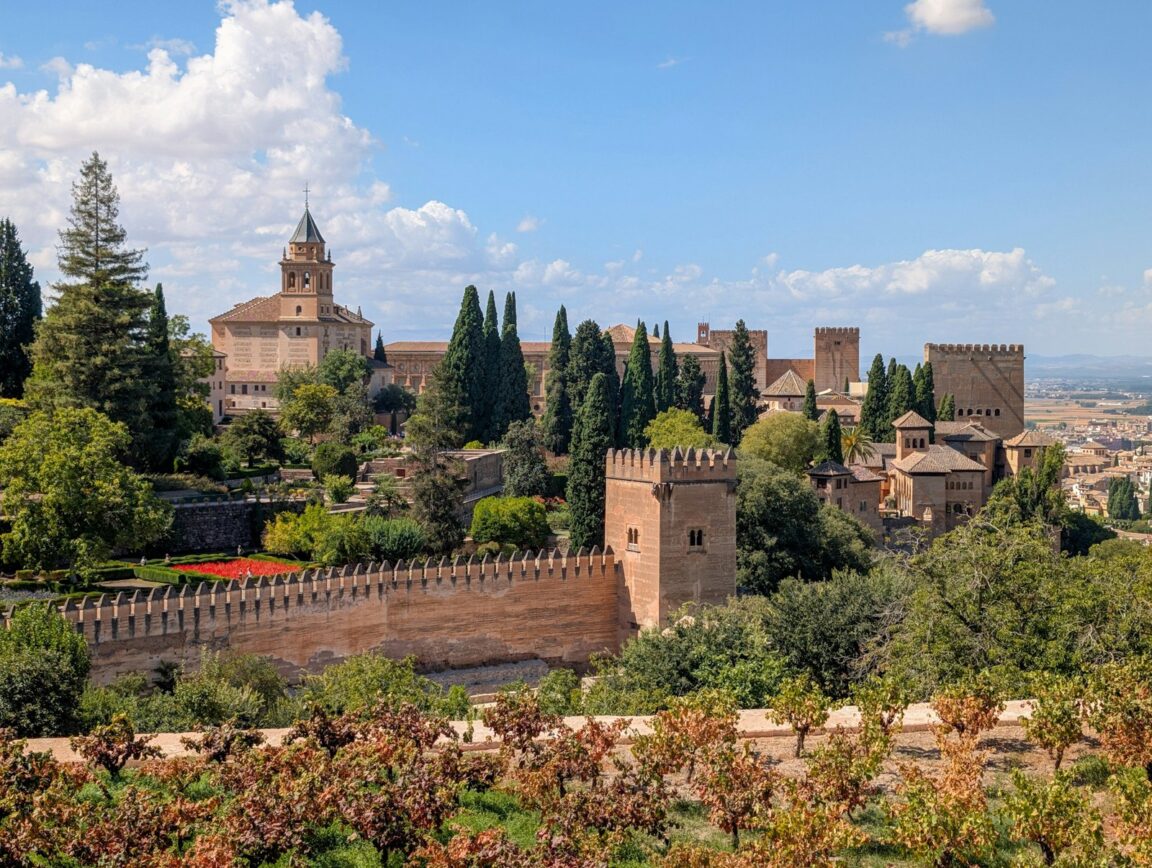
Granada is a city of two facing hills divided by the River Darro. The Alhambra palace city stands on the Sabika hill to the south. The Albaicin climbs the hill opposite. Between and below them sits the lower town, where Centro spreads out on the only genuinely flat ground in the historic core, and Realejo fills the slope and the level streets at the foot of the Alhambra hill.
Three practical forces drive the choice. The first is gradient: cobbled lanes in the Albaicin and on the Realejo hillsides are steep, sometimes stepped, and unforgiving with a rolling suitcase. The second is the Alhambra itself, because a timed morning entry rewards a base with a simple, predictable route up the hill. The third is the evening. Granada runs late, tapas bars fill after nine, and the walk home at midnight is part of the stay. A base that looks perfect at noon can feel wrong at midnight if it leaves you a dark climb or a long quiet road.
One boundary before the detail. This guide is only about where to sleep and how each base behaves. Ticket types, palace order and entry rules belong to our canonical admission guide, Visiting the Alhambra, Granada: Tickets, Palaces and Timing, Explained, and nothing here replaces it. Read that piece before you book a room, because the palace slot you secure should confirm the base you choose, not the other way round.
Realejo: the calm compromise below the Alhambra
Realejo is the answer for most two night stays, and it earns that position by having the fewest serious drawbacks. The district began in the Moorish era and became known as Gharnata al-Yahud, Granada of the Jews, the quarter where the city Jewish community lived. After the Reconquest the Catholic Monarchs took over the properties of the Nasrid royal family, which is how the area gained its present name.
Official tourism guidance from Andalucia divides Realejo into two very different halves, and the split is exactly what a guest needs to understand before booking. The Sabika and Mauror hillsides are a maze of narrow streets paved with traditional Granada cobblestones, mostly residential and very quiet. The flat area below, the old Jewish quarter between Santo Domingo and the Plaza del Padre Suarez, holds the working heart of the neighbourhood around Campo del Principe, a broad square lined with terraces that fills with local families in the evening. Book the flat half for convenience. Book the hillside half for silence, and accept the slope that buys it.
Who should stay in Realejo?
Choose Realejo if you want to walk to the cathedral and Plaza Nueva in about ten minutes, eat where residents eat, and still reach the Alhambra on foot or by minibus without a dawn expedition. Calle Pavaneras and the streets around Campo del Principe carry the cultural weight of the district, with the Alhambra Theatre adding evening life that is local rather than touristic. The trade off is honest: Realejo has no single famous view to match the Albaicin, some of its upper streets climb more than first time visitors expect, and the prettiest lanes sit a short walk from the main sights rather than among them. For a two night stay built around one Alhambra morning and two long evenings, that is a trade most travellers should take.
Centro: flat streets, full services and the easiest arrival
Centro, often signed as Centro-Sagrario, is the genuine heart of Granada and has been a commercial district for centuries. Its anchor is the cathedral, built by order of the Catholic Monarchs over the main mosque and considered a masterpiece of the Spanish Renaissance, with the Royal Chapel beside it. Plaza Nueva, at the eastern edge of the district, is the oldest square in the city and the hinge between the lower town, the Albaicin climb and the road up to the Alhambra.
The case for Centro is logistical, and it is strong. The streets are level, taxis and buses can reach hotel doors, the main bus stops and the minibus departures for the Alhambra sit in or beside the district, and restaurants, pharmacies and shops run at full city hours. Travellers arriving by train or airport bus, travelling with children, or managing any mobility limit should start their search here and only move uphill for a specific reason. If your Granada plan includes onward travel by rail, our guide to train luggage rules in Spain is worth reading before you pack, because Granada station days run smoother with a bag you can lift.
What is the catch with staying in Centro?
Centro trades atmosphere for ease. The busiest streets carry traffic noise, the blocks around Calle Reyes Catolicos and Gran Via feel like a working Spanish city rather than a historic quarter, and the famous tapas street Calle Navas draws a heavy visitor crowd at peak hours.
The Alhambra hill: sleeping beside the monument
A small number of properties sit on the Alhambra hill itself, inside or beside the wooded grounds of the monument, including the parador installed in a former convent within the complex. The appeal is obvious and real. You wake above the city in gardens and trees, you can walk to the entrance pavilion without transport, and an early Nasrid Palaces slot becomes a stroll rather than a commute.
The costs of that privilege are equally real. The hill has almost no independent restaurant scene, so dinner means planning around the property itself or a trip down into town and a taxi or minibus back up. Evening Granada, the tapas rounds and late squares that define the city for many visitors, happens below you. Treat the hill as a deliberate splurge for travellers whose trip centres on the monument, perhaps a single night paired with a night in Realejo or Centro, rather than the default answer for a two night stay.
And the Albaicin? The view everyone wants, priced in effort
The title of this guide promises a look beyond the Albaicin, but no honest comparison can leave it out, because it is the base most visitors picture. Granada oldest neighbourhood keeps its medieval street plan of narrow cobbled lanes, whitewashed walls and carmenes, the walled garden houses that hide orchards and fountains behind plain doors. It was declared a World Heritage Site in 1994 as an extension of the Alhambra listing. From the Mirador de San Nicolas, the terrace in front of the church of the same name, the Alhambra fills the view across the Darro with the Sierra Nevada behind it, above all at sunset.
Stay here if the view and the quarter itself are the point of your trip, and if you travel light. The lanes are steep, many are stepped, car access is restricted, and a taxi may only be able to leave you at the edge of the lower quarter near Plaza Nueva or along the Carrera del Darro, the riverside street that runs beneath the Alhambra toward the Paseo de los Tristes. The C31 and C32 minibuses climb into the quarter and save legs, but they do not remove the final stepped lane to many addresses. Lower Albaicin properties near the Darro soften most of these problems while keeping the atmosphere. Upper Albaicin addresses near Plaza Larga deliver the full historic quarter and the full climb.
Which base makes an early Alhambra entry painless?
Work backwards from the slot on your ticket. The Nasrid Palaces admit visitors in a fixed half hour window, the ticket is issued in the visitor name and identity documents are checked, and the walk inside the complex from the main entrance pavilion to the palaces takes time of its own. Our Alhambra admission guide covers the booking system in full. For the neighbourhood decision, only the journey to the gate matters, and it ranks like this.
From the Alhambra hill, the journey is a walk inside the grounds, the simplest of all. From Realejo, the Cuesta del Caidero and the streets below the hill put you on the southern approach, and the C30 minibus route passes through the district edge on its climb from the centre. From Centro, walk up the Cuesta de Gomerez from Plaza Nueva, a shaded climb of roughly twenty minutes that most fit travellers handle comfortably with an early start, or take the C30 minibus from the Plaza Isabel la Catolica area straight to the ticket offices. From the Albaicin, the route crosses the valley: down to Plaza Nueva and up the Gomerez climb, or the C32 minibus that links the Albaicin directly with the Alhambra. It is the longest and least forgiving journey of the four, which is why an Albaicin stay pairs better with a mid morning palace slot than with the first entry of the day.
Whichever base you choose, build the morning around a buffer.
How should different travellers choose?
First time visitors with two nights: Realejo, in the flat streets near Campo del Principe or along Calle Pavaneras. You get quiet sleep, local evenings and a manageable Alhambra morning.
Travellers with heavy luggage, children or limited mobility: Centro, on a level street near the cathedral or Plaza Nueva, where taxis reach the door and no stepped lane stands between you and your room.
Romantic stays and photographers: The lower Albaicin near the Carrera del Darro, or a carmen with an Alhambra facing terrace in the upper quarter if the climb is part of the pleasure rather than a burden.
Monument focused splurges: One night on the Alhambra hill for the dawn entry and the empty evening grounds, then a second night in town for the tapas scene, if your dates and budget allow the split.
Travellers pairing Granada with the Pueblos Blancos can add our guide to Setenil de las Bodegas, and those heading onward should read our guide to flamenco in Seville.
Frequently Asked Questions
Is Realejo or Centro better for a first visit to Granada?
Centro is easier, Realejo is pleasanter. Centro offers flat streets, full services and the simplest arrival and departure. Realejo offers quieter nights, a stronger local food scene around Campo del Principe and a walk of about ten minutes to the cathedral. First timers who prioritise sleep and evenings usually prefer Realejo. First timers who prioritise logistics usually prefer Centro.
Can taxis reach hotels in the Albaicin?
Only partly. Car access to the Albaicin is restricted and many lanes are too narrow or stepped for vehicles, so taxis often drop guests at accessible points such as Plaza Nueva or the Carrera del Darro, leaving a walk for the final stretch. The C31 and C32 minibuses serve stops inside the quarter. Confirm the exact drop off point with your property before booking if luggage or mobility is a concern.
Is it worth paying to stay on the Alhambra hill?
It is worth it for one specific reason: a stress free early entry and an evening inside the monument grounds after day visitors leave. It is poor value if your evenings matter, because restaurants and tapas bars are down in the city and every night out ends with a climb or a taxi back up. Many travellers get the same benefit more cheaply from Realejo or Centro plus the C30 minibus.
How early should I leave my hotel for a morning Alhambra slot?
Plan to arrive at the entrance pavilion well ahead of the half hour window printed for the Nasrid Palaces, and remember that reaching the palaces from the entrance takes further time on foot. From Centro or Realejo, allow at least forty minutes door to gate by minibus or on foot. From the Albaicin, allow more, because the route crosses the Darro valley first. The full timing rules are in our Alhambra admission guide, linked above.
Which neighbourhood is quietest at night?
The residential hillsides of Realejo and the Alhambra hill itself are the quietest bases. Upper Albaicin lanes away from the mirador are also calm, though the San Nicolas area draws evening crowds at sunset. Centro is the loudest of the four around its main avenues and squares, so light sleepers booking there should ask for a high floor or a room facing an interior courtyard.
Where should I stay in Granada with a car?
None of the historic hillside quarters suits a car. Centro, with its public car parks at the edge of the old town, is the practical choice, and even there the car should stay parked for the whole stay while you walk and use the minibuses. Travellers touring Andalucia by road often sleep in Centro, visit the Alhambra on foot or by C30, and keep driving days for the countryside between cities.
Last updated November 21, 2026. Neighbourhood descriptions checked against official Andalucia tourism guidance and the Patronato de la Alhambra visitor information on the day of writing. Bus routes and entry rules can change, so confirm both before you travel.