 Sofia Rossi
Sitges is the rare beach town where the LGBTQ+ scene is not a corner of the resort but the resort itself: a compact Catalan old town 40 minutes from Barcelona by train, with 17 beaches, a main gay beach at Platja de la Bassa Rodona, and a bar strip on and around Carrer Joan Tarrida that has run for decades. Come for a beach week in summer, for Carnival in February or March, or for Bears Week in September, and stay in the old town so that everything, sand included, is a walk. Spain has had marriage equality since 2005, and Sitges applies that national settlement with unusual enthusiasm.
Quick Facts
- Getting there: R2S Rodalies train from Barcelona, about 40 minutes
- Beaches: 17 in total along the Sitges coast
- Main gay beach: Platja de la Bassa Rodona, below the seafront promenade in the centre of town
- Bar centre: Carrer Joan Tarrida and the streets around Plaça Indústria in the old town
- Big dates: Carnival in February or March, Pride in June, Bears Week in September
- Marriage equality: Legal across Spain since 2005
- Legal reference: ILGA World database entry for Spain at database.ilga.org
Why Sitges holds its position
Plenty of European resorts claim a gay welcome. Sitges has the receipts: a gay scene documented since the 1970s, a town economy that treats LGBTQ+ visitors as its core market rather than a niche, and a calendar in which Carnival, Pride and Bears Week are civic events, not tolerated add ons. The result is a place where a same sex couple checking in, booking a double room or holding hands on the promenade is not making a statement. It is Tuesday.
The national frame helps. Spain legalised same sex marriage in 2005, among the first countries in the world to do so, and the ILGA World database entry for Spain records the wider protections that sit behind it. The official town site, Visit Sitges, markets the LGBTQ+ welcome as a headline rather than a footnote, and the national tourism portal spain.info does the same for the country as a whole. In Sitges, that top level support shows up at street level as rainbow flags on mainstream businesses and a bar strip that never had to hide.
The beaches, starting with Bassa Rodona
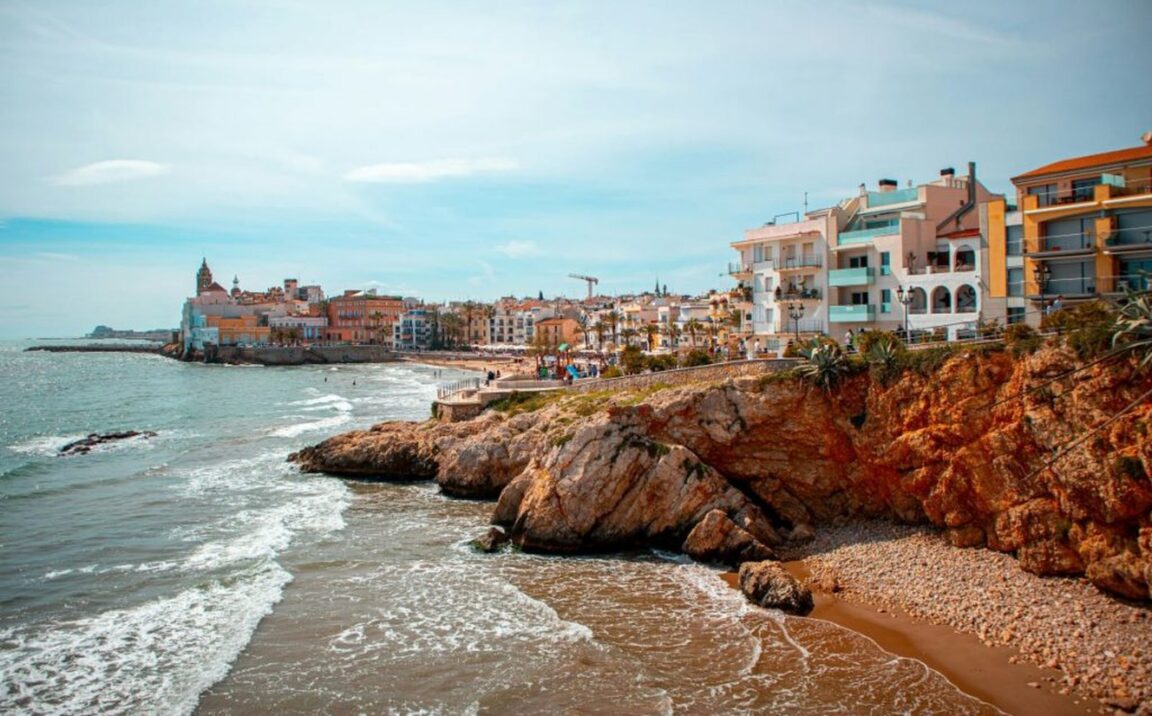
Sitges has 17 beaches strung along its coast, and choosing between them is the main decision of any day here. Platja de la Bassa Rodona, in the centre of town below the promenade and the Hotel Calipolis, is the established gay beach: a broad, serviced stretch of sand with sunbed hire, a beach bar and a crowd that arrives late morning and stays until the light goes. Its position is the point. You can walk from an old town hotel to a towel on Bassa Rodona in under ten minutes, leave for lunch, and be back for the afternoon.
Around it, the town beaches each have a character. Platja de la Ribera, next along the promenade, is the busiest general beach. Platja de Sant Sebastià, on the far side of the church point, is calmer and more local in feel. Platja dels Balmins, beyond the cemetery, is clothing optional and mixed. The pattern to copy is simple: base your beach days at Bassa Rodona if the social scene is the point of the trip, and walk east or west along the promenade on the days when you want quiet more than company. The sea is swimmable from late May into October, and the promenade makes every beach in town reachable on foot.
The old town and the bar strip
The old town is a tight grid of whitewashed streets between the station and the sea, and its LGBTQ+ nightlife concentrates on Carrer Joan Tarrida and the small streets feeding Plaça Indústria, locally treated as the centre of the scene. Bars here are small, close together and built for moving between: a drink in one, a look into the next, a late decision about the clubs that open after the bars fill. Summer nights run late by Spanish habit, with terraces busy from about 11pm and the real peak after midnight.
By day the same streets hold the town’s other life: the parish church of Sant Bartomeu i Santa Tecla on its point above the sea, the Maricel and Cau Ferrat museums in the old fishermen’s quarter, and a steady supply of cafés and vermouth bars. Stay inside this grid if you can. The large resort hotels along the western seafront are comfortable, but a ten minute walk each way, twice a day, quietly taxes a holiday built on spontaneity. If you are pairing Sitges with Barcelona nights, our guide to the Mercer Hotel Barcelona covers a strong luxury base in the capital, and our three days in Lisbon itinerary is the natural next stop on an LGBTQ+ friendly Iberian trip.
Carnival, Pride and Bears Week
Carnival is Sitges at full volume. Held in the week before Lent, in February or March, it fills the town with parades, costume parties and two main processions that draw crowds from across Catalonia, and the gay bars treat it as a second high season. Book early, expect the old town to be loud until dawn, and lean in: costume effort is the local currency. It is the single best week to see how completely the town and its LGBTQ+ scene overlap, because during Carnival there is effectively one party and everyone is in it.
Pride in June is smaller than Barcelona’s but more concentrated, with events centred on the seafront and the old town. Bears Week in September is one of the largest bear gatherings in Europe, taking over the same bar strip at the end of the beach season, when the sea is at its warmest and the summer crowds have thinned. The three events spread the scene across the year, which is why Sitges works as an LGBTQ+ trip in almost any month except the quietest weeks of winter.
Getting there and around
The R2S Rodalies line runs from Barcelona Sants and Passeig de Gràcia to Sitges in about 40 minutes, with frequent departures through the day and a walk of roughly ten minutes from Sitges station down to the old town and seafront. That rail link shapes the trip: Sitges can be a Barcelona day trip, but it rewards staying over, because the town’s best hours are the beach afternoon and the late bar night, and day trippers miss one or the other. Within Sitges you need nothing but feet. The town is small, flat along the seafront, and arranged so that hotel, beach, dinner and bars form a loop you will learn on the first day.
Safety and judgment
Sitges is a low risk destination for LGBTQ+ travellers, with legal equality, a protective local culture and a police presence scaled up for its big event weeks. The real risks are the ordinary resort ones: sun, dehydration on long beach days, and opportunistic theft in the densest Carnival crowds, where a phone in a back pocket is the standard loss. Swim within the flagged areas, pace the afternoon drinking in summer heat, and use the same care with drinks in packed bars that you would use in any nightlife town. Beyond that, the judgment Sitges asks of visitors is mostly social: it is a small town as well as a party resort, so keep late night noise down on residential streets and the welcome stays exactly as warm as advertised.
A simple three day pattern
Day one belongs to arrival and orientation: train from Barcelona, check in, a first swim at Bassa Rodona, and an early circuit of the old town bars while you still have the energy to learn their names. Day two is the beach day proper, starting late, breaking for a long lunch off the promenade, and returning to the sand until evening, when the Joan Tarrida strip does its best work. Day three is for the town itself: the museums on the seafront, the walk east to Balmins and Sant Sebastià, and a final dinner in the old town. In Carnival or Bears Week, drop the structure entirely and let the event calendar set the hours, because on those weeks it will anyway.
Frequently Asked Questions
Which is the main gay beach in Sitges?
Platja de la Bassa Rodona, in the centre of town below the seafront promenade, is the established gay beach, with sunbed hire and a beach bar. Platja dels Balmins, further east, is clothing optional and mixed.
How do I get to Sitges from Barcelona?
Take the R2S Rodalies train from Barcelona Sants or Passeig de Gràcia. The journey takes about 40 minutes, and Sitges station is a ten minute walk from the old town and beaches.
When is Sitges Carnival?
Carnival runs in the week before Lent, in February or March depending on the year. Its two main parades are among the biggest events in the town’s calendar, and accommodation books out early.
Is Sitges only for gay men?
No. The historic scene leans male, especially during Bears Week, but the town’s beaches, bars and big events draw a broad LGBTQ+ crowd and plenty of allies, and the welcome is general rather than gated.
How many beaches does Sitges have?
Sitges has 17 beaches along its coast, from the serviced town beaches on the promenade to quieter coves at both ends. Most visitors base themselves at Bassa Rodona, Ribera or Sant Sebastià.
Photo: The Sitges seafront and old town, looking towards the church of Sant Bartomeu i Santa Tecla, by Chan Lee on Unsplash.