 Rafael Santos
Base in Cuenca for at least three nights, spend the first two days at city pace among the hat workshops, cathedral domes and river paths of its UNESCO listed historic centre, and take the high lakes of Cajas National Park only on day three or later, once the altitude has settled. Cuenca sits at about 2,560 metres, high enough to reward a slow start, while the main Cajas trailheads sit far higher, in paramo country roughly 30 kilometres west of the city. Travellers who reverse the order spend their best city day recovering. Travellers who follow it get both halves of Cuenca at their best.
Quick Facts
- Where: Cuenca, officially Santa Ana de los Rios de Cuenca, capital of Azuay Province in Ecuador’s southern Andes.
- Altitude: About 2,560 metres (about 8,400 feet). Cajas National Park rises far above the city, so its walks belong after acclimatisation, not on arrival day.
- UNESCO status: The Historic Centre of Santa Ana de los Rios de Cuenca was inscribed on the World Heritage List in 1999.
- The four rivers: The Tomebamba, Yanuncay, Tarqui and Machangara cross or border the city, and the Tomebamba shapes its best known walk.
- The hat: The Panama hat is Ecuadorian, woven from toquilla straw, the fibre of the Carludovica palmata plant. Cuenca is a major centre for finishing and exporting it.
- Cajas entry: Day entry is exempt from charge. Registration at a designated control point, such as La Toreadora, is required, and overnight stays carry separate fees.
- Currency and language: Ecuador uses the US dollar. Spanish is the working language, including at workshops and park controls.
- Time needed: Three nights minimum for the city plus Cajas. Four or five nights suits a slower craft and day trip programme.
Why does the order of days matter so much in Cuenca?
Because Cuenca asks two different things of a visitor’s body, and only one of them is gentle. The historic centre is flat, compact and made for walking. Its planned Spanish grid, laid out after the city’s founding in 1557 on ground that had held the Inca city of Tomebamba and, before it, a Canari settlement, can be read on foot in short, forgiving stretches between plazas, churches and cafes. Nothing in the centre requires speed or stamina, which makes it ideal altitude medicine: movement without strain, interest without effort.
Cajas is the opposite proposition. The park protects a glacial lake system in high Andean paramo west of Cuenca, managed by ETAPA EP, the city’s municipal water company, because the lakes and wetlands feed Cuenca’s water supply. Its best known walks start at La Toreadora, beside the lake of the same name, at elevations where the air is noticeably thinner than in the city, the weather turns quickly and a simple lakeside loop can feel twice its distance. The sensible sequence writes itself. Walk the city while the body adjusts, sleep at 2,560 metres for at least two nights, then climb to the lakes with a full day, warm layers and no other commitment.
What should the first, slow day in the historic centre include?
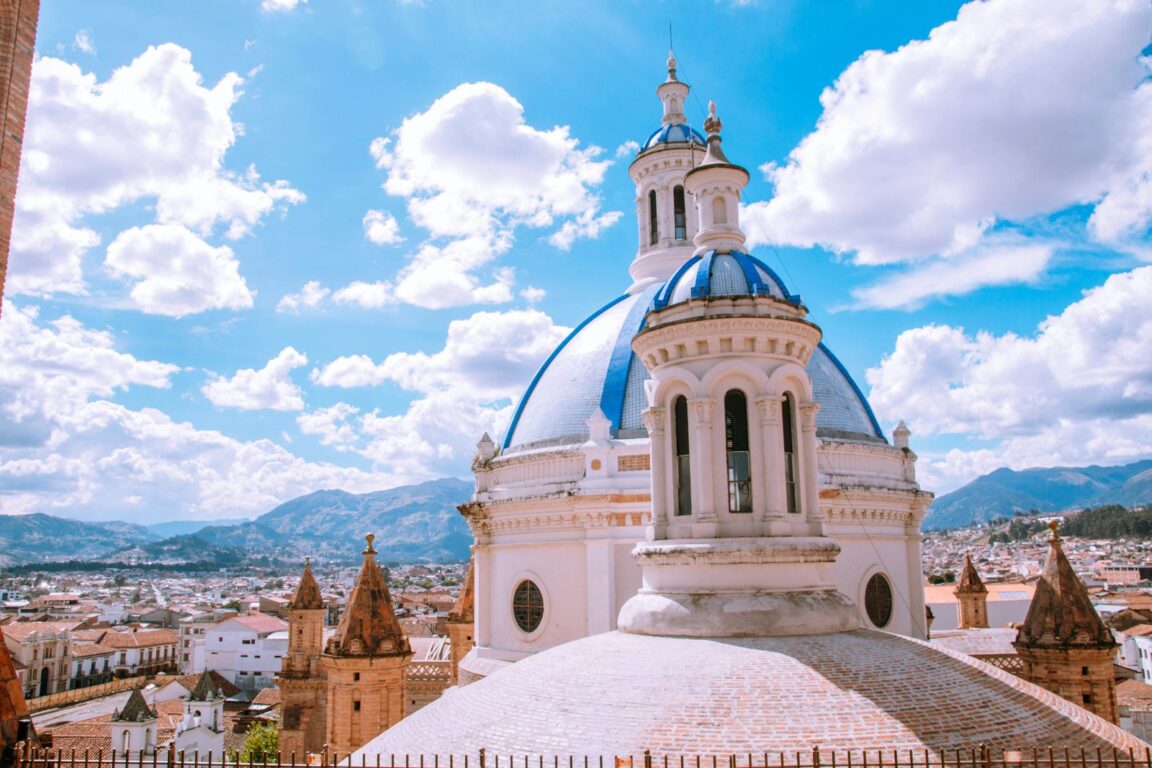
Start at Parque Calderon, the square at the centre of the grid, where Cuenca’s two cathedrals face each other. The Old Cathedral, begun in the sixteenth century, now serves as a museum. Across the square stands the New Cathedral, the Catedral de la Inmaculada Concepcion, begun in 1885 and recognised everywhere by its three blue domes, the view in this article’s featured image. Seeing both in one unhurried circuit teaches the city’s basic grammar: a colonial plan, republican era facades, and churches that still anchor daily life rather than sitting behind ropes.
From the square, let the day drift rather than march. The Plaza de las Flores, beside the Carmen de la Asuncion church, runs a daily flower market that shows Cuenca’s highland agriculture at its most colourful. The city’s markets, including 10 de Agosto and 9 de Octubre, reward a slow pass for Andean fruit, grains and lunch counters, provided bags stay zipped and phones stay put in the crowds. Keep the first day’s walking in short loops, drink water before thirst argues, and treat an early night as part of the itinerary rather than a failure of ambition. Readers planning a wider Andean circuit will find a useful contrast in our guide to Arequipa, Peru, another highland city that rewards a patient first day.
Where do the river walks fit into an acclimatisation plan?
On the afternoon of day one and the morning of day two, when gentle, level walking is exactly what the body needs. The Tomebamba is the most loved of Cuenca’s four rivers. It runs along the southern edge of the historic centre, below the row of houses known as El Barranco, whose facades face the centre while their backs step down the bank toward the water. Paths follow the river through grassy banks and trees, past the Puente Roto, the broken bridge left as a monument after flood damage, and on toward the Pumapungo museum and archaeological park at the centre’s eastern end.
Pumapungo deserves its own unhurried slot. The site preserves remains of Tomebamba, the Inca city that preceded colonial Cuenca, with terraces and foundations set out in a park, and its museum covers the Indigenous cultures of Ecuador. It is the single best place in the city to understand that Cuenca is not simply a Spanish foundation. Two peoples, the Canari and the Inca, built here first, and the colonial grid was drawn over their city. Walk back along the opposite bank as the light changes, and the acclimatisation work of the day is done without a single hill climb.
Why is the Panama hat Ecuadorian, and what happens in a Cuenca workshop?
The name is the mistake. The hat is woven in Ecuador from paja toquilla, toquilla straw, and its weaving tradition was inscribed by UNESCO on its Intangible Cultural Heritage list in 2012. The straw comes from the Carludovica palmata plant, grown mainly in coastal provinces such as Manabi, where towns including Montecristi and Jipijapa became famous for the finest weaving. The hats reached the world through Panama, carried across the isthmus and sold to travellers passing through, including workers heading for the California gold fields and, later, the canal zone. The port of sale became the name, and the name stuck, however firmly Ecuador corrects it.
Cuenca’s role is finishing at scale. From the nineteenth century, production expanded into Azuay and Canar provinces, and Cuenca became a centre where woven hat bodies, many made by weavers in surrounding towns and countryside, are washed, bleached, blocked, pressed, trimmed and banded for export. That division of labour is what a workshop visit shows. At Homero Ortega, the family company founded in 1972 by a fifth generation hat maker of the same name, visitors can tour a working factory and its museum, following a hat from a soft, shapeless woven cone to a finished, shaped piece with its sweatband and ribbon fitted. Other long established Cuenca makers, including Barranco, run comparable workshop and showroom visits in and near El Barranco.
How should a traveller judge a hat before buying one?
By weave, not by label. The finer and tighter the weave, the more hours the hat holds and the higher the price climbs, from modest everyday pieces to superfino grades that can take months to weave and cost accordingly. Hold a hat to the light. A fine weave reads even and dense, with no gaps or lumps, and the straw feels smooth rather than scratchy. Ask where the hat body was woven, how it was finished, and whether the size can be adjusted on site, a service the established workshops routinely offer. Buy the hat that will actually be worn at home, in a style that suits the buyer’s own wardrobe, rather than the most expensive grade on the shelf. A good Cuenca workshop visit takes about an hour, fits perfectly into day two, and asks nothing of the lungs at all.
When is Cajas National Park worth the climb, and how does entry work?
On day three at the earliest, and only on a morning that starts clear. Cajas lies roughly 30 kilometres west of Cuenca on the road toward Guayaquil, and the journey itself climbs steadily from the city into open paramo, a high grassland of lakes, wetlands and low, wind shaped vegetation. ETAPA EP manages the park and publishes its visitor rules. Day entry is exempt from charge, a point ETAPA’s own tariff information and Cuenca’s official tourism guidance agree on. What is not optional is registration. Visitors must register at designated sites, principally La Toreadora, Llaviucu and Soldados, before walking, giving the park a record of who is on its trails. Carry a passport or a clear copy for that registration.
Overnight stays are a separate matter and carry fees that vary by visitor category, with foreign visitors over 16 paying the highest listed nightly rate. Most Cuenca based travellers do not need them. The standard visit is a day trip: a bus from the Terminal Terrestre toward Guayaquil via the park, or an organised transfer, a registered start at La Toreadora, a walk matched honestly to the day’s fitness, and a return to the city by mid afternoon, before paramo weather typically closes in. ETAPA advises against starting or continuing hikes late in the day, when fog can become intense and temperatures fall fast. Treat 16:30, the published end of the entry window, as a hard boundary for being off the trails, not a target.
Which Cajas walk suits a newly acclimatised visitor?
The Toreadora lake loop, the park’s best known short route, is the honest first choice. It circles Laguna Toreadora from the refuge and control point, on marked paths through paramo and patches of polylepis woodland, the gnarled, high altitude forest that shelters in the park’s hollows. It delivers the essential Cajas picture, still water, open grassland and big sky, without committing an unacclimatised walker to a long crossing. Longer routes, including multi lake traverses and the climb toward the Tres Cruces pass on the continental divide, belong to visitors who have slept several nights at altitude, walk regularly at home, and have checked conditions and route status with the park before setting out.
Dress for a different climate from the city’s. At Cajas elevations, sun, wind, rain and near freezing cold can all arrive within one walk. A waterproof shell, a warm mid layer, a hat and gloves, sun protection for the fierce high altitude light, water and food and shoes with real grip are the minimum kit. There is no mobile coverage to rely on across much of the park, which is another reason the registration step matters and why no one should start a longer route alone late in the day. Travellers building a longer South American highland route can compare the pacing here with our Cartagena itinerary, where the challenge reverses and sea level heat sets the pace.
How many days does Cuenca need, and where do the craft towns fit?
Three nights is the working minimum: two for the city, its workshops and its rivers, one for Cajas. A fourth and fifth night open up the craft towns of the Azuay valley, which make natural half day trips once the altitude question is settled. Gualaceo, with its markets and orchid growing, and Chordeleg, known for jewellery and for hat weaving whose finished work feeds the Cuenca factories, both sit within easy reach east of the city. Sigsig, further out, is another weaving town where the hat story begins at the loom rather than the showroom. Ingapirca, Ecuador’s most important Inca archaeological site, lies north in Canar Province and pairs naturally with a craft town day rather than with Cajas, keeping one high effort day from following another.
Eating in Cuenca supports the slow plan. Lunch is the main meal, and the city’s almuerzo tradition of a set midday menu suits travellers who want one substantial meal and a light evening. Highland staples to look for on menus include mote, the large kernel hominy that appears everywhere, hornado, slow roasted pork, and cuy for the curious, served in established restaurants rather than as a dare. None of it needs a reservation driven sprint across town. In Cuenca, the restaurants, workshops and museums all sit inside the same walkable grid, which is precisely the point.
Frequently Asked Questions
Will the altitude in Cuenca be a problem?
For most visitors it means a slower first day, shortness of breath on stairs and a need for water and sleep, rather than a ruined trip. Cuenca, at about 2,560 metres, sits lower than Quito. Anyone who feels seriously unwell should rest, descend if symptoms worsen and seek medical advice locally rather than pushing on to Cajas.
Is Cajas National Park free to enter?
Day entry is exempt from charge under the tariff published by ETAPA EP, the park’s manager. Registration at a designated control point such as La Toreadora is required before walking, and overnight stays carry separate fees by visitor category. Check the current rules with ETAPA or Cuenca’s official tourism office before going, as access details can change.
Are Panama hats really made in Cuenca?
The hats are Ecuadorian, woven from toquilla straw, and Cuenca is one of the country’s main centres for finishing and exporting them. Hat bodies are woven by hand, many in Manabi and in towns around Azuay, then washed, blocked, pressed and trimmed in Cuenca workshops such as Homero Ortega, whose factory and museum visitors can tour.
How far is Cajas from Cuenca, and how do visitors get there?
The main La Toreadora sector is roughly 30 kilometres west of the city on the Cuenca to Guayaquil road via Molleturo. Buses from the Terminal Terrestre heading toward Guayaquil stop for the park, and organised day transfers are widely offered in the city. The drive climbs steeply, so allow close to an hour each way.
What is the best time of year to visit Cuenca?
Cuenca’s highland climate changes little in temperature across the year, with cool nights and mild days. The relatively drier months, roughly June to September, give Cajas its best walking odds. In any month, plan the lakes for the morning, when skies over the paramo are most often clear.
How long should a hat workshop visit take?
Allow about an hour for a factory tour, museum and showroom at an established maker such as Homero Ortega. That timing fits easily into a second, acclimatising day in the city, alongside the river walks and Pumapungo, without any strenuous effort.
Image credit: The blue domes of the New Cathedral in Cuenca, Ecuador, by Juan Ordonez, via Unsplash, Unsplash License.
Facts checked 25 November 2026 against UNESCO, ETAPA EP and Cuenca tourism sources, and the Homero Ortega company history. Entry rules and park conditions can change. Confirm Cajas access with ETAPA before travelling.