 Camille Baptiste
Read Trinidad and its valley as one story and the town stops being a pretty stopover: do the plaza museums in the cool of the morning, when the cobbles around Plaza Mayor are still quiet, drive northeast to the sugar estates of the Valle de los Ingenios and climb the Manaca Iznaga tower while the light is clear, then come back to town for the open air music on the Casa de la Musica steps after dark. That order is not a styling choice. UNESCO inscribed Trinidad and the Valley de los Ingenios together, as a single World Heritage property, because neither half explains itself alone. The valley produced the sugar. The town spent it, housed it and displayed it. A visit that keeps the two together, in that sequence, is the visit that makes sense of both.
Quick Facts
Where: Trinidad, province of Sancti Spiritus, on Cuba’s south central coast, between the Caribbean and the Sierra del Escambray
World Heritage status: Trinidad and the Valley de los Ingenios inscribed together by UNESCO in 1988, reference 460, under criteria (iv) and (v)
Historic centre: 37 hectares at the heart of the inscribed property, centred on Plaza Mayor
The valley: Three interconnected valleys, San Luis, Santa Rosa and Meyer, about 12 kilometres northeast of town, covering 225 square kilometres in UNESCO’s description
Valley remains: Sites of 75 former cane sugar mills, plus plantation houses, barracks and related facilities, per UNESCO
Manaca Iznaga tower: About 45 metres (147 feet) high, built in the early 19th century for estate owner Alejo Maria Iznaga y Borrell
Founded: In the early 16th century; the town dates its founding to 1514
Best rhythm: Museums in the morning, the valley late morning, the music steps at night
Entry paperwork: Check current Cuban entry rules before booking; see our guide to Cuba’s e-Visa and the end of the tourist card
Hours note: Museum and estate hours in Cuba change often and are not reliably published online, so confirm them locally on arrival rather than planning around a timetable found on the internet
Why are Trinidad and the valley listed together?
UNESCO’s brief synthesis puts the logic plainly. Trinidad, in the central Cuban province of Sancti Spiritus, was founded in the early 16th century but owes its existence and its historical reason for being to the sugar industry that flourished there and in the nearby valley from the late 18th century to the late 19th century. The town’s prosperity in that period is, in UNESCO’s words, clearly legible in its built environment, in buildings that range from modest vernacular houses to elaborate and luxurious mansions. The valley, meanwhile, is described as a living museum of Cuban sugar production and a remarkable testimony to the development of the industry.
That legibility is what a morning in town is for. Trinidad was not a port that happened to have nice houses. It was the counting house, warehouse district and showroom of a sugar economy, and the grand buildings around Plaza Mayor were paid for by estates a short ride away. Read the plaza first, then go and stand in the fields that financed it, and the architecture stops being decoration. It becomes evidence.
The listing also carries the harder half of the story, and a responsible visit does not skip it. UNESCO records that at the industry’s peak more than fifty sugar mills were operating in the valley, and that in 1827 more than 11,000 enslaved people were working in the mills. The wealth in the plaza and the coercion in the valley are the same fact viewed from two ends. The barracks that survive beside the plantation houses are part of the inscribed property for a reason.
What should you do first around Plaza Mayor?
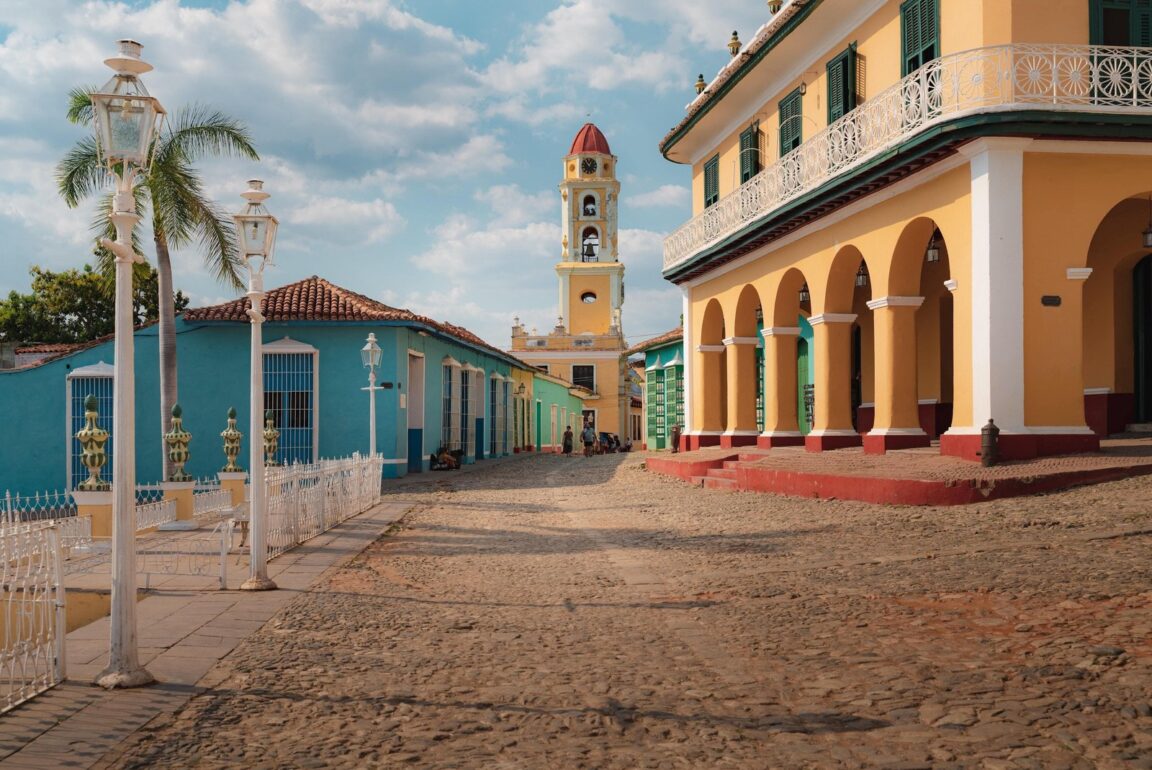
Start at Plaza Mayor itself, early. UNESCO identifies the square as the heart of the 37 hectare historic centre, overlooked by the campanile of the Convento de San Francisco, and names the two buildings that frame it best. The Palacio Brunet, UNESCO says, provides the most authentic picture of the golden age of the city. The neoclassical Palacio Cantero now houses the municipal history museum. Those two palaces, read in the morning before the heat builds on the cobbles, give a first time visitor the town’s whole argument in two interiors: one showing how a sugar family lived at the top of the trade, the other setting out the town’s own account of how it got there.
The Palacio Brunet is also the home of the Museo Romantico, the romantic museum whose period rooms of 19th century furniture and decorative arts are the standard first museum stop in Trinidad. Treat it as a house first and a collection second. The point is the scale of domestic life that sugar money bought: high ceilings built for air, courtyards, and rooms arranged for receiving. The Museo de Arquitectura Colonial, the museum of colonial architecture on the square’s edge, is the useful companion piece. It explains the fabric itself, the doors, grilles, roof tiles and building methods that repeat down every street, so that the walk afterwards becomes reading rather than just looking.
Climb for the view while the morning is still cool. The campanile of the former Convento de San Francisco is the tower in almost every photograph of Trinidad, and from the top the town’s layout resolves: red terracotta roofs, the grid of cobbled streets, the mountains behind and the sea in front. UNESCO stresses that much of that fabric survives intact, including the irregular system of squares and plazas and the cobblestone streets, built and kept with traditional materials such as lime mortar, wood and terracotta clay roofing tiles. The view from the tower is where that survival becomes visible all at once.
Practical notes for the morning are simple. Wear shoes with grip, because the cobbles are rounded and slippery after rain, and carry water. Keep the museum plan loose: hours are not published on a single reliable official timetable and they shift, so ask locally and order the morning around what is open. The plaza buildings stand minutes apart, so a swapped order costs nothing.
How does the Valle de los Ingenios complete the story?
Twelve kilometres northeast of Trinidad, three interconnected rural valleys, San Luis, Santa Rosa and Meyer, make up the Valle de los Ingenios, the Valley of the Sugar Mills. UNESCO gives the inscribed valley an area of 225 square kilometres and counts the sites of 75 former cane sugar mills within the property, along with plantation houses, barracks and other facilities tied to the industry. Most of the mills are ruins now. That is precisely what makes the valley worth the drive rather than a photo stop. This is an industrial landscape in cane country, and it reads at road scale, estate by estate, chimney by chimney.
Arrange transport before you leave town, through your accommodation or a driver agreed in advance, and go in the late morning when the light over the valley is clear and the worst heat is still ahead of you. Build the visit around one estate done properly rather than a sweep past several gates. The estate that anchors almost every visit is Manaca Iznaga, because so much of it still stands in one place: the owner’s house, the tower and some of the original barracks, the barracones where enslaved workers were housed. UNESCO and Cuban official tourism both single the estate out for exactly that completeness.
Standing at Manaca Iznaga, the system is legible in a way no museum label can match. The house shows the owner’s comfort. The barracks show the labour regime that paid for it. The fields around both show the crop. A gradual and progressive decline in the sugar industry, which UNESCO notes accelerated significantly in the 1990s, left this landscape frozen rather than redeveloped, which is why the testimony survives. Give the estate unhurried time, and let the discomfort of the place sit alongside its beauty. Both are the history.
Why climb the Manaca Iznaga tower?
Because the tower is the valley in a single object. It stands about 45 metres, or 147 feet, high, and it was built in the early 19th century, with 1816 the date most often given, by or for the estate owner Alejo Maria Iznaga y Borrell. At the time it was, by contemporary accounts repeated in reference works on the valley, the tallest structure in Cuba. A tower that height in flat cane country was never only decorative, and the standard accounts of its purpose are consistent. Its bell announced the start and end of the working day for enslaved workers, the times for prayer, and an alarm in case of fire or escape. Its height also served surveillance over the surrounding fields, and it displayed the owner’s power and standing in the sugar industry and in local society. The large bell now rests at the foot of the tower.
The climb is by steep internal stairs, and the reward is orientation. From the top, the valley opens out in cane fields and farm plots, with the Escambray hills closing the view to the north. Distances that felt abstract from the road make sense from up there: how close the estates sat to each other, how the land was watched, and how far Trinidad’s plaza really is from the ground that paid for it. Visitors with vertigo or limited mobility should weigh the steep stairs honestly and enjoy the estate from ground level instead, where the house, the old sugar press on the grounds and the barracks carry the story without the ascent. As with the museums, confirm on the day whether the tower is open for climbing and what the current entry charge is, in cash, rather than relying on a figure quoted online.
What happens on the Casa de la Musica steps after dark?
Evening returns the day to the town, and Trinidad’s centre of gravity shifts a few steps from Plaza Mayor. Beside the church, a wide outdoor staircase climbs to the Casa de la Musica, and after dark that staircase becomes an open air venue: a live band at the top, listeners and dancers filling the steps, and music running late into the night. It is the town’s standing nightly gathering rather than a staged show, which is why it lands differently from a concert. Arrive without a schedule, take a step where there is room, and stay for as many sets as the night offers.
The steps also explain something the museums cannot. Trinidad can feel, in the morning, like a place preserved in amber, all fabric and no present tense. The night corrects that. The same square that held the sugar palaces holds the town’s social life now, loud and local, and the continuity is the point UNESCO’s authenticity assessment makes in drier language: this is a living town of single family houses and working streets, not a cleared heritage zone. For more on how Cuban music carries a night, see our companion piece on Havana after dark and the music rooms that carry the night, which pairs naturally with an evening here.
Practical evening notes are brief. Carry small cash for drinks and any entry or seating charge, which can change. Keep valuables minimal on crowded steps. And plan the walk back to your room in daylight terms: the cobbles that charmed at nine in the morning are ankle hazards in the dark, so a phone light and unhurried pace are worth it.
How many days does Trinidad need, and what pairs with it?
One full day can hold the arc this guide describes, morning museums, late morning valley, evening music, but two days hold it better. A second day lets the valley be done without clock watching, frees a slower second pass through the plaza museums, and leaves room for Playa Ancon, the beach on the peninsula south of town that most visitors pair with Trinidad, or for the green foothills of the Escambray behind the town. What Trinidad does not reward is being rushed as a day trip between other bases. The town’s whole value is sequence and contrast, palace against plantation, morning quiet against night noise, and that needs at least one full cycle of the day.
However long you stay, keep the discipline that made the listing: town and valley together. The plaza alone leaves pretty streets with no idea what paid for them; the valley alone gives ruins without the counting house. Follow UNESCO’s single argument in order, and Trinidad reads as cobbles in the morning, cane fields at midday and son music on the steps at night.
Frequently Asked Questions
Why is Trinidad a UNESCO World Heritage Site?
Trinidad and the Valley de los Ingenios were inscribed together in 1988, reference 460, under criteria (iv) and (v). UNESCO cites the town as an exemplary city whose existence and survival are owed to the 18th and 19th century sugar industry, and the valley as a remarkable testimony to that industry, with the sites of 75 former sugar mills, plantation houses and barracks.
How tall is the Manaca Iznaga tower, and can you climb it?
The tower stands about 45 metres, or 147 feet, high and dates to the early 19th century. Visitors do climb it by steep internal stairs for views over the valley, but opening and charges change, so confirm both on the day at the estate.
What are the opening hours for Trinidad’s museums?
There is no single reliable official timetable published online for the plaza museums, and hours and rest days shift. Confirm times locally on arrival, at your accommodation or at the first museum, and keep the morning order flexible, since the main museums stand within a few minutes of each other around Plaza Mayor.
How far is the Valle de los Ingenios from Trinidad?
UNESCO places the valley 12 kilometres northeast of Trinidad. It is a short drive, but you need transport arranged, since the estates sit on separate roads across a wide rural valley rather than within walking distance of each other.
Where is the live music in Trinidad at night?
On the wide steps of the Casa de la Musica, just off Plaza Mayor beside the church, where a live band plays in the open air and the steps fill with listeners and dancers late into the evening.
How long should you spend at Manaca Iznaga?
Allow enough time to see the owner’s house, the surviving barracks and the grounds as well as the tower climb. Rushed stops that only climb the tower miss the estate’s real value, which is how completely the sugar system survives in one place.
Featured image: Plaza Mayor and a cobbled street in Trinidad, Cuba, with the campanile of the Convento de San Francisco, by Daniel Sessler via Unsplash, Unsplash License. Facts checked 25 November 2026 against UNESCO’s listing for Trinidad and the Valley de los Ingenios and Cuban official tourism sources.