 James Wolfe
Pack for two seasons in one suitcase. Autumn in Seoul is not a single temperature but a daily swing: the Korea Meteorological Administration’s 1991 to 2020 climate normals put the city’s September mean at 21.6 degrees Celsius, October at 15.0 and November at 7.5, and within a single November day the average runs from a low of 3.5 degrees to a high of 11.9. A morning that starts near freezing can end in shirt sleeve sunshine, and the first frost normally arrives around 28 October. The system below, checked against the KMA normals on 24 November 2026, dresses for that swing, plans around the Chuseok holiday crush, and deliberately leaves room in the case for what Seoul’s shopping districts will talk you into buying.
Quick Facts
Season covered: September to late November in Seoul
The swing: KMA normals show November averaging 3.5 degrees at night and 11.9 by day in Seoul
First frost: Around 28 October on the KMA normal dates; first ice around 3 November
Chuseok 2026: The harvest holiday ran 24 to 26 September 2026, with trains and highways at their busiest of the autumn
Bag strategy: Pack to roughly two thirds of your airline’s checked allowance and keep the rest for shopping
Facts checked: 24 November 2026, against Korea Meteorological Administration climate normals
How wide is the morning to evening temperature gap, really?
Wide enough to ruin an outfit chosen at breakfast. In October, Seoul’s most comfortable month, a clear day can start in single figures, peak in the high teens, and drop again the moment the sun leaves the palace courtyards. In November the gap hardens: gloves at the bus stop in the morning, a coat carried over your arm by lunch, and the coat back on, buttoned, for the walk to dinner. The layering answer is a three part system rather than one heavy coat. A thin merino or synthetic base layer handles the cold start, a midweight knit or fleece does the day’s work, and a packable insulated jacket or a proper wool coat closes the system at night.
Choose the outer layer by month. September still carries late summer humidity and the tail of the rain season, so a breathable waterproof shell earns its place over insulation. October is the classic trench and light puffer month. By November, and certainly by the last week, a real winter coat is the honest choice: the KMA forecast in the week of 24 November 2026 had morning temperatures falling below freezing across most of the country, with Seoul’s daytime high at only 9 degrees on the 24th. If your trip straddles October and November, pack for November and shed layers, not the other way round.
What belongs in the case, item by item?
Build around a repeatable uniform so every piece works with every other piece. Three base layer tops, two mid layers, one insulated outer, two trousers (one tailored, one relaxed), and one skirt or dress layer if that is your style covers a week with a single laundry stop. Autumn Seoul is a walking city of palace grounds, market lanes and subway stairs, so footwear matters more than formality: one pair of broken in walking shoes with grip for palace stone and temple steps, and one smarter pair for evening. Add a compact umbrella through September and October, then swap it for a warm hat and gloves from November.
Two Seoul specifics catch visitors out. First, interiors run hot. Department stores, restaurants and the subway are heated generously from late October, so layers you can remove and carry beat a single thick jumper you will sweat in. A tote or packable day bag that holds the shed layer is a packing item, not an accessory. Second, palace and temple visits involve a lot of standing on stone in the shade. Thermal leggings or long underwear under trousers, unfashionable and invisible, are the difference between enjoying Gyeongbokgung at opening time and leaving after twenty minutes.
How does Chuseok change what you should pack?
Chuseok, the three day harvest holiday when much of the country travels to family hometowns, fell on 24 to 26 September in 2026. Seoul empties of residents and fills with a different rhythm: many small family restaurants close, palaces stay open and have in recent years offered free entry across the holiday period, and the KTX trains out of the city sell out in both directions around the break. For packing, the holiday matters in three ways. Dress one step smarter than your sightseeing default, because the Koreans who remain in the city are visiting family and dressing for it, and palace photographs look better for the effort. Carry a complete change of plans in your day bag, because the neighbourhood place you researched may be shuttered and the day becomes improvisational. And if your dates touch the holiday edges, pack so the case can be carried up station stairs without help, because platforms and intercity terminals run at crush density.
The same logic applies in miniature to the autumn festival weekends and the university festival season, when Hongdae and the palace districts stay up late. One outfit in the case should be able to go from a daytime market to an evening of barbecue and bars without a hotel return, because autumn evenings in Seoul reward staying out.
How much empty space should you leave for shopping?
More than feels sensible. Seoul is one of the world’s great shopping cities at every level: skincare and cosmetics in Myeongdong, independent fashion in Hongdae and Seongsu, fabric and wholesale floors in Dongdaemun that run into the night, and traditional markets such as Gwangjang where quilts, brassware and snacks compete for the same suitcase corner. The discipline is to decide the allowance before you leave home. Check your airline’s checked baggage limit on the carrier’s own site, pack the case to about two thirds of that weight, and weigh it on a bathroom scale or a cheap luggage scale before departure. A case that leaves home at two thirds returns home legal; a case that leaves home full returns home with you wearing three jumpers at check in.
Pack a lightweight duffel flat in the case as the overflow valve. If the shopping wins, the duffel becomes the second bag where your fare allows it, or swallows the soft goods while the hard case takes the breakables. Buy heavy items, ceramics, bottles, books, early in the trip rather than on the last day, so the weight distribution is a choice rather than a pavement negotiation outside the hotel. Readers building a wider Asia packing system should also see our guide to the carry on only system for a two week Asia trip, and those splitting time with Japan can pair this list with our Tokyo in 5 days district itinerary.
What should stay out of the case?
Bulky knitwear you can buy better in Seoul, a second heavy coat, and full size toiletries. Korea’s skincare retail is a destination in itself, and every convenience store stocks the basics at honest prices. Leave the hairdryer as well: hotels supply them, and Korean voltage and plugs (220 volts, round two pin type C and F) mean a simple adapter, not a converter, is what most modern dual voltage devices need. Keep one adapter per person rather than one per family, because the evening charge queue of phones, cameras and power banks is real. A power bank belongs in hand luggage, never in a checked case, on every airline.
Frequently Asked Questions
What is the coldest month covered by an autumn trip to Seoul?
November. The KMA normals give Seoul a November mean of 7.5 degrees Celsius, with average lows of 3.5 degrees, and late November mornings regularly fall below freezing. Pack a genuine winter coat for November dates.
When was Chuseok in 2026 and does it affect a Seoul trip?
Chuseok ran from 24 to 26 September 2026. Intercity trains and highways are at their busiest, many small family restaurants close, and the palaces stay open and busy with Korean families. Sightseeing works well; intercity day trips need booking discipline.
How many layers do you actually need for Seoul in October?
Three: a base layer for cold mornings, a knit or fleece for the day, and a light insulated or wool outer for the evening. Interiors are heated strongly, so removable layers beat one thick garment.
How much suitcase space should you reserve for shopping?
About a third of your checked weight allowance. Pack the case to roughly two thirds of the airline limit, weigh it before departure, and carry a flat packed duffel as overflow for Myeongdong, Hongdae and Dongdaemun purchases.
Do you need a voltage converter for Korea?
For most modern phones, laptops and cameras, no. Korea uses 220 volts with round two pin plugs (types C and F), so a plug adapter is enough for dual voltage devices. Check any single voltage appliance, such as some hair tools, before packing it.
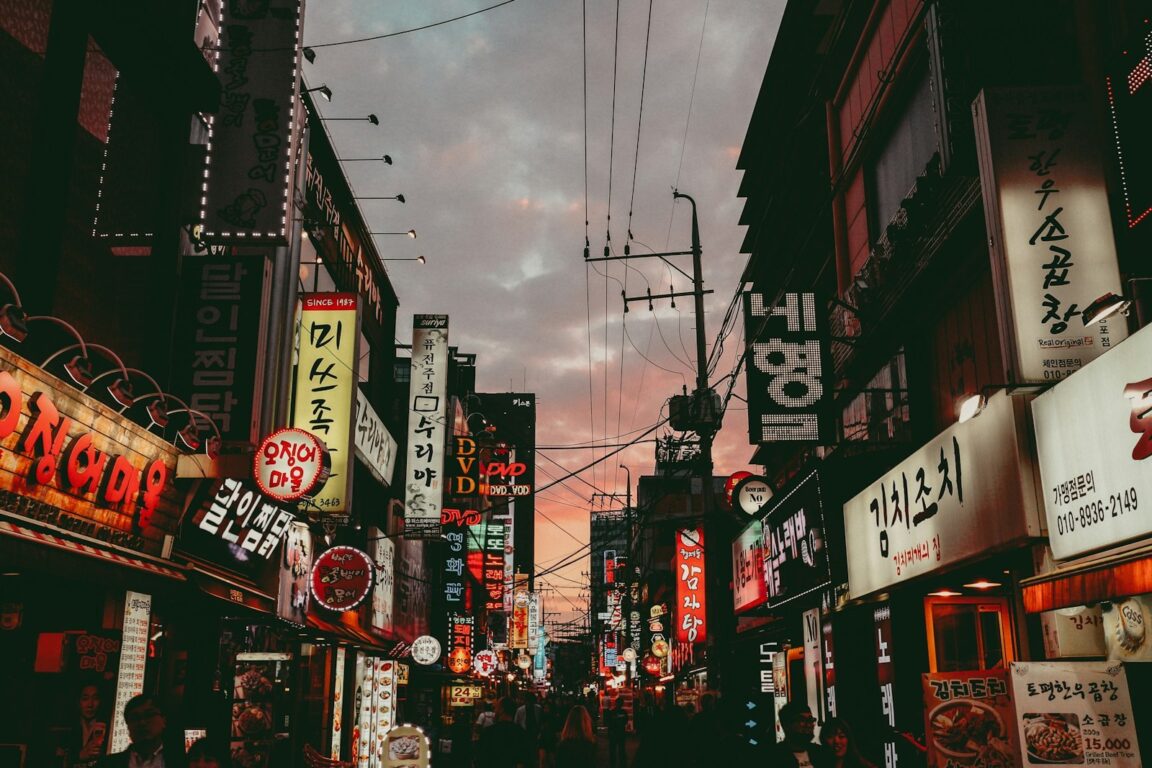
Photo: A Seoul shopping street at dusk, its Korean restaurant and shop signs lit for the evening. Photo via Unsplash (photo 1517154421773-0529f29ea451), Unsplash License, used with credit.