 Priya Nair
Sigiriya works best as a sequence, not a scramble: be at the ticket counter when it opens, walk the water gardens while the light is still low, climb past the mirror wall and the fresco gallery before the tour groups reach the stairs, and stand on the summit palace terraces while the rock is still cool. Then, for the view of Sigiriya itself, cross to neighbouring Pidurangala, the temple rock about a kilometre north, either at sunrise the next morning or in the late afternoon, when sunset light strikes the Lion Rock full in the face. Split that way, the two rocks stop competing and start explaining each other.
Quick Facts
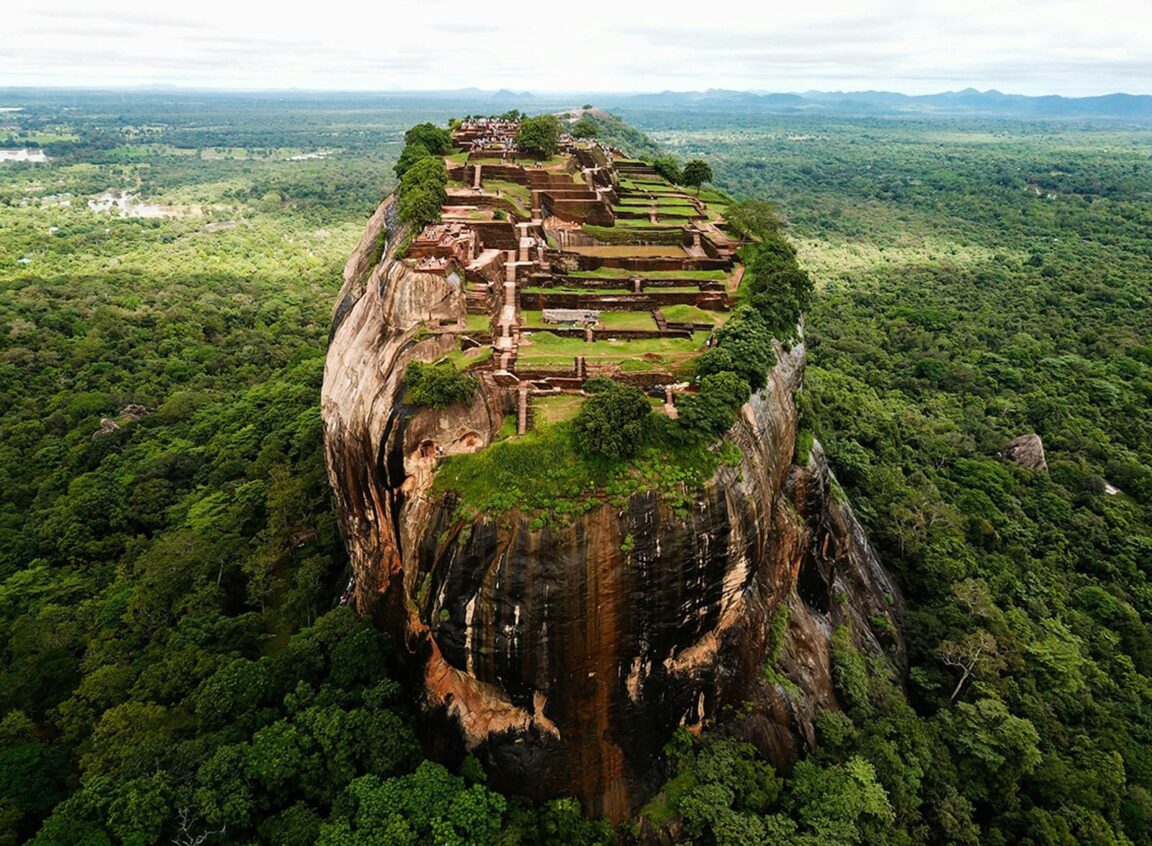
- The rock: Sigiriya is a granite column about 180 metres high in Sri Lanka’s Matale District, near Dambulla, crowned with the ruins of a fifth century royal palace.
- The builder: King Kashyapa, who reigned from 477 to 495 CE, moved his capital here and built the palace, gardens and lion gateway that visitors climb through today.
- The listing: UNESCO inscribed the Ancient City of Sigiriya as a World Heritage Site in 1982.
- The ticket: A foreign adult pays US$35 and a child aged 6 to 12 pays US$20 on the Central Cultural Fund price list, charged in rupees at the fund’s rate; SAARC passport holders and ISIC card holders also pay the half rate, and children under six enter free.
- The hours: Central Cultural Fund ticket counters open daily from 7:00 am to 5:00 pm; the Sigiriya Museum, included in the ticket, opens from 8:00 am to 5:00 pm.
- The climb: About 1,200 steps run from the gardens to the summit. Allow one and a half to two hours for the ascent with stops, and half a day for the whole site.
- The neighbour: Pidurangala Rock, about a kilometre north, is climbed from its temple for a reported LKR 1,000 in cash, with tickets sold from about 5:00 am, early enough for sunrise.
Why the order of the day matters
Sigiriya punishes late starts in two ways. The first is heat. The rock stands on an open dry zone plain with almost no shade on its staircases, and by late morning the metal steps and exposed terraces hold the sun. The second is flow. The climb funnels every visitor through the same narrow points: the spiral staircase to the fresco gallery, the mirror wall terrace and the lion staircase to the summit. Tour coaches tend to arrive from mid morning, and once a queue forms on those stairs it moves at the pace of its slowest climber. An opening time start avoids both problems at once, which is why the sequencing in this guide is built around the 7:00 am counter opening rather than around breakfast.
There is one honest limit to set out plainly. Sigiriya itself is not a sunrise climb, because the counters open after the sun is up. Sunrise belongs to Pidurangala, whose temple sells tickets from about 5:00 am. Travellers with two mornings in the area can give each rock its best hour: Pidurangala at dawn for the classic view of Sigiriya floating above the forest, and Sigiriya at opening for the climb itself. Travellers with one day can still do both, climbing Sigiriya first and Pidurangala in the late afternoon.
The water gardens: do not rush the flat part
The visit begins well before the rock. From the main western entrance, the approach crosses a moated precinct laid out on a strict east to west axis, and the first gardens are water gardens: symmetrical walled enclosures of rectangular pools, island pavilions joined by causeways and sunken limestone fountains. The system was fed by underground conduits from the artificial lake south of the rock, and the fountain plates can still run under gravity pressure in the rainy season, fifteen centuries after they were cut. That engineering is a large part of why UNESCO lists Sigiriya as one of the best preserved examples of ancient urban planning, and it deserves more than a walk through on the way to the stairs.
Reading the gardens as you cross them
Walk the central axis slowly and the design reads in stages. The water gardens come first, all straight lines and symmetry. Beyond them, where the ground begins to rise, the plan loosens into the boulder gardens, a maze of winding paths and rock cut stairs threaded between enormous natural boulders that once carried timber pavilions. Above those, brick faced terraces step up the slope to the foot of the cliff. Defence, pleasure garden and palace were designed as one composition, and the climb makes most sense when it is read as a single ascent through all three registers rather than as a staircase with a garden in front of it.
The museum, near the entrance, fits best at the end of the visit or in the heat of the day. Its displays include reproductions of the frescoes, excavation photographs and translations of mirror wall graffiti, which give the climb context that the site itself, short on signage, does not always supply.
The climb: frescoes, mirror wall and the lion’s paws
From the terraced gardens the route climbs the western face of the rock. About halfway up, a modern spiral staircase leads into a sheltered pocket in the cliff where the frescoes survive. The painted gallery once ran about 140 metres along the rock face and may originally have held several hundred figures. Today 22 paintings remain, showing richly jewelled women against the rock, protected by the overhang that sheltered them when the rest of the gallery weathered away. Photography of the frescoes is prohibited, and the ban is enforced; keep cameras and phones away in the gallery and simply look.
The mirror wall and its thousand year guest book
Below the fresco pocket runs the mirror wall, a brick wall whose plaster was once polished to a shine in which the king could see himself as he passed. Between roughly the sixth and fourteenth centuries, visitors scratched verses onto it in Sinhala, Sanskrit and Tamil, reacting to the paintings above them. Around 1,800 of these inscriptions have been recorded, which makes the wall one of the oldest visitor books in the world and a reminder that Sigiriya has been a destination, not just a ruin, for well over a thousand years. The route passes along the wall on a protected walkway, so read what you can in translation at the museum either before or after.
Through the lion gate to the summit
The final ascent begins on a small plateau where Kashyapa built a gateway in the form of an enormous lion, the structure that gives Sigiriya, Sinhagiri in Sinhala, its name. The lion’s head and body are long gone; what survives are two vast brick and plaster paws flanking the staircase, with the steps rising between them through where the lion’s mouth would have been. It remains the most theatrical threshold in Sri Lankan archaeology, and it is also the steepest, most exposed section of the climb, with iron staircases bolted to the rock above the paws.
The summit plateau covers the flat top of the rock with the foundations of the upper palace: terraced courts, audience halls and rock cut cisterns and pools that stored water at the top of a 180 metre column. The view runs unbroken over forest canopy to the reservoirs and hills of the Cultural Triangle, with Pidurangala standing close to the north. Give the summit proper time. Many visitors treat it as a photo stop and descend within minutes, which wastes the part of the site that explains why a king would build on top of a rock in the first place: water, defence and a court laid out above the plain it ruled.
One safety note from the site’s own ticket terms deserves repeating. Wasp nests hang on the rock face, and staff instructions around them should be followed exactly: keep quiet and keep moving where officers direct. The Central Cultural Fund’s terms ask visitors to comply with its officers on this point, and disturbed nests have closed the site in the past.
Pidurangala: the sunrise alternative and the sunset view
Pidurangala is a separate, smaller rock about a kilometre north of Sigiriya, reached through the grounds of the temple at its foot. It was a Buddhist monastery site long before and long after Kashyapa’s court, and the climb still begins as a temple visit: cover shoulders and knees, remove shoes where asked, and pay the fee, reported at LKR 1,000 per person in cash, at the temple desk. There is no Central Cultural Fund ticket here and no card payment to rely on, so carry small notes.
What the Pidurangala climb involves
The path climbs uneven stone steps through forest for most of its length, passing a long brick reclining Buddha sheltered in a cave about halfway up. The final section leaves the steps behind and becomes a scramble over and between large boulders, where hands are needed and a head torch is essential in the dark. Allow 30 to 45 minutes to reach the top. The summit is a broad, bare rock slab with no railings and no facilities, and its entire point is the view: Sigiriya standing square in front of you, rising out of the forest plain.
Sunrise or sunset from Pidurangala
For sunrise, start the climb 45 to 60 minutes before the sun is due, which near Sigiriya means setting off in full darkness for much of the year. The reward is the day’s defining image, mist lifting off the canopy as first light catches the eastern face of the Lion Rock. For sunset, the logic reverses: climb in daylight in the late afternoon and watch the low sun strike Sigiriya directly, turning the rock face gold, then descend carefully with a torch as the light goes. Sunset is usually the quieter of the two, and it pairs naturally with a Sigiriya climb the same morning. Either way, Pidurangala is the view of the fortress, while Sigiriya is the fortress itself; the two climbs answer different questions, and doing both is not duplication.
Putting the Cultural Triangle day together
A workable one day sequence runs like this. Arrive at the Sigiriya counters before 7:00 am with tickets bought online through the Central Cultural Fund e-ticket service if queues are a concern, noting that the online receipt is still exchanged for a paper ticket at the counter and that an order is valid for a single entry on the day. Walk the water gardens in the cool of the morning, climb through the fresco gallery and mirror wall terrace before the stairs fill, and spend the late morning on the summit and in the museum. Rest through the midday heat, then climb Pidurangala in the late afternoon for the sunset view back. Travellers based in Sigiriya village, Dambulla or Habarana can all reach the entrance by tuk tuk or car in the early morning, and basing in the area for at least one night is what makes the early start possible at all.
Sigiriya also anchors a wider South and Southeast Asia heritage route. Travellers pairing it with the coast can continue south to the surf town covered in our guide to surf and yoga in Weligama, Sri Lanka, while those comparing great Asian monument climbs will find the same early start logic at work in our guide to visiting Angkor Wat at sunrise.
Practical notes for the climb
Carry water from the start; there is none to buy on the rock. Wear shoes with grip for stone steps and, on Pidurangala, for the boulder scramble. A hat matters more than almost anything else once the sun reaches the summit terraces. Monkeys around the staircases are bold with food, so keep snacks inside a closed bag. Travellers with a fear of heights should know that the lion staircase section is steep, exposed and fitted with handrails, and that turning points are limited once a queue forms behind. The ticket is a single entry, so plan the museum and gardens into the same visit rather than expecting to re-enter after lunch.
Frequently Asked Questions
How much does Sigiriya cost for foreign visitors?
A foreign adult ticket costs US$35 and a child aged 6 to 12 costs US$20 on the Central Cultural Fund price list, charged in rupees at the fund’s exchange rate on the day. SAARC passport holders and ISIC card holders pay the half rate of US$20, children under six enter free, and the ticket includes the Sigiriya Museum. Pidurangala is separate and costs a reported LKR 1,000 in cash at its temple.
What time should visitors start the Sigiriya climb?
Start at the 7:00 am counter opening. That puts the climb ahead of both the midday heat on the exposed staircases and the tour group queues that build from mid morning at the fresco staircase and lion gate. A late afternoon start, finishing well before the 5:00 pm counter close, is the second best option.
Can visitors watch sunrise from the top of Sigiriya?
No, not reliably. Sigiriya’s ticket counters open at 7:00 am, after sunrise. Sunrise is Pidurangala’s moment: its temple sells tickets from about 5:00 am, and the 30 to 45 minute climb, finished with a torch for the boulder scramble, puts visitors on top in time for first light over Sigiriya.
How long does Sigiriya take, and how hard is the climb?
Allow half a day for the full site: the water and boulder gardens, the fresco gallery, the mirror wall, the lion staircase and the summit palace. The climb is about 1,200 steps with an elevation gain of roughly 180 metres. It is steep and exposed in its final section but uses built staircases throughout, unlike Pidurangala, which ends in a hands on boulder scramble.
Are the Sigiriya frescoes open, and can they be photographed?
The surviving frescoes, 22 paintings in a sheltered pocket halfway up the western face, are on the standard climbing route and are included in the ticket. Photography of the frescoes is prohibited and enforced, so view them in person and see reproductions at the Sigiriya Museum, which is included in the same ticket and opens from 8:00 am to 5:00 pm.
Is Pidurangala a substitute for Sigiriya, or an addition?
An addition. Pidurangala has the monastery history, the reclining Buddha and, above all, the view of Sigiriya itself, but it has no palace ruins, frescoes or water gardens. Sigiriya is the archaeological site and the more expensive, more structured visit. Together they make one complete day in the Cultural Triangle.
Featured image: Aerial view of Sigiriya Rock and its summit palace terraces above the forest, Sri Lanka. Photo by Dylan Shaw via Unsplash, Unsplash License, used with credit.