 Priya Nair
Banff has two thermal sites and they do opposite jobs: at Banff Upper Hot Springs you get in the water, soaking in an outdoor pool at 37 to 40 degrees Celsius on the flank of Sulphur Mountain, while at the Cave and Basin National Historic Site, a short distance below, you do not swim at all, because that cave and basin are the protected 1883 discovery site where the argument over hot spring ownership led directly to Canada first national park. Do the soak in the morning, then walk the history in the afternoon, and the two visits explain each other.
Quick Facts
- Upper Hot Springs: Parks Canada outdoor pool, 1 Mountain Avenue, about 4 kilometres south of downtown Banff
- Elevation: 1,585 metres, the highest hot springs in Canada
- Water: Kept between 37 and 40 degrees Celsius. Top minerals are sulphate, calcium, bicarbonate, magnesium and sodium
- Hours and entry: Open daily 10am to 10pm, last entry 9:30pm. First come, first served, tickets only at reception, no reservations
- Cave and Basin: National Historic Site on Cave Avenue. No bathing. Winter hours, mid October to mid May, Thursday to Monday 11am to 5pm
- Park pass: A valid Parks Canada pass is required in addition to pool admission, because both sites sit inside Banff National Park
Why is the morning the right time to soak?
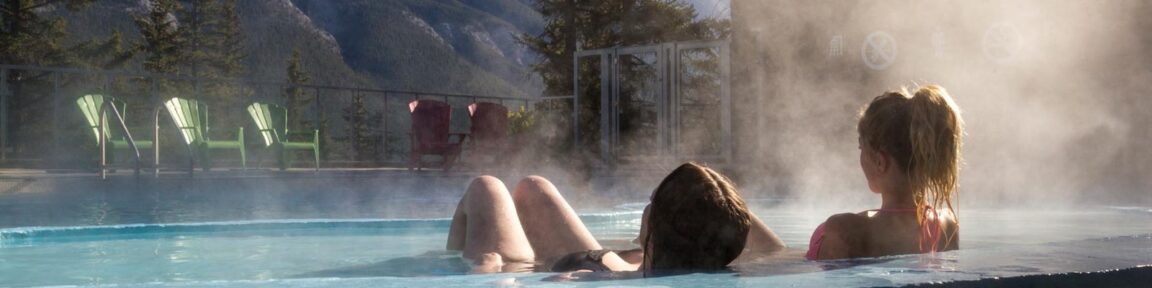
The Upper Hot Springs pool is a single, large outdoor pool fed by natural mineral water flowing through the Sulphur Mountain thrust fault, and it fills on a first come basis with no booking system to protect you. Morning arrivals get the calm version: steam rising off the water in cold air, the view across the Bow Valley to the long wall of Mount Rundle unobstructed, and space to move between the hotter and cooler edges of the pool. By mid afternoon on a ski day or a summer weekend, the same pool is a social event, and entry can mean waiting for capacity to turn over.
The setting is the substance here. Parks Canada describes relaxing in Canada highest outdoor pool among the jagged peaks of Rundle and Cascade mountains as an experience that has drawn visitors since 1886, and the current bathhouse, a federal heritage building that opened in 1932, keeps the ritual deliberately simple: change rooms, lockers, rentals if you forgot a swimsuit or towel, and the pool. Admission is priced as a public bath, not a spa, with single entry fees published by Parks Canada and a locker token included. Check the Parks Canada fees page on the day, because prices are reviewed and the pool closes each autumn for a maintenance period, reopening in early November in 2026 after the October closure.
Getting there is part of the morning logic. Roam Transit Route 1, the Sulphur Mountain route, runs from downtown Banff to the springs, and Parks Canada itself recommends transit because parking at the site is limited and fills quickly. Take the bus up, soak, and ride down without the car park negotiation.
For the wider town plan around the soak, our two days in Banff guide sequences the townsite and the Lake Louise shuttle, and our Banff in winter piece covers the cold weather version of this same ritual.
What happened at the Cave and Basin in 1883?
The Cave and Basin, at the foot of Sulphur Mountain on the other side of the townsite, is where the national park story starts. Hot springs on this mountain were known and used by Indigenous peoples for more than ten thousand years. In 1883, three Canadian Pacific Railway workers, the McCardell brothers and Frank McCabe, came on the thermal springs here, a warm pool inside a cave reached through an opening in its roof, with an open basin beside it. Their competing claims to the discovery, and the scramble by others to own and commercialise the springs, pushed the federal government to intervene.
The intervention became the seed of the system. In 1885 the government reserved a small area around the springs, and in 1887 that reserve grew into Banff National Park, Canada first national park and the foundation of the Parks Canada network. That is why this modest site, a cave, a basin and a set of boardwalks, carries national historic weight out of all proportion to its size. The visit today runs through a short tunnel into the domed cave, where warm water still bubbles up under the roof opening the railway workers climbed down, then out to the basin and the boardwalk trails through the marsh, habitat of the endangered Banff Springs snail, which lives only in these thermal waters. Bathing is prohibited, and the protection is the point.
How should you sequence the two sites in one day?
Soak first, history second, for practical as much as poetic reasons. The pool rewards the early arrival and the Cave and Basin rewards unhurried reading, and its shorter winter day, 11am to 5pm from Thursday to Monday in the cold season, fits an afternoon perfectly. Between the two, return through town for lunch. The sites sit on opposite sides of the townsite, the springs up Mountain Avenue to the south and the Cave and Basin at the end of Cave Avenue across the Bow River, an easy walk or short bike ride of about twenty minutes from downtown.
Admission economics are gentle. Cave and Basin entry is a modest historic site fee, with youth 17 and under free and the Parks Canada Discovery Pass covering entry, and guided cave tours run during the day and are included. The Upper Hot Springs charge is separate, paid at the door, and a national park pass is required for the day regardless, so buy the pass first and keep it visible in the car or on your person between sites. Travellers planning a wider Canadian park trip should also read our guide to the Canada Strong Pass and what it changes about park entry costs.
What should you know before you get in the water?
The pool is run like a public swimming facility, with lifeguards, a swimsuit requirement and rules that ban alcohol, glass and underwater filming, with photography limited to your own group and the scenery. The water temperature is maintained in the 37 to 40 degree band, hot enough that Parks Canada guidance and common sense agree on short immersions with breaks, especially at this altitude, where 1,585 metres makes heat and exertion feel stronger than visitors expect. Hydrate, sit out on the pool edge between soaks, and treat a winter soak, snow falling into steam while the peaks turn pink, as the premium version worth timing a trip around.
One expectation to set correctly: the Upper Hot Springs is a developed heritage pool, not a wild backcountry spring, and the Cave and Basin is a museum landscape, not a swimming hole. Travellers who arrive wanting exactly what each site actually is, a communal mountain soak with a century of tradition, and the small, strange cave where a country decided its wild places belonged to everyone, tend to rate this pairing as the most satisfying half day in Banff.
Frequently Asked Questions
Can you swim at the Cave and Basin?
No. The Cave and Basin is a protected National Historic Site and the thermal waters are habitat for the endangered Banff Springs snail. Bathing is prohibited. Swimming and soaking happen at the separate Upper Hot Springs pool.
Do I need to book Banff Upper Hot Springs in advance?
No. Entry is first come, first served and admission is sold only in person at reception. Arrive in the morning for the calmest soak and to avoid capacity waits on busy days.
How hot is the water at Banff Upper Hot Springs?
Parks Canada keeps the pool between 37 and 40 degrees Celsius, about 98 to 104 degrees Fahrenheit. The water is natural mineral water, highest in sulphate and calcium.
Why is the Cave and Basin historically important?
It is the site of the 1883 hot springs discovery by railway workers whose ownership dispute led the government to reserve the area in 1885, the first step toward Banff National Park in 1887 and the entire Canadian national park system.
What are the Cave and Basin winter hours?
From mid October to mid May the site opens Thursday to Monday, 11am to 5pm, closing on December 25 and for posted maintenance days. Summer hours are longer and daily. Confirm on the Parks Canada page before you go.
Image credit: Bathers in the steaming outdoor pool at Banff Upper Hot Springs, with the Sulphur Mountain view beyond. Photo by Parks Canada, via the official Parks Canada Banff Upper Hot Springs page (parks.canada.ca), subject own official website image, used with credit.