 Thandiwe Nkosi
Cape Town is the easiest city in Africa in which to be openly gay, and that is not a marketing line. South Africa wrote sexual orientation into the equality clause of its post-apartheid constitution, legalised same-sex marriage in 2006 as the first country in Africa and only the fifth in the world, and built a visible queer neighbourhood, De Waterkant, on the edge of the city centre next to Green Point. For LGBTQ+ travellers the practical result is a compact, walkable base where rainbow flags fly year round, where Pride fills the streets in late February or early March, and where the honest caveats are about ordinary big-city street awareness rather than about the law. This guide covers the legal ground, the neighbourhood, the nightlife and the safety judgment in that order.
Quick Facts
- Legal status: Same-sex marriage has been legal in South Africa since 2006, and the constitution expressly bans discrimination based on sexual orientation. The country record is tracked in the ILGA World database.
- The neighbourhood: De Waterkant, beside Green Point, is Cape Town’s established gay village, a grid of cottages, cafes, guesthouses and bars a short walk from the city centre.
- Pride timing: Cape Town Pride runs in late February or early March, at the end of the southern hemisphere summer.
- Best base: De Waterkant or Green Point for nightlife on foot, Sea Point for a quieter seafront version of the same convenience.
- Safety framing: Legal protection is strong and public acceptance in the central city is real, but petty crime awareness matters, as it does for every visitor to Cape Town.
- Official visitor information: Cape Town Tourism publishes current visitor guidance at capetown.travel.
Why the Welcome Is Structural, Not Decorative
Many destinations market themselves to LGBTQ+ travellers with a festival and a flag. Cape Town’s claim rests on law first. The 1996 constitution was the first in the world to prohibit discrimination on the grounds of sexual orientation in its equality clause, and the Civil Union Act of 2006 made South Africa the first African country with marriage equality. Adoption, employment protection and the right to serve openly in the military followed the same legal logic. Travellers can verify the current position, including the absence of any law criminalising same-sex relations, in the ILGA World database, which records South Africa among the small group of countries with both marriage equality and constitutional protection.
What that means on the ground is unremarkable, which is the point. Couples check into guesthouses in De Waterkant without comment, hold hands on the Sea Point promenade without incident, and find queer venues listed in mainstream city guides rather than whispered about. South African society is not uniformly liberal, and rural areas and some faith communities are more conservative, but the traveller-facing city, its laws, its police and its tourism industry operate on the constitutional settlement. A visitor’s rights do not depend on the goodwill of a hotel manager.
De Waterkant: The Gay Village, Street by Street
De Waterkant sits on the slope between the city centre and Green Point, a few streets of nineteenth century cottages painted in pastels, small squares, coffee roasters and design shops. It is where the rainbow crossings are, where many of the gay bars and clubs cluster, and where a large share of the boutique guesthouses actively welcome LGBTQ+ guests. The village is small enough to learn in an afternoon and dense enough to hold an evening: dinner on one street, drinks on the next, home on foot.
The neighbouring districts extend the base rather than compete with it. Green Point, directly below, adds the stadium, the park and a strip of restaurants along Main Road. Sea Point, ten minutes further along the coast, is the city’s most mixed and easygoing suburb, with a long seafront promenade that draws everyone at sunset. The V and A Waterfront is a short ride away for shopping and harbour restaurants. Staying in De Waterkant and ranging into these districts on foot or by short ride share trips is the pattern that works, and it pairs well with the sightseeing structure in our 2 days in Cape Town itinerary, which sequences the city centre, the mountain and the peninsula.
The Pink Route and How to Use It
Cape Town’s LGBTQ+ scene has long been described locally as a pink route: a loose circuit of venues running from De Waterkant through the city centre, taking in bars, clubs, saunas, drag shows and queer friendly restaurants. Treat the phrase as a planning device rather than a fixed trail. Venues open, close and move, so check current listings on arrival, start the evening in De Waterkant where the density is highest, and let the night contract back toward your base rather than expand across the city. Weekends carry the scene; midweek nights are quieter and more local, which many travellers prefer.
Drag and cabaret are a strength of the city, and theatre venues in the centre programme queer work through the year. The beach question also has a local answer: Clifton’s coves and Camps Bay draw a fashionable mixed crowd, and Sandy Bay, reached by a walk from Llandudno, is the city’s long established nude beach with a gay following. None of this requires insider knowledge to access, which is precisely what distinguishes Cape Town from destinations where the scene hides.
Cape Town Pride and the Calendar
Cape Town Pride, held in late February or early March, anchors the queer calendar at the height of summer. The festival combines a parade through the Green Point area with parties, community events and a festival village, and the city fills accordingly, so book De Waterkant accommodation early for those dates. The timing is a genuine advantage: Pride in warm weather, with beach days and mountain hikes either side of it. Travellers building a longer trip around Pride can use our guide to Table Mountain hiking routes for the clear mornings, since the mountain stands directly behind the neighbourhood and the cableway and trailheads are minutes away.
Through the rest of the year the calendar is steadier: a film festival circuit with queer programming, monthly parties, and the ordinary weekly rhythm of the village. December and January bring peak prices and crowds across the whole city, while March to May offers warm seas, lower rates and a still lively scene, and is the window many repeat visitors choose.
The Honest Safety Conversation
Two things are true at once. Cape Town is one of the most legally protective and socially open cities in the world for LGBTQ+ people, and it is a city where street crime, including muggings and phone snatching, is a real consideration for every traveller. Government travel advice, such as the United Kingdom’s guidance at gov.uk, focuses on crime patterns, protest disruption and road safety rather than on any legal risk to LGBTQ+ visitors, and that is the right emphasis.
The working rules are the standard Cape Town ones, applied without drama. Use ride share apps or reputable taxis at night instead of walking quiet streets, keep phones out of sight at the kerb, be thoughtful about dating apps as you would be anywhere, meeting first in a public venue in the village, and keep accommodation addresses private until trust is established. Within De Waterkant, Green Point and Sea Point, the evening streets are busy and the atmosphere is relaxed. Travellers who want to explore townships should go on organised tours, as official advice recommends, rather than independently. None of this diminishes the welcome; it simply prices it honestly.
Where to Stay and Getting Around
De Waterkant’s guesthouses and small hotels are the default choice: owner run, breakfast included, staff who can brief you on the current scene. Self-catering apartments in Green Point and Sea Point suit longer stays and groups. Wherever you book, confirm the exact street and walk it virtually first; the difference between a lively street and a quiet one matters more after dark than any star rating.
Getting around is simple. The centre, De Waterkant, Green Point and the Waterfront form a walkable cluster in daylight. The MyCiTi bus network covers the city centre and Atlantic seaboard routes, and ride share services are plentiful and inexpensive by international standards, which removes most late night transport anxiety. A hire car earns its keep only for the peninsula and winelands days, and can be rented for those days alone.
Frequently Asked Questions
Is it legal to be gay in South Africa?
Yes, fully. Same-sex relations are legal, discrimination based on sexual orientation is constitutionally prohibited, and same-sex marriage has been legal since 2006. The position is recorded in the ILGA World database.
When is Cape Town Pride?
Late February or early March each year, at the end of summer. Dates are announced by the organisers ahead of the season, and accommodation in De Waterkant sells out for the main weekend.
Can same-sex couples share a hotel room without problems?
Yes. Central Cape Town hotels and guesthouses host same-sex couples routinely, and De Waterkant properties market to LGBTQ+ guests openly. No traveller needs to book separate beds or use any workaround.
Is De Waterkant safe at night?
It is one of the city’s busier evening districts, and its main streets stay lively late. Apply normal Cape Town awareness: use ride shares for longer late night trips, keep valuables discreet, and stick to lit, populated streets.
Are there gay beaches in Cape Town?
Clifton and Camps Bay draw a mixed, fashionable crowd, and Sandy Bay near Llandudno is the long established nude beach with a gay following. All are mainstream public beaches reached by car or ride share.
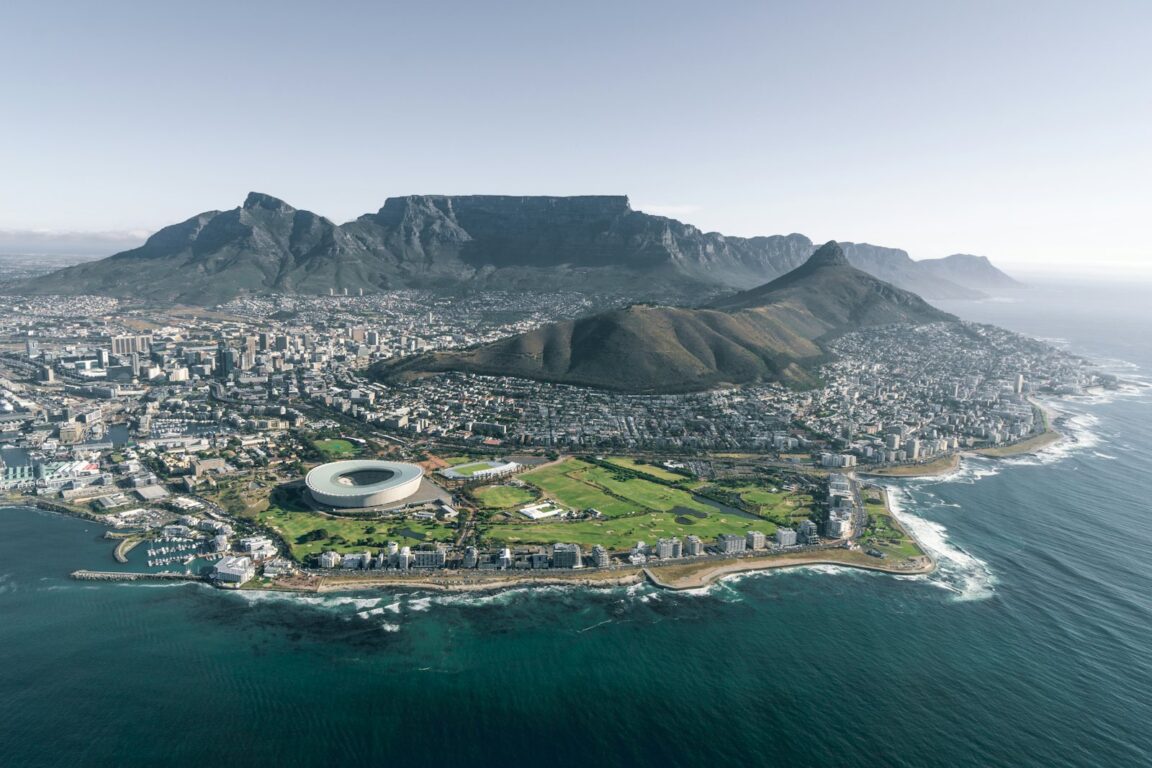
Featured image: Aerial view over Green Point, Cape Town Stadium and Green Point Park, with De Waterkant and the City Bowl below Table Mountain and Lion’s Head. Photo by Unsplash contributor (photo 1580060839134-75a5edca2e99), via Unsplash.