 James Wolfe
With two hours at Nationalmuseum, do not try to see everything. Follow the museum’s own chronological Timeline in order, spend the first half on the 16th and 17th centuries for Rembrandt and the Dutch paintings, give the Swedish 18th and 19th centuries and the design galleries the second half, and finish on the free ground floor in the restaurant or the Sculpture Courtyard. That order turns a short visit into a complete one, because the museum displays painting, sculpture, applied arts and design side by side by era, so one pass through the Timeline covers the Rembrandts, the Swedish masters and Swedish design together.
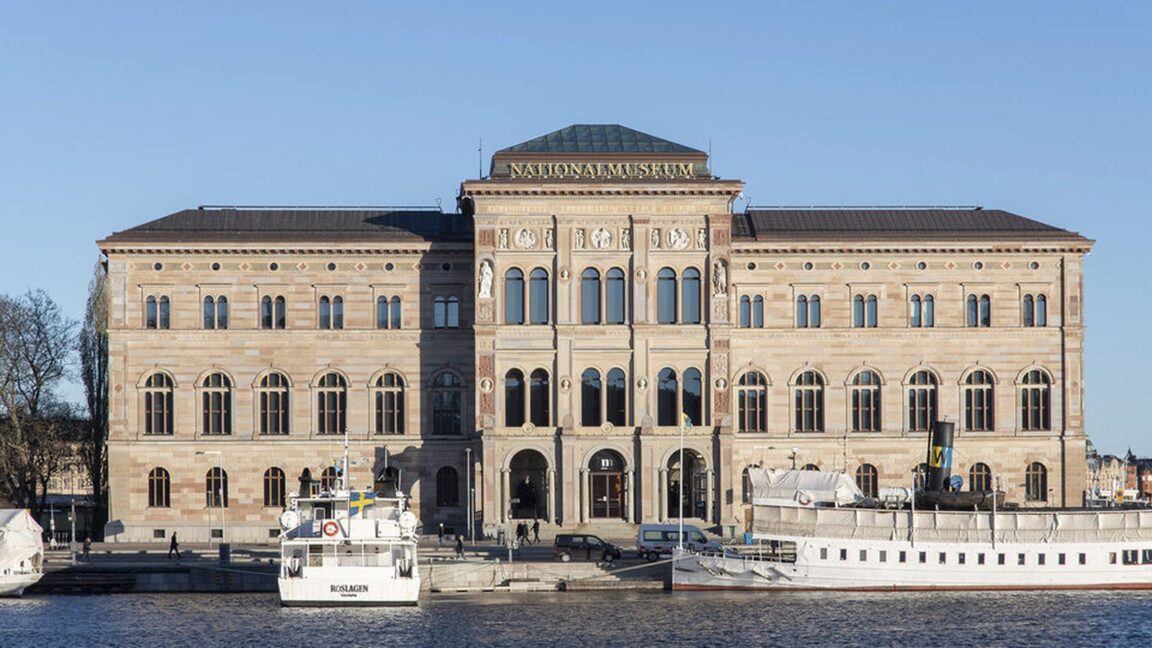
Nationalmuseum is Sweden’s museum of art and design, at Södra Blasieholmshamnen 2 on Blasieholmen in central Stockholm, across the water from the Royal Palace. Its collections, as the museum describes them on its official collections page, hold paintings and sculptures from the Renaissance to 1900 and applied arts and design from the late Middle Ages to the present day. The scale is the problem for a short visit, and the Timeline is the solution the museum itself provides.
Quick Facts
Address: Södra Blasieholmshamnen 2, Stockholm, on Blasieholmen, across the water from the Royal Palace.
Hours: Monday closed. Tuesday, Wednesday, Friday, Saturday and Sunday, 11:00 to 17:00. Thursday, 11:00 to 20:00.
Admission: Adults SEK 160. Last 60 minutes before closure SEK 80. Visitors under 20 free. Free for all visitors on Thursdays, 17:00 to 20:00.
Price change ahead: From 1 January 2027, adults SEK 170 and last 60 minutes SEK 100. Under 20s and Thursday evenings, 17:00 to 20:00, remain free.
Ticket scope: One ticket covers all temporary exhibitions and collection displays and is valid for the entire day. Payment is by card or Swish only.
Free ground floor: Entry to the ground floor is free for all, including the restaurant, the shop, the studios, the Sculpture Courtyard and the South Courtyard.
Getting there: Metro, Blue line to Kungsträdgården. Bus 65 to Nationalmuseum or Kungsträdgården, and buses 2, 55 and 76 to Karl XII:s torg.
Current temporary exhibitions: To the Sea!, 24 September 2026 to 7 February 2027, and Wilhelm Kåge and Shōji Hamada, 23 April 2026 to 10 January 2027.
Gallery note: Gallery 22, on the top floor, featuring art from 1770 to 1800, is temporarily closed due to repair work, per the museum’s Timeline page.
Why does the Timeline make a two hour visit work?
Because the museum has already done the editing. On the museum’s Timeline page, Nationalmuseum explains that more than 5,000 paintings, drawings, sculptures, applied arts and design objects are presented chronologically, following an imaginary timeline through the building, with art, applied arts and design displayed side by side to give a deeper understanding of each era. Each era has its own exhibition hall, and the smaller adjacent rooms explore themes from that period in more depth.
For a two hour visit, that structure is a gift. There is no need to choose between a paintings route and a design route, or to backtrack between separate departments. Walk the centuries in order, linger in the halls that matter most to this trip, and move briskly through the side rooms. The visit feels complete because it has a beginning, a middle and an end, not because every room was entered. Travellers who liked that kind of ordered first pass will recognise the same logic in our guide to the Rijksmuseum for first timers, where one chronological spine also does the heavy lifting.
First 40 minutes: the 16th and 17th centuries and the Rembrandts
Start at the start of the Timeline, in the 16th century, and give the opening section a focused 40 minutes. The museum names the artists a visitor will meet on this route, including Rembrandt, Judith Leyster and Artemisia Gentileschi, and its Timeline page illustrates the period with a named anchor work: Rembrandt Harmensz. van Rijn, The Kitchen Maid, dated 1651, oil on canvas. Treat that painting as the first fixed point of the visit. Find it, spend real time in front of it, and let the surrounding Dutch 17th century painting set the context around it.
That emphasis is well placed. The museum states that Dutch painting from the 17th century is well represented in its paintings and sculptures collection, which comprises some 16,000 works in total, and that Rembrandt is also a key name in its vast holdings of prints and drawings, which number 500,000 works from the late Middle Ages to 1900. A short visit cannot take in that depth, and it should not try. The point of this first block is quality over coverage: the Rembrandt anchor, Leyster’s Boy Playing the Flute and Gentileschi’s female saint, both illustrated by the museum on the Timeline page, and a slow look at the design objects displayed alongside the paintings of the same era.
Keep moving. The temptation in these early halls is to read everything, because everything is new. Save the reading for the Swedish sections ahead, where this museum is strongest and where a visitor to Stockholm gains something that cannot be seen as well anywhere else.
Next 35 minutes: Swedish masters and the French 18th century
The middle of the Timeline is where Nationalmuseum becomes distinctly Swedish. The collections carry an emphasis on Swedish 18th and 19th century painting, the museum says, and its French 18th century collection is considered one of the finest in the world. The named highlights on the museum’s own Timeline page make a tight, satisfying list for this block: Alexander Roslin, The Lady with the Veil, a portrait of the artist’s wife, Marie Suzanne Giroust Roslin; then, for the 19th century, Carl Larsson, Pontus, from 1890, and Anders Zorn, Castles in the Air, from 1885, a watercolour. Add Paul Gauguin, Landscape from Brittany, from 1889, which the museum also illustrates, and this section alone justifies the ticket.
Use the side rooms sparingly here. One deep dive is enough in 35 minutes. Pick the theme that connects to the main hall, spend ten minutes on it, and return to the spine. Note also the practical warning in the Quick Facts above: Gallery 22, covering 1770 to 1800 on the top floor, is temporarily closed for repair work, so a gap in that slice of the century is expected and is not a sign of having taken a wrong turn.
Stockholm rewards this kind of pacing beyond the museum as well. The Blasieholmen and Nybroviken waterfront outside is compact and walkable, which is why pairing the museum with a nearby base makes sense, as our guide to Bank Hotel Stockholm on Nybroviken sets out for travellers staying in this part of the city.
Next 30 minutes: Swedish design, from ceramics to the Celestial Globe
Design is not an add on at Nationalmuseum. It is half the institution’s title, and the collection behind it is large: about 30,000 objects of applied arts, design and industrial design, spanning the 14th century to today, of which a third are ceramics, with textiles, glass, precious and non precious metals, furniture and books making up the rest. The museum gives pieces from Sweden and the other Nordic countries priority, which is exactly what a short visit should follow.
Because design objects sit beside the paintings of their era on the Timeline, much of this block is already woven into the route. The final 30 minutes before the cafe should therefore slow down in the later sections, from the late 19th century into the 20th century and the present day, where Swedish design comes into its own. The museum’s chosen illustration for that moment is a strong one: Edward Hald’s Celestial Globe for Orrefors, manufactured in 1929 to 1930, engraved glass mounted in pewter, alongside other glass from the first half of the 1900s. Look for glass, ceramics and furniture from this period as a group, rather than hunting single objects, and the story of Swedish design, from craft tradition to industrial production, reads clearly in half an hour.
One current exhibition strengthens this block if its dates overlap the visit. Wilhelm Kåge and Shōji Hamada, listed by the museum from 23 April 2026 to 10 January 2027, brings a leading Swedish ceramic artist into the same visit as the permanent design galleries. With only two hours, treat it as a substitute for part of this design block, not as an extra stop on top of it. Readers planning a wider Scandinavian design and island trip can extend the theme with our coverage of Gotland beyond Visby and Bornholm, Denmark’s Baltic island, both reachable as onward journeys from Stockholm.
Final 15 minutes: the restaurant, the cafe stop and the Sculpture Courtyard
End where the visit can decompress. The museum’s restaurant sits on the ground floor, and, as the museum’s restaurant page explains, it serves Swedish dishes rooted in tradition yet contemporary, made with local Nordic ingredients, with lunch, afterwork drinks and freshly baked pastries and coffee for fika. There are no reservations. Visitors order at the counter and the food is then served at the table, and food can also be ordered to go. The restaurant opens at 11:00, per the museum’s opening hours page.
Two facts make this ending especially practical on a short visit. First, entrance to the ground floor is free for everyone, so the restaurant, the shop, the studios and the courtyards can be used even by a companion who skipped the galleries, or as a return stop later the same day. Second, the restaurant interior is itself part of the design story: the museum notes that some of Sweden’s leading designers and artisans designed everything from the tableware to the furniture and fittings. A coffee here is therefore not time away from the design galleries. It is a final exhibit, used rather than viewed.
If the weather and timing allow, pair the cafe stop with the Sculpture Courtyard, which the museum presents as a place to enjoy sculptures in a relaxing environment. Fifteen minutes across the restaurant and the courtyard is enough to close the visit properly, review what stood out, and leave through the ground floor without rushing back through the galleries.
What if there is time for one exhibition?
Choose To the Sea! and only if it replaces, rather than extends, one block above. The museum describes To the Sea!, running 24 September 2026 to 7 February 2027, as an exploration of the emergence of coastal and beach tourism from the 1870s to the mid 20th century, told through more than 200 paintings, photographs, advertising posters and examples of historic swimwear, with works by Claude Monet, Anders Zorn, Peder Severin Krøyer, Sigrid Hjertén, Georgia O’Keeffe and Robert Capa, among others. It connects naturally to the Swedish painting already on the Timeline, which is why it fits a short visit better than a disconnected extra.
The cheapest and calmest version of this whole plan is a Thursday evening. The museum stays open until 20:00 on Thursdays, and admission is free for all from 17:00 to 20:00, a saving also noted by Visit Stockholm, the city’s official visitor guide, in its list of museums with free entry. Three free evening hours are more than the two hours this route needs, and the same free Thursday window is the best answer for travellers on a tight budget. On other days, the last 60 minutes ticket at SEK 80 suits a one hour highlights dash, but it is too short for the full route above. Pay the full SEK 160, arrive at the 11:00 opening, and keep the two hours unhurried.
Getting here is straightforward, as the museum sets out on its official getting here page: the Blue line metro to Kungsträdgården, bus 65 stopping at the museum, or the Djurgårdsfärjan ferry to Skeppsholmen followed by a 10 minute walk. Confirm hours before travelling on the museum’s opening hours page, since holiday hours differ and the museum is closed on Mondays. For a comparison of how another major museum rewards a highlights first approach, see our guide to the Art Institute of Chicago on a first visit.
Frequently Asked Questions
How much does Nationalmuseum cost, and when is it free?
Adults pay SEK 160, and the last 60 minutes before closure cost SEK 80. Visitors under 20 enter free, and admission is free for all on Thursdays from 17:00 to 20:00. From 1 January 2027 the adult price rises to SEK 170 and the last 60 minutes price to SEK 100, per the museum’s admission page. The ground floor, including the restaurant and shop, is free for everyone at all opening times.
When is Nationalmuseum closed?
On Mondays. On other days it opens from 11:00 to 17:00, except Thursdays, when it stays open until 20:00. Holiday hours can differ, including closures around Christmas and New Year, so check the museum’s opening hours page for the exact date of a visit.
What should a visitor with two hours see first at Nationalmuseum?
The Timeline in chronological order. Start with the 16th and 17th centuries for Rembrandt, including The Kitchen Maid from 1651, then the Swedish 18th and 19th century highlights by Roslin, Larsson and Zorn, then the Swedish design sections, and finish in the ground floor restaurant or Sculpture Courtyard.
Does one ticket cover the temporary exhibitions as well?
Yes. The museum states that an entrance ticket covers all temporary exhibitions and collection displays and is valid for the entire day. That currently includes To the Sea!, to 7 February 2027, and Wilhelm Kåge and Shōji Hamada, to 10 January 2027.
Can the restaurant be visited without a museum ticket?
Yes. The restaurant is on the ground floor, and entry to that floor is free for all, including the restaurant, shop, studios, Sculpture Courtyard and South Courtyard. The restaurant takes no reservations, orders are placed at the counter, and it opens at 11:00.
How do visitors get to Nationalmuseum?
By metro, Blue line to Kungsträdgården, by bus 65 to Nationalmuseum or Kungsträdgården, or by buses 2, 55 and 76 to Karl XII:s torg. The museum is on Blasieholmen, across the water from the Royal Palace, and can also be reached by the Djurgårdsfärjan ferry to Skeppsholmen, then a 10 minute walk.
Image: Nationalmuseum, Stockholm, seen from the water on Blasieholmen, with the museum name across its central facade and boats moored in front. Photo: Nationalmuseum, via nationalmuseum.se, the museum’s official website, used with credit.
Facts checked November 25, 2026, against Nationalmuseum’s official site, nationalmuseum.se: opening hours, admission prices in SEK including the 1 January 2027 change, the Timeline and its named works, the collections, current exhibitions, the restaurant and directions. Prices, exhibition dates and gallery closures can change; confirm on nationalmuseum.se on the day of a visit.