 Jordan Ellis
Taos rewards the traveller who leaves the plaza. Ten miles northwest of town, the Rio Grande Gorge Bridge crosses the Rio Grande roughly 600 feet above the river where the sagebrush plain simply splits open; a couple of miles farther, the Greater World Earthship community rises from the mesa in bottle walls and south facing glass; and looping behind it all, the 84 mile Enchanted Circle circles Wheeler Peak, at 13,161 feet the highest point in New Mexico, through Questa, Red River, Eagle Nest and Angel Fire. Sequence them properly and one Taos base gives you three completely different landscapes without changing hotels: the gorge and Earthships west in a single morning, the Enchanted Circle’s back half as a full day’s drive.
Quick Facts
- The bridge: The Rio Grande Gorge Bridge, on US 64 about 10 miles northwest of Taos, is a steel deck arch bridge completed in 1965, standing roughly 600 feet above the Rio Grande.
- The Earthships: The Earthship Visitor Center at 2 Earthship Way, Tres Piedras, offers self guided tours daily from 10am to 4pm at $9 per person, per the official Earthship Biotecture site, with a guided tour daily at 4pm, $22 per adult and $13 per child aged 6 to 12.
- The loop: The Enchanted Circle is an 84 mile circuit around Wheeler Peak (13,161 feet), running Taos to Questa on NM 522, east on NM 38 over Bobcat Pass (9,820 feet) to Red River, then south past Eagle Nest Lake to Angel Fire and back to Taos on US 64.
- Driving time: The Circle takes about two and a half hours with no stops; with stops it is a full day. The gorge and Earthship run is a half day from town.
- Respect the community: Earthship Biotecture directs visitors to use the Visitor Center entrance and not to drive through the private Greater World residential community; the homes beyond the centre are private residences.
- Base logic: Stay in Taos itself. Everything in this guide is a there and back day from the plaza, so no second base is needed.
Why start at the gorge bridge early?
The Rio Grande Gorge is the cut the Rio Grande has carved through the Taos Plateau, inside the Rio Grande del Norte National Monument, and the bridge is its best known roadside landmark. Early light does two things here: it puts low sun into the gorge so the basalt walls and the river thread below read in relief rather than flat midday glare, and it beats the day’s wind, which builds across the exposed mesa by afternoon. The bridge spans the gorge with truss spans either side of its central arch, and the adjacent Rio Grande Gorge Rest Area gives you the rim views, parking and facilities in one stop. Check current pedestrian and rest area access conditions before you go, as arrangements at the bridge can change, and build the stop as a rim and viewpoint visit rather than assuming a full crossing on foot.
Give it an hour, not ten minutes. Walk the rim paths near the rest area, look north and south along the gorge to understand its scale, and save the close up river level experience for another day: the monument’s recreation areas below the rim, managed by the Bureau of Land Management, are a separate outing. The gorge also frames the drive west in the other direction, toward desert gateway country of the kind covered in Terlingua, the Big Bend gateway town, where the landscape similarly does the talking once you leave the highway pullout.
What do you actually see at the Earthship Visitor Center?
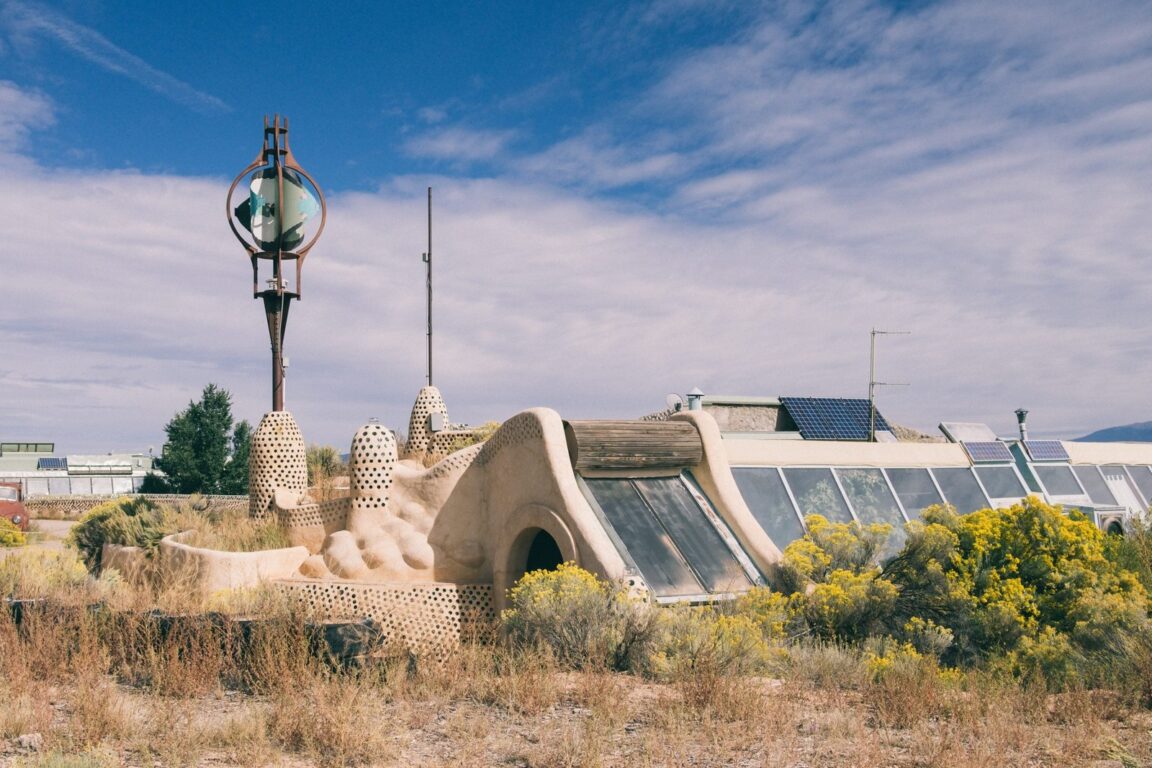
Continue west on US 64 past the bridge and the mesa changes character. The Greater World community is a neighbourhood of off grid houses built from earth packed tires, bottles and cans, shaped by architect Michael Reynolds and his Earthship Biotecture practice around passive solar design: thick thermal mass walls, south facing glasshouses, rainwater catchment, solar power and indoor food growing. The Visitor Center is the one public door into that world, a functioning Earthship at 2 Earthship Way where the self guided route walks you through the ideas in the building itself, from the bottle walls to the greenhouse corridor that heats and feeds the house.
The official Earthship site lists self guided tours daily, with visitors welcome to arrive anytime from 10am to 4pm, at $9 per person, and a guided tour daily at 4pm lasting about an hour and a half, at $22 per adult for ages 13 and up and $13 per child aged 6 to 12, with guided tickets reserved online or bought in person by 3:45pm. That timing shapes the morning: gorge first, Earthships second, arriving late morning for the self guided tour, or hold the visit to the end of the day and take the 4pm guided tour instead if your Enchanted Circle day runs clockwise past the mesa on the way home. What you may not do is wander the community. The houses are homes, the centre directs visitors to its own entrance, and the no trespassing signs beyond it are the whole instruction.
Is the Earthship stop worth it if you are not building one?
Yes, as a piece of Taos rather than a housing seminar. Taos has always collected experiments, from the art colonies to the communes of the 1960s, and the Earthships are the current, working version of that impulse, tested against high desert winters at altitude. Even a sceptic leaves with the passive solar basics understood physically, because the building demonstrates them at room temperature while the mesa outside does something else entirely. Allow an hour for the self guided route, longer if the guided tour’s question time catches you.
How does the Enchanted Circle’s back half run?
The Circle’s front half, north from Taos through Questa, is the approach; the back half is the payoff. From Questa, NM 38 climbs east to Red River over Bobcat Pass at 9,820 feet, through the old mining country of the Sangre de Cristo range. Red River is the loop’s natural lunch stop, a small ski and summer resort town in a high valley, and the road south from it drops past Eagle Nest Lake toward Angel Fire, where the valley opens out and the views back to Wheeler Peak explain why the loop exists. US 64 then returns west through Taos Canyon to town, a descent that is at its best in late afternoon light.
Run the whole loop counterclockwise from Taos, as most local guidance suggests, and the driving adds up to roughly two and a half hours of wheel time inside a day that will actually take six to eight hours once the pass viewpoints, Red River, the lake shore and Angel Fire are given their due. In late September and early October the aspens on the high sections turn gold and the loop earns its reputation; in winter, carry chains or all wheel drive and treat the pass sections with respect. The high desert discipline is the same one that governs the park roads in Saguaro National Park’s two districts: altitude and exposure, not distance, set the day’s real difficulty.
How do the three pieces fit one Taos stay?
Day one belongs to town: the plaza, the galleries and Taos Pueblo, checked on the morning itself because the pueblo closes for ceremonies and community events, sometimes at short notice. Day two runs west: gorge bridge in the early light, Earthship Visitor Center late morning, and the afternoon free for the plaza’s museums or the drive south to the church at Ranchos de Taos. Day three is the Enchanted Circle, started early enough that Red River is a lunch rather than a rush, with the Taos Canyon descent bringing you home. Travellers with only two days should merge days one and two and keep the Circle whole; it is the piece that suffers most from being cut.
Frequently Asked Questions
How far is the Rio Grande Gorge Bridge from Taos?
About 10 miles northwest of town on US 64, roughly twenty minutes of driving. The Earthship Visitor Center is a short continuation west on the same road, at 2 Earthship Way in Tres Piedras, so the two stops pair naturally in one outing.
How much does the Earthship Visitor Center cost?
The official Earthship Biotecture site lists the self guided tour at $9 per person, available daily with arrivals from 10am to 4pm, and the daily 4pm guided tour at $22 per adult aged 13 and up and $13 per child aged 6 to 12. Check the site before you go, as hours and prices are the operator’s to change.
Can visitors walk through the Earthship community itself?
No. The community is a private residential neighbourhood. Earthship Biotecture directs visitors to use the Visitor Center entrance and respect the no trespassing signs; the visitor centre and its tours are the public experience.
How long does the Enchanted Circle take?
The loop is 84 miles around Wheeler Peak and takes about two and a half hours of pure driving. Planned properly, with Questa, Bobcat Pass, Red River, Eagle Nest Lake and Angel Fire, it is a full day out from Taos.
What is the highest point on the route?
Wheeler Peak, which the Circle rings, is 13,161 feet and the highest point in New Mexico. The road itself tops out at Bobcat Pass, 9,820 feet, between Questa and Red River, which is high enough for weather to matter in any month.
Sources: Earthship Biotecture, the Earthship Visitor Center; Bureau of Land Management, Rio Grande Gorge and Orilla Verde visitor information. Checked 22 November 2026.