 Priya Nair
Do the Chalukya trail in this order: Aihole first for the experiments, Pattadakal second for the masterpieces, and Badami last for the cave temples and the bed. The three stops in Karnataka’s Bagalkot district, none more than about 35 kilometres apart, tell one continuous story: how the Early Chalukya dynasty, ruling from the 6th to the 8th century, worked out the grammar of the Indian stone temple. Aihole is the workshop, a village scattered with more than a hundred early shrines. Pattadakal is the coronation ground where that grammar matured into a UNESCO World Heritage complex of ten major temples. Badami, the old capital called Vatapi, is where the dynasty carved four great cave temples into red sandstone cliffs above Agastya Lake, and where the trail’s hotels and railway station make it the only sensible base. This guide orders the three stops, names what to look at in each, and covers the Archaeological Survey of India tickets and timings that govern the day.
Quick Facts
The trail: Badami, Aihole and Pattadakal in Bagalkot district, northern Karnataka, India, three Early Chalukya sites linked by short road legs.
Distances: Pattadakal is about 22 kilometres north east of Badami. Aihole is roughly 10 to 13 kilometres from Pattadakal and about 35 kilometres from Badami.
The base: Badami town, which has the railway station, the widest choice of lodging, and the Archaeological Museum. Aihole and Pattadakal have very limited places to stay.
The headline status: The Group of Monuments at Pattadakal was inscribed on the UNESCO World Heritage List in 1987. Badami and Aihole are protected by the Archaeological Survey of India and sit on India’s tentative list as part of the Evolution of Temple Architecture entry.
Tickets: All three main complexes are ASI ticketed monuments. Widely listed fees are about Rs 40 for Indian visitors and Rs 600 for foreign visitors at Pattadakal, and about Rs 25 and Rs 300 at the Badami caves, with children under 15 free. Confirm current fees at the gate, since the ASI revises them.
Hours: Plan around a roughly 9 a.m. to 5:30 p.m. day at the main complexes and confirm closing times on arrival. The ASI museums at Badami and Aihole are generally reported closed on Fridays.
Best season: October to March, when northern Karnataka is cool and dry. Summer heat on exposed sandstone is the trail’s main enemy.
Time needed: One long day for a highlights pass at all three, two days to do them justice, with Badami’s caves and fort split across a morning and an evening.
Stop one: Aihole, the workshop where the temple was invented
Start at Aihole because chronology is the whole point of this trail. The district administration counts about 125 temples in 22 groups here, built mostly between the 6th and 8th centuries in and around a living village on the Malaprabha river. Nothing is roped into a single grand composition, and that is the charm: masons were trying things out. The Durga temple, named for the fort (durga) it stands near rather than the goddess, tests an apsidal, horseshoe-ended plan borrowed from earlier Buddhist halls and wraps it in a pillared ambulatory. The Lad Khan temple, among the oldest, is almost a village hall with a stone roof and a later shrine stacked on top. The Ravana Phadi cave cuts the experiment into rock, with sculpture of a confidence the structural temples had not yet reached. Above the village, the Meguti Jain temple carries a celebrated inscription of the poet Ravikirti dated to 634 CE, which anchors the whole site’s chronology. Give Aihole ninety minutes to two hours, and hire a local guide at the main complex if one is available, because the temples are scattered and the order matters more than any single building.
Stop two: Pattadakal, the coronation ground and the masterpiece
Pattadakal is where the experiments became architecture. The name signals its job: this was the place of coronation, where Chalukya kings were crowned, and the royal workshops marked the honour with the dynasty’s finest building campaign. UNESCO’s World Heritage List entry for the Group of Monuments at Pattadakal, inscribed in 1987, recognises the complex as the high point of an eclectic art that blended northern and southern Indian temple forms. Ten major temples stand in one manicured enclosure on the Malaprabha’s bank, nine Hindu and one Jain, and the essential viewing order runs from the earlier, smaller shrines to the two great 8th century temples built for the queens of Vikramaditya II: the Virupaksha temple, the largest in the complex and still an active place of worship, modelled on the Kailasanatha temple at Kanchipuram, and its near twin the Mallikarjuna. Between them, the Papanatha temple stretches the experiment out, mixing a northern shikhara with southern detailing in a single long building, while the Galaganatha and Sangameshwara temples show the Dravida tower being refined course by course. Two to three hours is honest here. The site museum and the river bank behind the enclosure repay the slower visitor.
On ticketing, Pattadakal is one of the ASI’s centrally protected ticketed monuments, and the Government of India’s Press Information Bureau listing of ticketed monuments names the Group of Monuments at Pattadakal alongside the Jain and Vaishnava caves at Badami and the Durga temple complex at Aihole, all under the ASI’s Dharwad Circle. A parliamentary answer on ASI e-ticketing confirms the same three sites in its annex of ticketed monuments with online booking, so booking ahead online is an option worth using in the October to March peak. Readers who like their rock-cut sites dramatic will also enjoy our guide to Sigiriya, Sri Lanka’s lion rock fortress, the closest South Asian parallel to Badami’s cliff-top ambition.
Stop three: Badami, caves in the cliff and a town around a lake
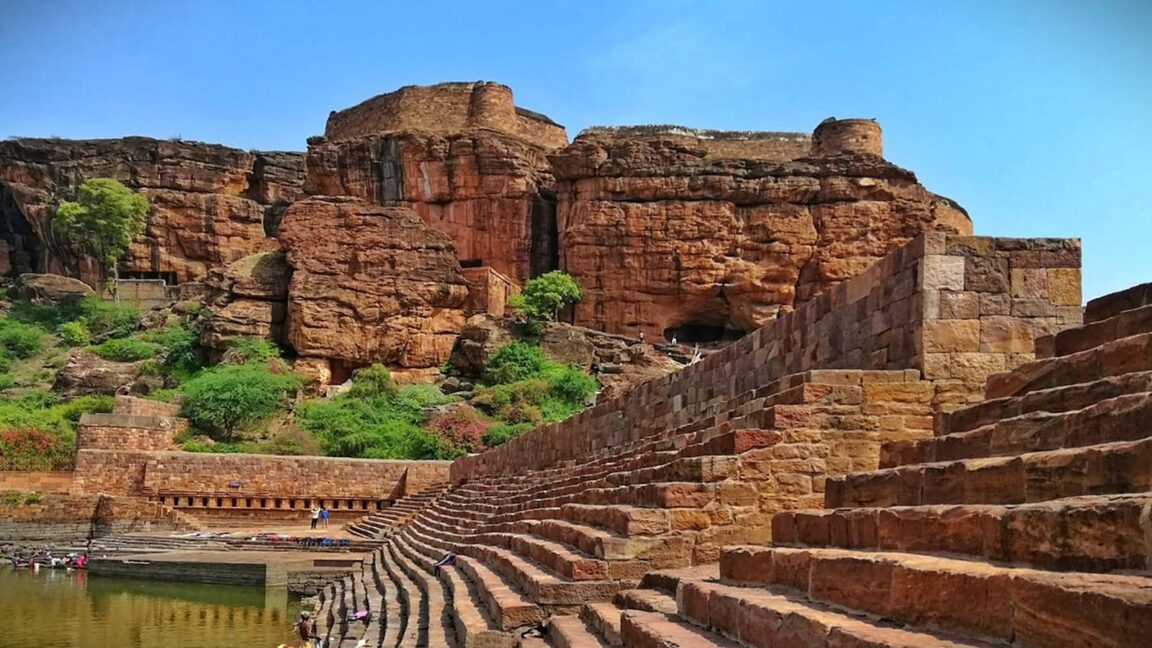
End at Badami, and give it the late afternoon. The town gathers in a sandstone cleft around Agastya Lake, and the four cave temples climb the southern cliff in a stepped sequence. Cave 1 belongs to Shiva, its entrance guarded by an eighteen-armed Nataraja carved to display dozens of dance poses in a single figure. Cave 2 turns to Vishnu, with the boar Varaha and the dwarf Vamana swelling into the giant Trivikrama. Cave 3, the largest and most finished, carries an inscription of King Mangalesha dated 578 CE and the trail’s grandest sculpture, Vishnu enthroned on the serpent Ananta among them. Cave 4, at the top, is Jain, its Tirthankaras cut with a calm that feels like a deliberate change of key after the Hindu caves’ energy. Across the lake, the Bhutanatha temples sit at the water’s edge in the evening light, and the northern hill carries the fort, the Upper and Lower Shivalaya temples and the view back over the whole composition. The ASI’s Archaeological Museum, near the lake, holds sculpture gathered from the area including Lajja Gauri images, and works best as the visit’s coda, ideally the following morning before the road out.
Practicalities shape the Badami stay. The town’s railway station takes overnight trains from Bengaluru and towards Mumbai, and Hubballi’s airport is the nearest airhead, roughly 140 kilometres from Pattadakal. Eat early and locally, and if the trail has whetted your appetite for regional Indian food writing, our Pondicherry food guide to Franco-Tamil kitchens covers the coast’s very different table, while travellers extending a north India heritage route should see our room-by-room assessment of Raas Jodhpur, the haveli hotel under Mehrangarh Fort. A restorative finish in the south is covered by our guide to Kerala ayurveda and panchakarma, explained honestly, and for another Asian site where masons solved a new structural problem in stone, read our route through Kaiping’s diaolou towers in Guangdong.
How should you sequence the days?
With two days, the rhythm is easy: arrive in Badami, walk the lake and Bhutanatha temples in the evening, take the caves first thing next morning while the cliff is in shade, then drive to Aihole for the late morning and Pattadakal for the afternoon, returning to Badami to sleep. With one day only, reverse the temptation to start at the caves. Aihole at opening, Pattadakal by late morning, and Badami’s caves in the last light keeps the story in order and puts the most exposed site, Pattadakal’s open enclosure, before the worst heat. In summer, start earlier still and carry more water than you think you need; there is little shade at Aihole and Pattadakal, and the sandstone reflects heat back at you. Whatever the season, confirm the day’s closing times at the first gate you reach, since reported hours for these complexes vary between sources and the ASI adjusts them.
Frequently asked questions
Which of the three sites is a World Heritage Site?
Only Pattadakal is inscribed, as the Group of Monuments at Pattadakal, listed by UNESCO in 1987. Badami and Aihole are ASI protected monuments and appear on India’s tentative list within the Evolution of Temple Architecture entry covering all three.
Where should I stay on the Chalukya trail?
Badami. It has the railway station, the broadest range of hotels and restaurants, and sits within about 35 kilometres of both other stops. Lodging in Aihole and Pattadakal villages is very limited.
Can I see all three in one day?
Yes, as a highlights pass: Aihole first, then Pattadakal, then Badami’s caves, with early starts and short drives between them. Two days is better, because Pattadakal alone deserves two to three hours and Badami’s fort and museum get squeezed out of a one-day run.
How much are the entry tickets?
Fees are set by the ASI and revised periodically. Recent listings put Pattadakal at about Rs 40 for Indian visitors and Rs 600 for foreign visitors, and the Badami caves at about Rs 25 and Rs 300, with children under 15 admitted free. Check the board at each gate or the ASI’s online booking before you travel.
What is the best month to visit Badami, Aihole and Pattadakal?
October to March offers the cool, dry weather this exposed sandstone country needs. The Pattadakal Dance Festival, part of the Chalukya Utsav celebrations, is generally held in the winter season and can add an evening performance to a January or February trip.
Is photography allowed inside the cave temples?
Rules vary by monument and change over time, and some ASI sites charge separately for video equipment. Check the notice board at the Badami ticket counter on the day rather than relying on older trip reports.
Image: The Agastya Lake steps and sandstone cliffs of Badami, Karnataka. Photo by Shivkumar Yash, via Unsplash.