 Priya Nair
Visit Larabanga Mosque as an exterior visit, with a local guide, outside prayer times, and you will see one of the most significant buildings in West Africa handled the right way. The whitewashed mud mosque in the village of Larabanga, in Ghana’s Savannah Region, is regarded as the oldest mosque in Ghana and one of the oldest in West Africa. It is still a working place of worship, not a museum, and that single fact decides everything about a good visit: non-Muslim visitors generally view it from outside, dress modestly, ask before photographing people, and take the history from the village guide who meets visitors at the mosque. Paired with nearby Mole National Park, it makes the strongest half day in northern Ghana. This guide explains what the building is, why its date is honestly debated, how the visit works on the ground, and how to combine it with a Mole safari without rushing either.
Quick Facts
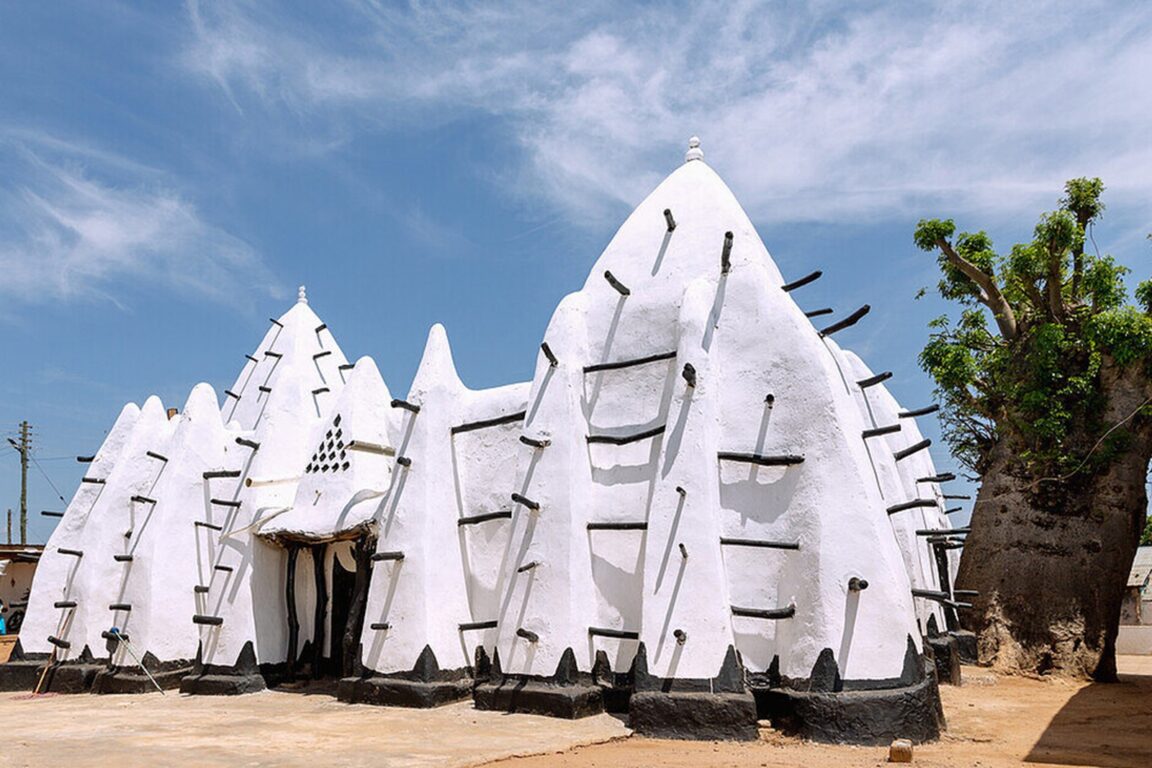
What it is: A Sudanese-style (Sudano-Sahelian) mosque built of mud, straw and timber, whitewashed, with tapering buttresses, two pointed towers and wooden poles called toron projecting from the walls.
Where: The village of Larabanga, West Gonja, Savannah Region, Ghana, a few kilometres from the entrance of Mole National Park on the Damongo road.
Age: Local tradition dates the mosque to 1421 and credits a Muslim trader named Ayuba. The elders’ account recorded by Mole National Park places its building in the early 17th century by Muslim merchants travelling the salt and gold routes. Treat the 1421 date as tradition, not a tested date.
Status: The mosque sits on Ghana’s UNESCO Tentative List, submitted on 17 January 2000 as part of the Trade Pilgrimage Routes of North-Western Ghana. Tentative listing is not World Heritage inscription.
Access: Exterior viewing for non-Muslim visitors is the norm. The interior is a prayer space for a modest congregation and is generally closed to visitors.
Guide: Hire the English-speaking village guide at the mosque. Going in alone or without permission causes offence, and the guide is how the history reaches you.
Time needed: About 60 minutes for the mosque exterior, the village and the Mystic Stone with a guide.
Best timing: A weekday morning outside prayer times, when the light is good on the whitewash and the guide is easiest to find.
Why does this small mud mosque matter so much?
Larabanga matters because it is a surviving piece of the Sudanic building world in Ghana, maintained by the community that prays in it. The Ghana Museums and Monuments Board, the mosque’s custodian authority, groups Larabanga with the ancient mosques of the north west that Muslim traders and scholars built along the routes carrying gold, kola and salt between the forest and the Sahel. Its architecture is the Sahel translated into savannah materials: packed earth and mud brick, a flat roof carried on timber, buttresses that taper as they rise and end in pinnacles, and the projecting toron poles that double as permanent scaffolding when the walls need replastering. The form will look familiar to anyone who knows the great mud mosques of Mali, and that is the point. Larabanga is the southern reach of that tradition, kept alive at village scale.
The building has needed rescue more than once. The World Monuments Fund’s record for Larabanga notes that the mosque was placed on the 2002 World Monuments Watch, and that the listing funded work to strip harmful cement render from the walls and replace it with traditional mud-based plaster. An earlier restoration in 1969 had used the same traditional materials, according to the account kept by Mole National Park’s official site, and a further restoration followed in February 2003 with a grant from American Express through the World Monuments Watch Fund, executed by CRATerre of the Grenoble School of Architecture with the Ghana Museums and Monuments Board. Earth buildings only survive if people keep replastering them, and Larabanga’s congregation still re-renders the walls, traditionally in the dry season. A visit fee and a guide’s fee are small money pointed at exactly that upkeep.
How does a respectful visit actually work?
Arrive, find the guide, and let the visit be led. Visitors are met by a village guide who walks you around the exterior, tells the founding story, and manages the boundaries of an active mosque: where you may stand, when photography is fine, and when a prayer time means waiting quietly rather than circling the walls with a camera. Cover shoulders and knees, remove shoes anywhere you are asked to, and keep voices low near the prayer hall. Photography of the building’s exterior is normally welcome outside prayers; photographing worshippers is a different matter and needs explicit permission.
Set your expectations about the interior before you arrive and you will not be disappointed. The mosque holds a modest congregation, and non-Muslim visitors generally see the exterior and the village, not the inside. What you get instead is arguably better: the founding narrative told where it happened, the toron poles and buttresses explained at arm’s length, and two village sights that most drive-past visitors miss. The first is the Mystic Stone, a boulder outside the village wrapped in a local legend that every guide tells and that has become an attraction in its own right. The second is the mosque’s old Quran manuscript, which local custodians describe as nearly as old as the mosque itself and show to visitors on request. Ask your guide about both rather than wandering off to find them alone.
If your Ghana trip also takes in the coast, the contrast is instructive: our guide to visiting Elmina Castle with a guide covers a very different Ghanaian heritage site, a European-built fort where the guided format matters for opposite reasons. And before any of it, check the entry paperwork in our explainer on Ghana’s diaspora visa easement, since northern Ghana rewards travellers who arrive with their documents already sorted.
How do you pair Larabanga with Mole National Park?
Easily, because the mosque practically stands at the park’s gate. Larabanga is the village on the approach road to Mole, Ghana’s largest wildlife reserve, and almost every visitor passes it on the way in or out. The natural order is a safari first and the mosque second, or the reverse if you arrive in the afternoon: Mole’s walking safaris leave early, around 6:30 in the morning, so a common pattern is the dawn walk, breakfast, then an hour at Larabanga before the heat peaks, or a mosque stop on arrival day and safaris the day after. Guesthouses in Larabanga itself offer a budget base a short drive from the gate, which suits travellers who want the village, not just the park, in their trip.
The route in runs through Tamale, the northern hub: bus or car to Damongo, then on to Larabanga and the park gate. Budget a full travel day from the south and at least two nights at Mole, because wildlife sightings depend on getting more than one safari in. Travellers building a wider West and East Africa heritage route will find the same Swahili-era Islamic story told in stone rather than mud in our guide to Lamu Town, Kenya’s car-free Swahili port, while the religious-calendar angle is covered in our explainer on Timkat in Gondar, Ethiopia’s Epiphany festival. For the money side of an East African safari leg, see our breakdown of what a Tanzania safari week costs in fees.
When should you go, and what should you avoid?
Go in the morning, in the dry season if you can choose. Mornings outside prayer times give you the guide’s full attention, soft light on the whitewash, and a village going about its day rather than a building photographed against noon glare. The dry season is also when the community replasters the mosque, and timing a visit to see the building freshly rendered, bright white against red earth, is worth real effort. Avoid arriving during Friday prayers expecting a tour, avoid treating the mosque as a photo backdrop you can walk around unaccompanied, and avoid repeating the 1421 date as settled fact in conversation with your guide, who will likely tell you the tradition with more nuance than any signboard. The honest framing, that tradition says 1421 and the elders’ recorded account says the early 1600s, respects both the community and the evidence.
Frequently asked questions
Can non-Muslims go inside Larabanga Mosque?
Generally no. The mosque is an active prayer space for a small congregation, and non-Muslim visitors are normally shown the exterior and the village by a local guide. Treat any exception as a specific invitation from the imam or your guide, never as an entitlement.
Is Larabanga Mosque really the oldest mosque in West Africa?
It is widely described as the oldest mosque in Ghana and one of the oldest in West Africa. Its exact age is debated: tradition dates it to 1421, while the elders’ account recorded by Mole National Park places its construction in the early 17th century. Report it as traditionally dated, not proven.
Is Larabanga a UNESCO World Heritage Site?
Not yet. It is on Ghana’s UNESCO Tentative List as part of the Trade Pilgrimage Routes of North-Western Ghana, submitted in January 2000. Tentative listing signals intent to nominate; it is not inscription on the World Heritage List.
How long does a visit take?
About an hour covers the mosque exterior, the village walk and the Mystic Stone with a guide. Add time if the custodians show the old Quran manuscript or if you are combining the stop with a meal in the village.
What should I wear and bring?
Cover shoulders and knees, be ready to remove shoes where asked, and bring small notes for the guide fee and any village contribution. Carry water, since there is little shade around the mosque at midday.
How do I get to Larabanga?
Travel via Tamale to Damongo, then continue to Larabanga village on the Mole National Park road. Most visitors stop on the way to or from a Mole safari, since the village sits a few kilometres from the park entrance.
Image: Larabanga Mosque, Ghana. Photo via the Ghana Museums and Monuments Board (gmmb.gov.gh), the mosque’s custodian authority.